
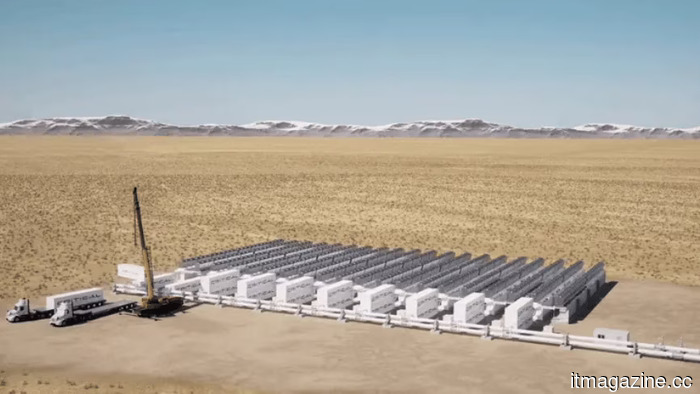
Critical Energy secures $22M for prefabricated geothermal systems.
The quest to harness artificial intelligence encounters a challenge that solar panels and wind turbines alone cannot address: the need for electricity at 3 AM, during calm winds and cloudy skies. Critical Energy, a startup based in Los Angeles and established by a former SpaceX engineer, has secured $22 million to meet this constant energy demand through geothermal power, which functions similarly to traditional power plants. The focus is less on drilling deeper and more on expediting the construction of surface components.
The funding comprises a $19 million seed round, raised through multiple stages and co-led by Susa Ventures and Upfront Ventures, along with $3 million in venture debt from Silicon Valley Bank.
The bottleneck has shifted from underground to above ground. For the past five years, the narrative surrounding geothermal energy has predominantly focused on subsurface techniques. By adopting horizontal drilling and fracking methods from the oil and gas sector, the costs and duration required to access the Earth's heat have significantly decreased, in some cases reducing the price of drilling a well by approximately half.
However, the actual power plant infrastructure has seen little innovation. Currently, these plants are often custom-built for individual wells and assembled on-site over a period of 18 to 24 months. Consequently, a well that can be drilled in just weeks may wait nearly two years for the machinery necessary to convert its heat into electricity.
“It’s still significantly quicker and more cost-effective to construct in reverse, by building in a factory,” said founder and CEO Spencer Jackson to TechCrunch.
Transitioning from rocket engines to turbines, Jackson dedicated about seven years at SpaceX, focusing on Falcon Heavy structures, Starship's thermal protection, and aspects of the Raptor engine. He advocates treating a power plant as a product rather than a construction task.
Critical Energy’s turbines are housed in container-sized units, primarily built off-site, intended for quick transportation and activation within weeks, and can be combined for larger installations. The company notes that the turbomachinery design resembles that of a rocket engine. Their first commercial project, with a capacity of 2.5 megawatts, is projected to be completed by 2027.
Investors are once again showing interest in geothermal energy due to current market dynamics. Data centers are placing significant strain on power grids, prompting regulators to encourage households to reduce peak energy consumption. A recent estimation indicates that advanced geothermal could supply nearly two-thirds of new data centers by 2030.
This situation is attracting investment into reliable, dispatchable clean energy sources, similar to the influx of capital into large-scale energy storage. Critical Energy positions itself not as a competitor to drillers like Fervo Energy but as a crucial provider of the turbines the entire industry will require.
However, there are caveats. For the moment, this remains more of a concept than a proven success. Critical Energy has a pilot project in Los Angeles, but it has yet to launch a commercial facility, and some of its more ambitious claims—such as a sub-$2,000-per-kilowatt cost and 300 gigawatts of new generation capacity annually by 2045—reflect the founder's aspirations rather than established results.
The more profound risk involves a common dilemma faced by modular-hardware companies: the economics of factory production are viable only if sufficient orders are received. Should the geothermal industry underground continue to thrive, Critical Energy could be ahead of the curve in addressing a genuine demand. Conversely, if growth slows, it risks creating an assembly line that awaits orders that may not come.
Other articles
 Marcus cautions that the OpenAI IPO might jeopardize the AI supply chain.
AI researcher Gary Marcus states that OpenAI's issues with its IPO would have a ripple effect on Nvidia, Oracle, and CoreWeave, as spending on enterprise AI declines and cash burn increases.
Marcus cautions that the OpenAI IPO might jeopardize the AI supply chain.
AI researcher Gary Marcus states that OpenAI's issues with its IPO would have a ripple effect on Nvidia, Oracle, and CoreWeave, as spending on enterprise AI declines and cash burn increases.
 Meloni states that children can easily circumvent social media restrictions.
Italy's Prime Minister stated at the G7 that prohibiting children from using social media is "easily bypassed" and that it should be the platforms, rather than parents, who take on the responsibility.
Meloni states that children can easily circumvent social media restrictions.
Italy's Prime Minister stated at the G7 that prohibiting children from using social media is "easily bypassed" and that it should be the platforms, rather than parents, who take on the responsibility.
 Trump declines UK request for exemption from Anthropic AI ban.
Starmer's administration advocated for the UK to be exempt from the Anthropic export ban. Washington responded with "zero chance," highlighting Britain's reliance on AI.
Trump declines UK request for exemption from Anthropic AI ban.
Starmer's administration advocated for the UK to be exempt from the Anthropic export ban. Washington responded with "zero chance," highlighting Britain's reliance on AI.
 The head of Amazon AI acknowledges that their models fall behind those of OpenAI and Anthropic.
Peter DeSantis states that Amazon's AI models "haven't been at the forefront" and expresses optimism about bridging the gap within a year, using custom chips and exclusive data.
The head of Amazon AI acknowledges that their models fall behind those of OpenAI and Anthropic.
Peter DeSantis states that Amazon's AI models "haven't been at the forefront" and expresses optimism about bridging the gap within a year, using custom chips and exclusive data.
 Meloni states that kids can easily circumvent social media bans.
Italy's Prime Minister stated at the G7 that prohibiting children from social media is "easily bypassed" and that it is the platforms, rather than parents, who should be held accountable.
Meloni states that kids can easily circumvent social media bans.
Italy's Prime Minister stated at the G7 that prohibiting children from social media is "easily bypassed" and that it is the platforms, rather than parents, who should be held accountable.
 Mastodon introduces email newsletters, allowing individuals without an account to follow creators on the open social web.
Mastodon 4.6 enables creators to send posts to email subscribers who lack fediverse accounts. This feature is designed for institutions and independent publishers.
Mastodon introduces email newsletters, allowing individuals without an account to follow creators on the open social web.
Mastodon 4.6 enables creators to send posts to email subscribers who lack fediverse accounts. This feature is designed for institutions and independent publishers.
Critical Energy secures $22M for prefabricated geothermal systems.
Critical Energy, established by a former SpaceX employee, has secured $22 million to scale up the production of modular geothermal turbines, wagering that the growing demand for AI will require stable sources of clean energy promptly.