
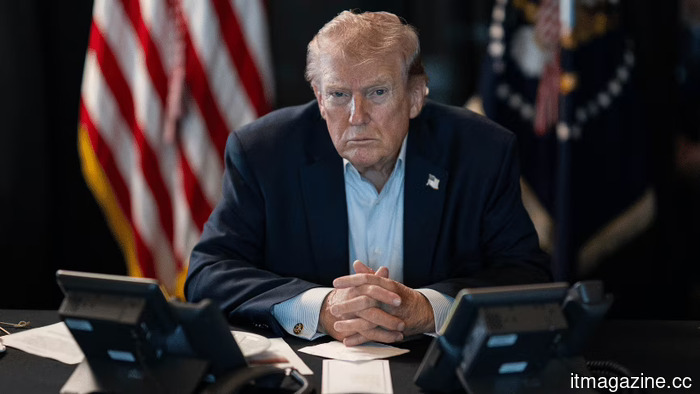
Trump declines UK request for exemption from Anthropic AI ban.
Britain sought an exemption from the Anthropic export ban from the White House but was told there was “zero chance” of approval. This rejection highlights the UK's reliance on American AI and strengthens arguments for developing independent alternatives.
Sir Keir Starmer's administration spent the weekend lobbying for restored access to Anthropic’s advanced AI models. An insider close to President Trump informed The Telegraph of the improbability of a UK exemption.
This setback comes as Starmer meets Trump at the G7 summit in Évian-les-Bains, where the ban is expected to be discussed. Many British businesses now face a stark reality of how swiftly access to essential AI resources can be cut off by decisions made overseas.
On June 12, the US Commerce Department required Anthropic to halt foreign access to its most advanced models, Fable 5 and Mythos 5, due to national security concerns following a reported security breach. Commerce Secretary Howard Lutnick sent a letter to CEO Dario Amodei regarding this issue.
The breach was reportedly indicated by Amazon CEO Andy Jassy to senior officials, involving the model's use to analyze a codebase for software defects—a technique that Anthropic claims is also available in competing models, including OpenAI’s GPT-5.5, commonly used by cybersecurity experts.
Anthropic chose to globally disable both models as it couldn't quickly implement nationality-based access controls, affecting both American and international users. The company noted that if this standard were to be applied universally, it could halt all new model rollouts for leading model providers.
The UK lacks its own advanced AI model, meaning hospitals, financial institutions, and government researchers that had incorporated Fable 5 into their operations found their tools unexpectedly disabled.
Kanishka Narayan, the UK’s AI minister, stated that the ban has serious repercussions for national defense, emphasizing that the most advanced models are integral to drones, counter-drone technology, and cybersecurity. “Our AI capabilities are central to our national security and defense,” he added.
In contrast, US Secretary of War Pete Hegseth noted that "three months ago, the Department of War expelled Anthropic from our premises permanently," asserting that each passing day validates that decision.
Over 80 cybersecurity leaders from companies such as Nvidia and Adobe signed an open letter requesting the removal of the restrictions, claiming the ban obstructs the identification and resolution of software vulnerabilities and that Anthropic’s models only provide marginal improvements compared to competitor systems, including China’s Kimi 2.7, which is still widely available.
On Monday, Anthropic met with Commerce Department officials in Washington, assisted by National Cyber Director Sean Cairncross, to discuss potential solutions. Legal experts indicated that the basis for the restrictions might be tenuous since AI models are accessed remotely rather than exported physically, raising questions about the legality of the ban.
In response, the UK government has set up a £500 million Sovereign AI Fund to support local developers, with private investments of an additional £1 billion aimed at building sovereign AI infrastructure. The Anthropic ban provides significant support for these initiatives.
At the G7, Canada's Prime Minister Mark Carney likened the Anthropic ban to the 2008 financial crisis, cautioning about systemic “model risk” when critical infrastructure is reliant on a single provider. Insiders believe that Trump will likely reverse the ban globally rather than provide individual exemptions to any country.
For every British company that has integrated a foreign AI model into its operations, the issue has become urgent. Resilience now requires understanding which suppliers could potentially be cut off at a moment’s notice and having contingency plans ready for when that occurs.
Other articles
 Meloni states that kids can easily circumvent social media bans.
Italy's Prime Minister stated at the G7 that prohibiting children from social media is "easily bypassed" and that it is the platforms, rather than parents, who should be held accountable.
Meloni states that kids can easily circumvent social media bans.
Italy's Prime Minister stated at the G7 that prohibiting children from social media is "easily bypassed" and that it is the platforms, rather than parents, who should be held accountable.
 Marcus cautions that OpenAI's IPO might undermine the AI supply chain.
AI researcher Gary Marcus suggests that OpenAI's difficulties with its IPO would have a ripple effect on Nvidia, Oracle, and CoreWeave, especially as enterprise AI investments slow down and the rate of cash burn increases.
Marcus cautions that OpenAI's IPO might undermine the AI supply chain.
AI researcher Gary Marcus suggests that OpenAI's difficulties with its IPO would have a ripple effect on Nvidia, Oracle, and CoreWeave, especially as enterprise AI investments slow down and the rate of cash burn increases.
 A 21-year-old Stanford graduate has successfully secured $11.6 million to develop a wearable hormone monitoring device that does not require blood samples.
Clair Health secured an $11.6 million seed funding round led by Khosla Ventures for a wrist-mounted device that monitors estrogen and progesterone levels without the use of needles. The product is set to be shipped in November.
A 21-year-old Stanford graduate has successfully secured $11.6 million to develop a wearable hormone monitoring device that does not require blood samples.
Clair Health secured an $11.6 million seed funding round led by Khosla Ventures for a wrist-mounted device that monitors estrogen and progesterone levels without the use of needles. The product is set to be shipped in November.
 Currently, 50% of Americans utilize AI chatbots; however, 40% believe that AI will negatively impact society, and two-thirds express distrust in the government's ability to regulate it.
A survey conducted by Pew Research involving 5,119 adults in the US revealed that 49% utilize AI chatbots, while 40% believe AI will negatively impact society, and 67% express minimal confidence in government regulation.
Currently, 50% of Americans utilize AI chatbots; however, 40% believe that AI will negatively impact society, and two-thirds express distrust in the government's ability to regulate it.
A survey conducted by Pew Research involving 5,119 adults in the US revealed that 49% utilize AI chatbots, while 40% believe AI will negatively impact society, and 67% express minimal confidence in government regulation.
 France disrupts EDF's hydropower monopoly through new auction legislation.
The French Parliament has passed a legislation that changes EDF's hydropower concessions into permits and mandates annual auctions of 6 GW. EDF is said to be planning an investment of 4.5 billion euros in new pumped-hydro projects.
France disrupts EDF's hydropower monopoly through new auction legislation.
The French Parliament has passed a legislation that changes EDF's hydropower concessions into permits and mandates annual auctions of 6 GW. EDF is said to be planning an investment of 4.5 billion euros in new pumped-hydro projects.
 Amazon's AI leader acknowledges that their models are behind those of OpenAI and Anthropic.
Peter DeSantis states that Amazon's AI models "haven't been at the forefront" and expresses a desire to bridge the gap within a year, utilizing custom chips and proprietary data.
Amazon's AI leader acknowledges that their models are behind those of OpenAI and Anthropic.
Peter DeSantis states that Amazon's AI models "haven't been at the forefront" and expresses a desire to bridge the gap within a year, utilizing custom chips and proprietary data.
Trump declines UK request for exemption from Anthropic AI ban.
Starmer's administration advocated for the UK to be exempt from the Anthropic export ban. Washington responded with "zero chance," highlighting Britain's reliance on AI.