
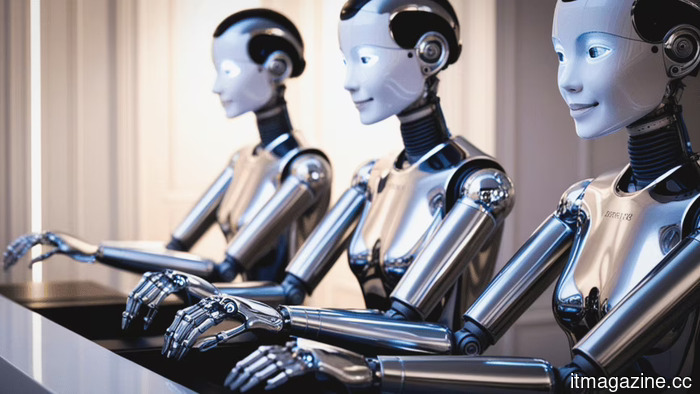
China's five-year plan focuses on the effects of AI on employment.
China has spent the past two years proclaiming its goal to lead in the AI sector. However, its recent five-year employment plan subtly acknowledges that achieving this could result in significant job losses for many individuals.
The State Council, which functions as China's cabinet, has laid out its employment policy blueprint for the years 2026 to 2030. Hidden within a document largely focused on factories, graduates, and migrant workers is an important directive with implications that extend beyond China's borders: the government will begin to closely monitor how artificial intelligence impacts job creation and job loss.
Signed on June 11 and released on June 17, the plan mandates the research and development of a system to track AI's influence on employment over the next five years, along with an early-warning mechanism to identify where this technology threatens jobs.
Why a jobs plan is effectively an AI plan
The background reveals the magnitude of the situation. China's workforce exceeds 700 million, the largest globally, and the Communist Party views rising unemployment as a risk to social stability rather than merely an economic figure.
This positions AI as a political challenge as much as a technological one. Beijing has invested substantial resources and rhetoric into its ambition to become an AI superpower, and it is now creating a safety net for the upheaval that such ambitions entail.
Bloomberg reports that authorities intend to analyze the labor market using unconventional data, such as industrial electricity consumption, social insurance information, and mobile payment statistics. However, the actual plan document is less specific, merely calling for an improved monitoring network and greater data sharing among departments, suggesting that the detailed surveillance mentioned reflects intent rather than established policy.
Creating and cushioning
The strategy is not solely defensive. It harnesses China's “AI+” initiative to create new job types, promotes roles that involve “human-machine collaboration,” and advocates for AI use in sectors facing labor shortages or hazards.
Additionally, it directs platform companies to enhance algorithm transparency, ensure timely wage payments, and comply with new labor regulations, acknowledging the legion of delivery workers and gig employees generated by the previous tech boom. Flexible employment is expected to affect around 320 million individuals this year, nearly half of the total workforce.
This scenario is familiar to Beijing. State media and officials have been addressing these issues for months, from the Workers’ Daily's calls for protective measures for labor rights to executives publicly committing to safeguard employees against automation.
A declaration of purpose, not a framework
Despite the attention the plan has garnered, it does not announce any existing initiatives. It primarily "researches the establishment of" and "explores" rather than actualizes plans, and unlike the previous five-year strategy, it does not set a target for new urban jobs by 2030.
The timing is also problematic. As AI emerges in a Chinese job market already pressured by a property downturn and deflation affecting corporate earnings, it remains uncertain whether a monitoring network can address these issues or merely provide more precise measurements of them. What is clear from the plan is that Beijing now views the ramifications of its AI ambitions as something to monitor closely.
Other articles
 The head of Amazon's AI division acknowledges that their models are behind those of OpenAI and Anthropic.
Peter DeSantis mentions that Amazon's AI models "haven't been at the forefront" and expresses his hope to narrow the gap within a year, utilizing custom chips and exclusive data.
The head of Amazon's AI division acknowledges that their models are behind those of OpenAI and Anthropic.
Peter DeSantis mentions that Amazon's AI models "haven't been at the forefront" and expresses his hope to narrow the gap within a year, utilizing custom chips and exclusive data.
 Marcus cautions that OpenAI's IPO might undermine the AI supply chain.
AI researcher Gary Marcus suggests that OpenAI's difficulties with its IPO would have a ripple effect on Nvidia, Oracle, and CoreWeave, especially as enterprise AI investments slow down and the rate of cash burn increases.
Marcus cautions that OpenAI's IPO might undermine the AI supply chain.
AI researcher Gary Marcus suggests that OpenAI's difficulties with its IPO would have a ripple effect on Nvidia, Oracle, and CoreWeave, especially as enterprise AI investments slow down and the rate of cash burn increases.
 Amazon's AI leader acknowledges that their models are behind those of OpenAI and Anthropic.
Peter DeSantis states that Amazon's AI models "haven't been at the forefront" and expresses a desire to bridge the gap within a year, utilizing custom chips and proprietary data.
Amazon's AI leader acknowledges that their models are behind those of OpenAI and Anthropic.
Peter DeSantis states that Amazon's AI models "haven't been at the forefront" and expresses a desire to bridge the gap within a year, utilizing custom chips and proprietary data.
 Arcade.dev has secured $60 million to enhance its enterprise AI agents.
Arcade.dev secured a $60M Series A funding round led by SYN Ventures to regulate the actions AI agents can perform within company systems, effectively containing the agents within pilot programs.
Arcade.dev has secured $60 million to enhance its enterprise AI agents.
Arcade.dev secured a $60M Series A funding round led by SYN Ventures to regulate the actions AI agents can perform within company systems, effectively containing the agents within pilot programs.
 One million Dutch people depend solely on social media for their news.
The 2026 Digital News Report reveals that 7% of Dutch adults rely exclusively on social media for news, an increase from 2% in 2018, although trust and interest are still declining.
One million Dutch people depend solely on social media for their news.
The 2026 Digital News Report reveals that 7% of Dutch adults rely exclusively on social media for news, an increase from 2% in 2018, although trust and interest are still declining.
 Mastodon introduces email newsletters, allowing individuals without an account to follow creators on the open social web.
Mastodon 4.6 enables creators to send posts to email subscribers who lack fediverse accounts. This feature is designed for institutions and independent publishers.
Mastodon introduces email newsletters, allowing individuals without an account to follow creators on the open social web.
Mastodon 4.6 enables creators to send posts to email subscribers who lack fediverse accounts. This feature is designed for institutions and independent publishers.
China's five-year plan focuses on the effects of AI on employment.
The employment plan from China's State Council for 2026–2030 mandates that the government monitors the impact of AI on job creation and loss, serving as a political safeguard for its own AI development.