
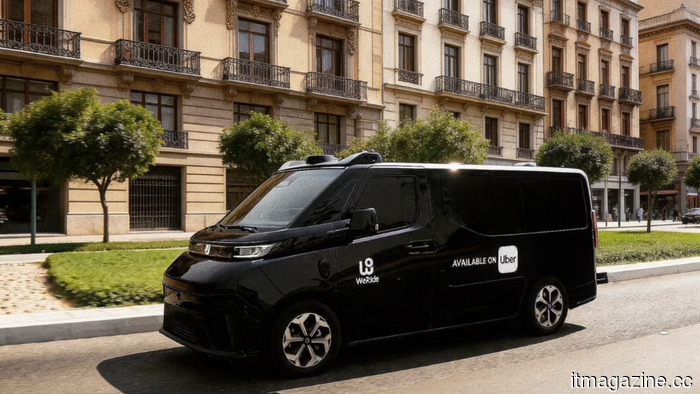
WeRide and Uber expand their robotaxi collaboration to Madrid.
The robotaxi landscape in Europe is gradually expanding city by city, with Madrid becoming the latest addition on Tuesday. WeRide and Uber announced they will initiate what they characterize as Spain's inaugural commercial robotaxi pilot in the Madrid Region, allowing rides to be booked via the Uber app, with operations set to commence later this year.
This launch marks the companies' first collaborative venture into the European market, in partnership with the Comunidad de Madrid, the regional government.
Initially, the service will have trained safety operators in the driver's seats instead of having no drivers at all. The companies indicate that the fleet will grow "progressively," with WeRide, Uber, and fleet operator AVOMO planning to introduce hundreds of vehicles as certain performance benchmarks are achieved, with the intention of advancing to fully driverless rides in major city areas thereafter. Specific details regarding the launch date, fleet size, or fare structure have not been revealed.
One notable entity in this announcement is AVOMO. As part of the Moove Cars Group, this company manages the operations of the vehicles; it currently oversees Uber’s autonomous fleets in Austin and Atlanta, managing about 400 vehicles and employing over 200 people.
AVOMO's involvement underscores WeRide's "asset-light" strategy, wherein the technology company provides the autonomy while allowing partners to handle fleet ownership and daily operations. Manuel Puga, chief executive of Moove Cars Group, remarked, "After nearly two years of close collaboration with Uber in the United States, we are entering this next phase."
For WeRide, this marks its fifth European market, and the company notes it is the fourth of 15 cities outlined in a prior expansion agreement with Uber, with plans to reach 11 more by 2030 and ambitions for tens of thousands of robotaxis globally. WeRide, recognized as the first publicly traded robotaxi firm, possesses driverless permits in eight markets and claims to have operated its vehicles in over 40 cities.
The Madrid initiative draws significantly from its experiences in the Gulf, where it provides commercial driverless services in Abu Dhabi and Dubai, with plans to expand into Riyadh.
Following the sale of its own self-driving unit in 2020, Uber has structured its autonomous strategy largely through partnerships like this one. The same collaboration model supports its pilot in Tokyo with Wayve and Nissan, as well as its partnership with Pony.ai and Verne, which launched Europe’s first commercial robotaxi service in Zagreb earlier this year.
Sarfraz Maredia, Uber’s global head of autonomous mobility, described Madrid as “a natural place to become a leading European market for AVs,” pointing to what he referred to as a clear regulatory pathway.
However, the regulatory landscape remains uncertain. The announcement contains language indicative of forward-looking statements, and, akin to previous robotaxi launches in Europe, it remains contingent upon approvals, milestones, and the necessary validation of the vehicles' safety. Presently, Madrid is merely a point on a roadmap, with operators still present in the driver's seats.
Other articles
 Amazon's Ring faces a lawsuit regarding its Familiar Faces facial-recognition technology.
A man from Virginia is taking legal action against Amazon regarding Ring's Familiar Faces feature, claiming it scans and retains the images of people's faces who are not authorized. He is requesting a minimum of $5 million in damages.
Amazon's Ring faces a lawsuit regarding its Familiar Faces facial-recognition technology.
A man from Virginia is taking legal action against Amazon regarding Ring's Familiar Faces feature, claiming it scans and retains the images of people's faces who are not authorized. He is requesting a minimum of $5 million in damages.
 Uber has chosen Munich as the location for its upcoming robotaxi initiative, collaborating with Autobrains and Nvidia.
Uber and the Israeli company Autobrains are set to introduce a robotaxi initiative in Munich, utilizing Nvidia DRIVE Hyperion, subject to approval from German regulators.
Uber has chosen Munich as the location for its upcoming robotaxi initiative, collaborating with Autobrains and Nvidia.
Uber and the Israeli company Autobrains are set to introduce a robotaxi initiative in Munich, utilizing Nvidia DRIVE Hyperion, subject to approval from German regulators.
 Jensen Huang states that workers should be compensated "as much as possible," just days after Nvidia allocates 50% of its free cash to shareholders.
At Computex, Jensen Huang stated that employees should receive "as much as possible," supporting Samsung's memory-bonus system. However, this comment comes just days after Nvidia pledged $80 billion towards buybacks and dedicated 50% of its free cash flow to returning money to shareholders.
Jensen Huang states that workers should be compensated "as much as possible," just days after Nvidia allocates 50% of its free cash to shareholders.
At Computex, Jensen Huang stated that employees should receive "as much as possible," supporting Samsung's memory-bonus system. However, this comment comes just days after Nvidia pledged $80 billion towards buybacks and dedicated 50% of its free cash flow to returning money to shareholders.
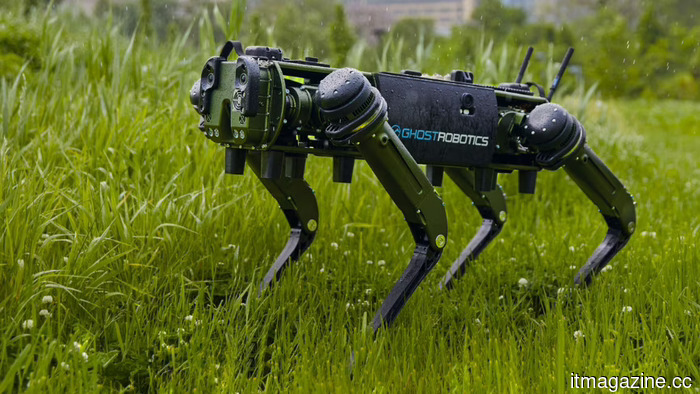 Taiwan unveils robotic patrol dogs that may protect its islands in the South China Sea.
Taiwan's military research institute showcased three Ghost Robotics robotic dogs, one of which is armed, that may eventually be utilized to patrol the Pratas and Itu Aba.
Taiwan unveils robotic patrol dogs that may protect its islands in the South China Sea.
Taiwan's military research institute showcased three Ghost Robotics robotic dogs, one of which is armed, that may eventually be utilized to patrol the Pratas and Itu Aba.
 As Microsoft approaches Build, it faces a challenge with AI integrated throughout its offerings and a dilemma regarding paying customers.
Microsoft kicks off its Build developer conference in San Francisco, aiming to integrate AI further into Windows and Copilot, although adoption remains uncertain.
As Microsoft approaches Build, it faces a challenge with AI integrated throughout its offerings and a dilemma regarding paying customers.
Microsoft kicks off its Build developer conference in San Francisco, aiming to integrate AI further into Windows and Copilot, although adoption remains uncertain.
 Internal disputes within the White House are hindering the progress of AI regulation in the U.S. following the Mythos incident.
A "knife fight" among Commerce, intelligence agencies, and pro-industry groups has stalled US AI policy, leading to Trump cancelling an executive order and leaving no established framework.
Internal disputes within the White House are hindering the progress of AI regulation in the U.S. following the Mythos incident.
A "knife fight" among Commerce, intelligence agencies, and pro-industry groups has stalled US AI policy, leading to Trump cancelling an executive order and leaving no established framework.
WeRide and Uber expand their robotaxi collaboration to Madrid.
WeRide, Uber, and fleet operator AVOMO are set to launch Madrid’s inaugural commercial robotaxi pilot later this year, initially featuring safety operators.