
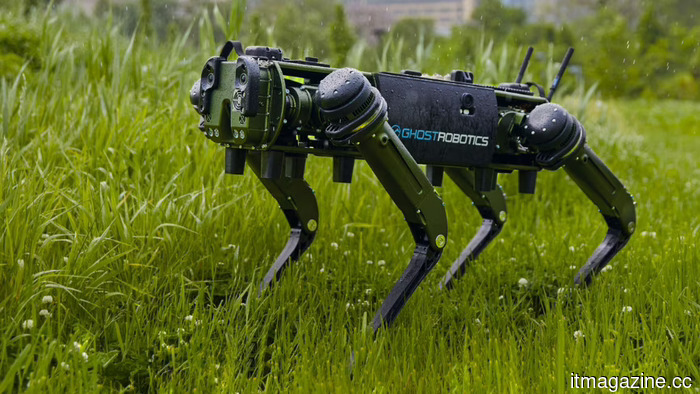
Taiwan unveils robotic patrol dogs that may protect its islands in the South China Sea.
A military research institution showcased three models of a four-legged robot, one of which is equipped with weapons, for potential deployment at remote outposts that the coast guard finds difficult to staff. On Monday, Taiwan’s primary weapons development institute tested three robotic dogs, presenting them as a possible solution to a challenging issue: monitoring small, distant islands in the South China Sea without increasing the number of personnel stationed there.
The National Chung-Shan Institute of Science and Technology, which is owned by the military, exhibited three variations of a quadrupedal robot constructed by Ghost Robotics, a US manufacturer of quadruped machines, as reported by Reuters. The institute has equipped these robots with its own technology for three purposes: reconnaissance, surveillance, and offensive capabilities, with the latter featuring a gun mounted on its back—an aspect that captures attention and places these machines in a gray area between surveillance tools and weapons.
Unlike some competitors, Ghost Robotics has not prohibited the weaponization of its quadrupeds, which has facilitated the integration of its technology into military programs that Boston Dynamics' policies do not allow. Taiwan’s marines have indicated a significant demand for robots capable of conducting patrols and inspections along the beaches and coastlines of the Spratlys and the Pratas, two island groups of concern.
The geographical context underlines this interest. Taiwan oversees Itu Aba, also known as Taiping, the largest natural island in the Spratlys, while it also maintains control over the Pratas, located at the northern edge of the South China Sea, which are typically safeguarded by the coast guard in peacetime rather than the military. Both are small, isolated, and costly to keep manned continually.
Robots capable of patrolling a perimeter in adverse weather without the need for rest or resupply, apart from power, are theoretically well-suited for such roles. Meanwhile, the backdrop is a continuously escalating maritime standoff, with Taiwan expressing concerns over an increasing frequency of Chinese coast guard patrols and drones near the Pratas, part of Beijing’s broader campaign against the island it claims as its own.
Unmanned systems have become a staple in this conflict from both sides; for the past year, Chinese military forces have also tested armed robotic dogs and small drones in amphibious drills close to Taiwan.
At this point, the demonstration has not led to deployment. According to Reuters, the military has indicated a need for the robots but has not placed a formal order, leaving the timeline, quantities, and prospects for the armed variant's actual deployment uncertain. Quadrupedal robots are gradually being integrated into military services in various regions, exemplified by the French Army’s trials of Boston Dynamics’ Spot and a surge in funding for robotic systems on European battlefields. Taiwan’s interpretation of this concept now has a demonstration platform, a weapon, and target islands, but a formal order has yet to materialize.
Другие статьи
 SoftBank is said to be in preliminary discussions to support an $800 million funding round for Agile Robots.
According to Bloomberg, SoftBank is in preliminary discussions to invest over $300 million in a funding round of approximately $800 million for the Munich-based robotics company Agile Robots.
Marvell sees an increase after Jensen Huang labels it the next trillion-dollar company.
Marvell's stock jumped approximately 25% in premarket trading after Nvidia's Jensen Huang forecasted at Computex that it would become the next $1 trillion company.
SoftBank is said to be in preliminary discussions to support an $800 million funding round for Agile Robots.
According to Bloomberg, SoftBank is in preliminary discussions to invest over $300 million in a funding round of approximately $800 million for the Munich-based robotics company Agile Robots.
Marvell sees an increase after Jensen Huang labels it the next trillion-dollar company.
Marvell's stock jumped approximately 25% in premarket trading after Nvidia's Jensen Huang forecasted at Computex that it would become the next $1 trillion company.
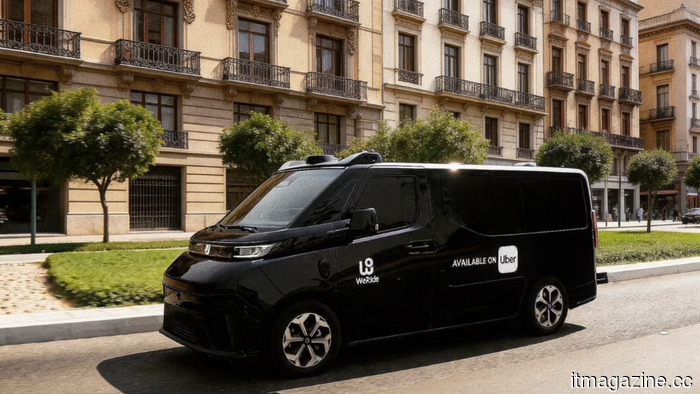 WeRide and Uber expand their robotaxi collaboration to Madrid.
WeRide, Uber, and fleet operator AVOMO are set to launch Madrid’s inaugural commercial robotaxi pilot later this year, initially featuring safety operators.
WeRide and Uber expand their robotaxi collaboration to Madrid.
WeRide, Uber, and fleet operator AVOMO are set to launch Madrid’s inaugural commercial robotaxi pilot later this year, initially featuring safety operators.
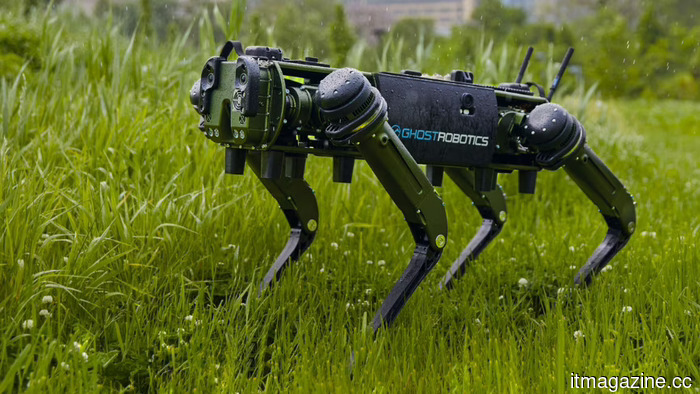 Taiwan unveils robotic patrol dogs capable of securing its islands in the South China Sea.
Taiwan's military research institute showcased three robot dogs from Ghost Robotics, one of which is armed, that may eventually be used to patrol the Pratas and Itu Aba.
Taiwan unveils robotic patrol dogs capable of securing its islands in the South China Sea.
Taiwan's military research institute showcased three robot dogs from Ghost Robotics, one of which is armed, that may eventually be used to patrol the Pratas and Itu Aba.
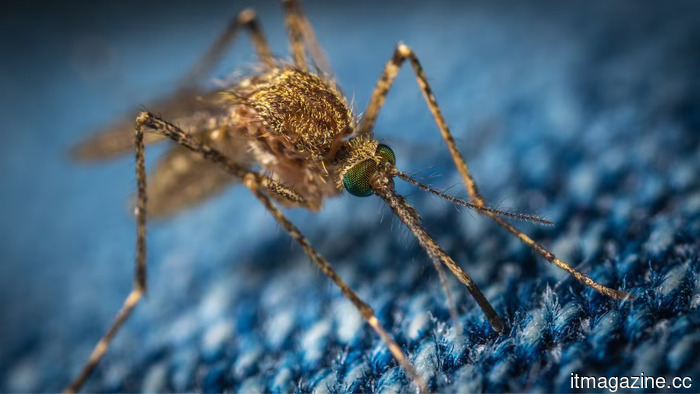 Google aims to deploy 32 million lab-grown mosquitoes to combat dengue and Zika viruses.
Alphabet's Verily seeks EPA authorization to deploy 64 million mosquitoes that carry Wolbachia in Florida and California, utilizing AI-driven sorting and breeding on an industrial scale.
Google aims to deploy 32 million lab-grown mosquitoes to combat dengue and Zika viruses.
Alphabet's Verily seeks EPA authorization to deploy 64 million mosquitoes that carry Wolbachia in Florida and California, utilizing AI-driven sorting and breeding on an industrial scale.
 Internal disputes within the White House are hindering the progress of AI regulation in the U.S. following the Mythos incident.
A "knife fight" among Commerce, intelligence agencies, and pro-industry groups has stalled US AI policy, leading to Trump cancelling an executive order and leaving no established framework.
Internal disputes within the White House are hindering the progress of AI regulation in the U.S. following the Mythos incident.
A "knife fight" among Commerce, intelligence agencies, and pro-industry groups has stalled US AI policy, leading to Trump cancelling an executive order and leaving no established framework.
Taiwan unveils robotic patrol dogs that may protect its islands in the South China Sea.
Taiwan's military research institute showcased three Ghost Robotics robotic dogs, one of which is armed, that may eventually be utilized to patrol the Pratas and Itu Aba.