
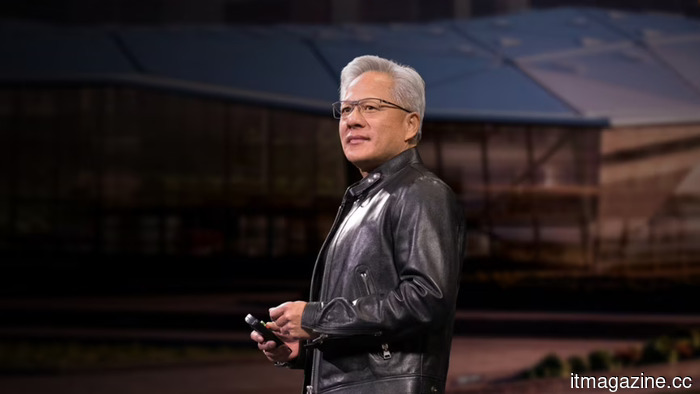
Jensen Huang states that workers should be compensated "as much as possible," just days after Nvidia allocates 50% of its free cash to shareholders.
Jensen Huang’s statements at Computex support Samsung's bonus scheme that rewards chip engineers with up to $400,000, coinciding with an $80 billion Nvidia buyback announced two weeks prior.
On Tuesday, during Computex in Taipei, Huang, the CEO of Nvidia, expressed to reporters that employees should be compensated "as much as possible." He framed this principle in response to inquiries about Samsung Electronics’ new bonus system, which provides significant bonuses to memory chip engineers. "I pay my employees as much as I can," Huang remarked, but followed up with, "but it doesn’t make this right," marking a rare instance of a CEO publicly qualifying his statements in real-time.
The Samsung context prompted the inquiry; earlier this month, the Korean memory company reached an agreement between union and management to allocate 10.5% of semiconductor operating profits to bonuses, offering payments of up to 600 million won (around $400,000) per worker in the memory division, contingent on achieving sustained profit targets through 2035. Reuters characterized this arrangement as the largest profit-share commitment in the history of major Korean corporations. Samsung provides Nvidia with HBM4 for the Vera Rubin platform, making the question relevant beyond mere topicality.
Adding complexity is Nvidia's cash-return commitment disclosed two weeks prior to Huang's comments. The company reported its Q1 fiscal 2027 results on May 18, including an authorization for an $80 billion stock repurchase, an increase in quarterly dividends from $0.01 to $0.25 per share (a 2,400% rise), and a pledge to return at least 50% of free cash flow to shareholders through 2026 and beyond. Nvidia returned a record $20 billion to shareholders in that quarter alone.
With Nvidia achieving $81.6 billion in quarterly revenue and 85% year-on-year growth, the ability to maintain these returns is evident, yet the financial dynamics are telling: the buyback is several times larger than Nvidia's total annual payroll.
Huang’s dual statements about maximizing worker pay and committing to shareholder returns aren’t inherently contradictory; both can coexist since the company has the resources for both. However, the public context matters, especially as gains in corporate AI productivity increasingly benefit shareholders over employees, compounded by Morgan Stanley's recent prediction that AI-related job losses could reach 20%.
Huang's instinctive defense of high employee compensation, even with his caveat, signifies a noteworthy acknowledgment of the tension between labor and capital arising from AI advancements.
Additionally, during his appearances at Computex, Huang suggested that Nvidia engineers should utilize AI tokens valued at approximately half their annual salary to enhance productivity, likening the failure to use AI tools to designing chips by hand. This stance, in effect, argues for substantial worker compensation through token budgets, meaning if engineers receive an annual token allotment of $100,000-$150,000 on top of their base salary, their overall compensation package surpasses the stated salary.
However, this perspective hinges on AI token prices remaining stable rather than escalating, as highlighted by Commonwealth Bank’s Matt Comyn this week.
Nvidia employs around 36,000 individuals globally. According to the company’s most recent disclosures, average compensation per employee is several hundred thousand dollars, including stock options. The AI surge has driven Nvidia's share price up approximately 1,170% over the last five years, creating significant wealth for many employees holding restricted-stock units.
Thus, Huang’s remarks reflect an Nvidia compensation reality that has been notably advantageous for workers by the benchmarks of major public tech firms. He is visiting Seoul this week to meet with Samsung Electronics chairman Lee Jae-yong and other industrial leaders, and the bonus structure issue will likely arise again. The public stance Huang has taken is more difficult to retract than standard executive non-answers.
Other articles
 Meta's AI bot assisted hackers in stealing Instagram accounts, and it was alarmingly simple to deceive.
Instagram has fixed a major security vulnerability that allowed hackers to utilize Meta's AI support chatbot to gain access to accounts without needing the victim’s password or email.
Meta's AI bot assisted hackers in stealing Instagram accounts, and it was alarmingly simple to deceive.
Instagram has fixed a major security vulnerability that allowed hackers to utilize Meta's AI support chatbot to gain access to accounts without needing the victim’s password or email.
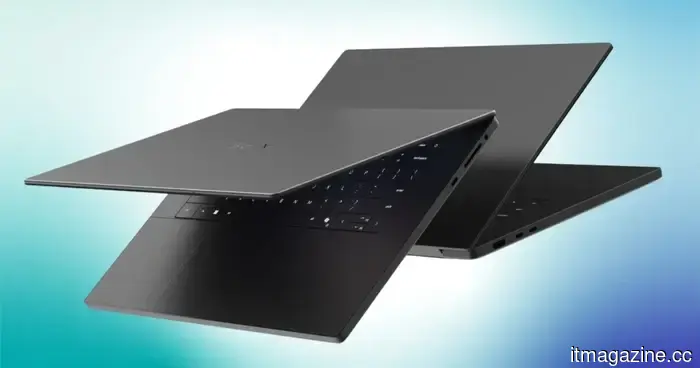 Dell's latest XPS 16 Creator Edition aims to serve as a substitute for your MacBook Pro.
Dell's XPS 16 Creator Edition features Nvidia RTX Spark, a Tandem OLED screen, as much as 128GB of unified memory, and includes the ports that MacBook Pro users have been longing for.
Dell's latest XPS 16 Creator Edition aims to serve as a substitute for your MacBook Pro.
Dell's XPS 16 Creator Edition features Nvidia RTX Spark, a Tandem OLED screen, as much as 128GB of unified memory, and includes the ports that MacBook Pro users have been longing for.
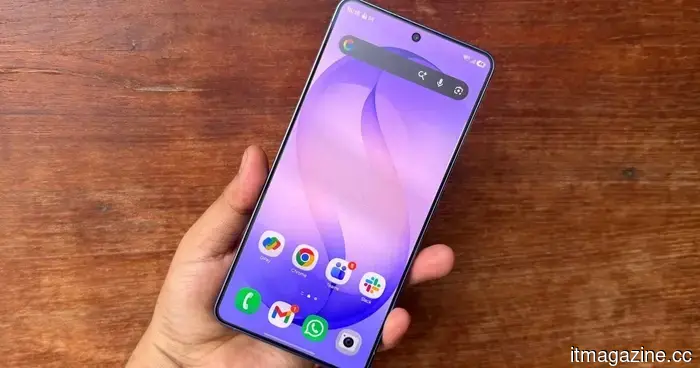 Samsung One UI 9 will turn off your fingerprint recognition every time you access the power menu.
One UI 9 Beta 2 automates the lockdown mode on Samsung Galaxy devices, eliminating the need for manual activation.
Samsung One UI 9 will turn off your fingerprint recognition every time you access the power menu.
One UI 9 Beta 2 automates the lockdown mode on Samsung Galaxy devices, eliminating the need for manual activation.
 SoftBank is said to be in preliminary discussions to support an $800 million funding round for Agile Robots.
According to Bloomberg, SoftBank is in preliminary discussions to invest over $300 million in a fundraising round of approximately $800 million for the Munich-based robotics company Agile Robots.
SoftBank is said to be in preliminary discussions to support an $800 million funding round for Agile Robots.
According to Bloomberg, SoftBank is in preliminary discussions to invest over $300 million in a fundraising round of approximately $800 million for the Munich-based robotics company Agile Robots.
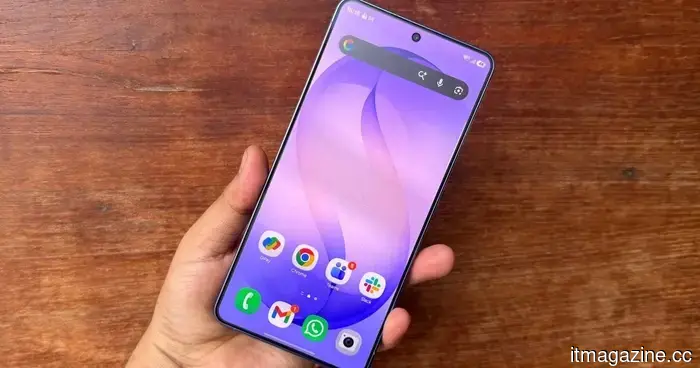 Samsung One UI 9 will deactivate your fingerprint every time you access the power menu.
One UI 9 Beta 2 automates the lockdown mode on Samsung Galaxy devices, eliminating the need for a manual activation step.
Samsung One UI 9 will deactivate your fingerprint every time you access the power menu.
One UI 9 Beta 2 automates the lockdown mode on Samsung Galaxy devices, eliminating the need for a manual activation step.
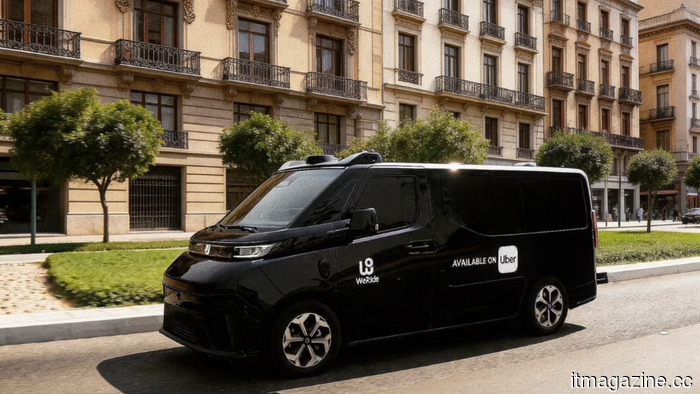 WeRide and Uber expand their robotaxi collaboration to Madrid.
WeRide, Uber, and fleet operator AVOMO are set to launch Madrid’s inaugural commercial robotaxi pilot later this year, initially featuring safety operators.
WeRide and Uber expand their robotaxi collaboration to Madrid.
WeRide, Uber, and fleet operator AVOMO are set to launch Madrid’s inaugural commercial robotaxi pilot later this year, initially featuring safety operators.
Jensen Huang states that workers should be compensated "as much as possible," just days after Nvidia allocates 50% of its free cash to shareholders.
At Computex, Jensen Huang stated that employees should receive "as much as possible," supporting Samsung's memory-bonus system. However, this comment comes just days after Nvidia pledged $80 billion towards buybacks and dedicated 50% of its free cash flow to returning money to shareholders.