
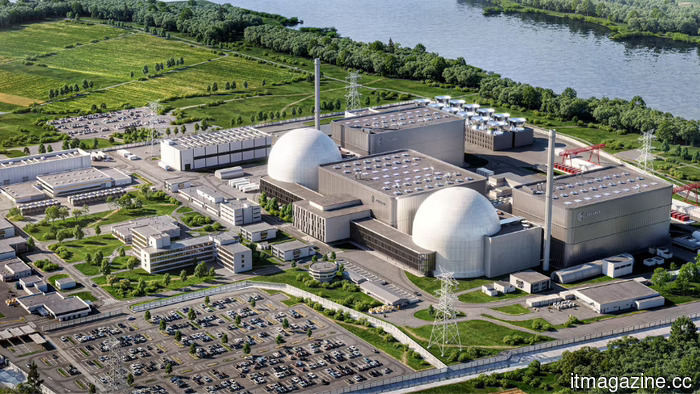
Focused Energy secures $240 million to commercialize NIF laser fusion technology.
TL;DR: Focused Energy, a fusion startup based in Germany, has secured an oversubscribed $240 million in a Series A funding round, led by utility company RWE, to advance laser-powered inertial confinement fusion technology inspired by the NIF's groundbreaking energy gain experiment. The company aims to create a demonstration reactor at a decommissioned nuclear fission plant in Germany.
Germany-based Focused Energy has successfully raised an oversubscribed $240 million in a Series A round aimed at developing a commercial reactor utilizing the same method that achieved the world’s first controlled fusion reaction yielding net energy gain. Led by German utility RWE, this funding round increases the company’s total private investment to $300 million, complemented by $200 million in grants, bringing its total funding to approximately $500 million, making it one of the most well-funded fusion startups globally.
The funding round also saw participation from organizations like SPRIND, the German Federal Agency for Breakthrough Innovation, Prime Movers Lab, and the European Innovation Council Fund. Focused Energy intends to construct its first demonstration system, named Lighthouse, at a site of a decommissioned nuclear fission power plant operated by RWE in Germany. This choice takes advantage of existing grid connections, cooling systems, and regulatory structures established for nuclear facilities.
Focused Energy's methodology involves inertial confinement fusion, where lasers compress a fuel target to create extreme conditions conducive to atomic fusion and energy release. This technique was validated in December 2022 at the National Ignition Facility (NIF) in California, marking a significant breakthrough as it was the first controlled fusion reaction to produce more energy than was used to initiate it—an important milestone prior to the rising global energy demand due to AI data centers.
The connection to the NIF is substantial. Debbie Callahan, who played a role in designing the fuel target for the historic NIF experiment, joined Focused Energy as chief strategy officer in December. She is responsible for simplifying the target for commercial production. The current fuel target used by NIF is complex and challenging to manufacture, with the facility conducting around 400 shots annually. In contrast, a commercial reactor would need to fire approximately 10 shots per second, totaling around 864,000 shots daily.
A key simplifying change involves removing the hohlraum—a precisely made gold cylinder that NIF uses to convert laser energy into X-rays to compress the fuel pellet. Focused Energy’s “direct drive” system eliminates this intermediary step, allowing lasers to compress the fuel pellet directly. This modification is expected to enhance the reactor's energy efficiency and ease the manufacturing process of the fuel target, both crucial for a system aimed at continuous industrial-scale operation.
Focused Energy enters a growing and competitive fusion sector, with numerous European deep tech startups gaining attention from both government and private investors. Fusion is recognized as one of the most capital-intensive fields. In February, Inertia Enterprises raised $450 million for its own inertial confinement reactor, positioning it as a direct competitor, while Thea Energy secured $100 million last week for its unique fusion approach. Type One Energy, supported by Bill Gates, gathered nearly $90 million toward a $250 million Series B in January. Commonwealth Fusion Systems, included in Gigascale Capital’s portfolio, raised $863 million for its magnetic confinement strategy.
This influx of investment is fueled by a confluence of factors, including NIF's demonstration that net energy gain is achievable, the increasing electricity demand driven by AI, and supportive government initiatives in the US, EU, and UK that are backing fusion development through grants and regulatory support. Technologies for energy storage and generation that offer baseload power with no carbon emissions are now attracting investments that would have seemed impossible just five years ago.
However, there is a significant engineering challenge ahead. The NIF’s net energy gain was calculated based on the energy delivered to the fuel, rather than the total energy consumed by the laser system, which is substantially higher. A commercial reactor must achieve gain based on the total system input, necessitating the development of more efficient lasers and higher-yield fuel targets.
While Focused Energy’s direct-drive method helps reduce energy losses associated with the hohlraum, the company must still prove that its laser system can meet the precision, firing rate, and efficiency needed for continuous operation. The urgency surrounding energy issues is pressing, with AI infrastructure projected to consume 9% of US electricity by 2030, but addressing the physics of fusion remains a critical challenge.
RWE’s role as the lead investor serves as a strong commercial endorsement. A major European utility investing in a fusion startup and offering a site for the demonstration system indicates that at least one entity with substantial experience in power plant operations believes Focused Energy’s approach may successfully transition to grid-connected electricity. Whether Lighthouse can close the gap between laboratory advancements and commercial power generation is the pivotal question of this $500 million venture.
Other articles
 The EU's plan for an AI gigafactory faces setbacks as delays cause partners to feel disconnected.
The EU's 20 billion euro initiative for five AI data centers is experiencing delays and funding shortages, resulting in bidding being postponed until July. The number of interested companies has decreased from 70 to 10, and consortia are reevaluating their positions.
The EU's plan for an AI gigafactory faces setbacks as delays cause partners to feel disconnected.
The EU's 20 billion euro initiative for five AI data centers is experiencing delays and funding shortages, resulting in bidding being postponed until July. The number of interested companies has decreased from 70 to 10, and consortia are reevaluating their positions.
 OpenAI Codex is extending its reach to enterprises through Sites, plugins, and support for non-developer users.
OpenAI has transformed Codex into an enterprise platform, featuring hosted web applications, 62 business application plugins, and 110 skills. Among the 5 million weekly users, non-developers make up 20% and are growing three times faster.
OpenAI Codex is extending its reach to enterprises through Sites, plugins, and support for non-developer users.
OpenAI has transformed Codex into an enterprise platform, featuring hosted web applications, 62 business application plugins, and 110 skills. Among the 5 million weekly users, non-developers make up 20% and are growing three times faster.
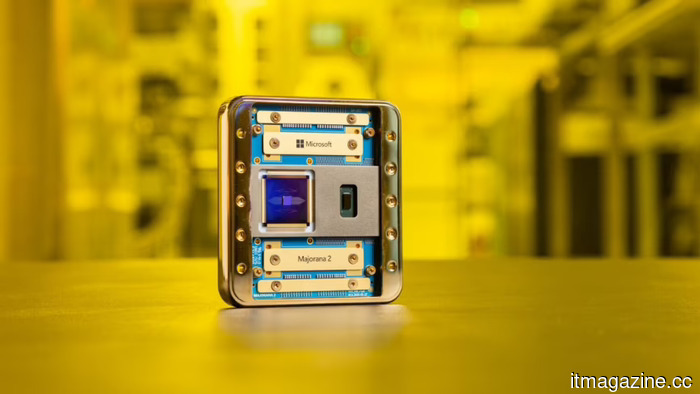 Microsoft's Majorana 2 quantum chip boasts a reliability improvement of 1,000 times and aims for a 2029 launch.
Microsoft's Majorana 2 qubits have a duration of 20 seconds, compared to microseconds for competitors, and are developed using agentic AI. The company aims to achieve a scalable quantum computer by 2029.
Microsoft's Majorana 2 quantum chip boasts a reliability improvement of 1,000 times and aims for a 2029 launch.
Microsoft's Majorana 2 qubits have a duration of 20 seconds, compared to microseconds for competitors, and are developed using agentic AI. The company aims to achieve a scalable quantum computer by 2029.
 Google Photos is finally making backups and exports somewhat less frustrating.
Google Photos is introducing incremental Takeout exports, which will reduce the size of recurring local backups after the initial full archive. However, the condition is that Photos needs to be the sole product selected during the setup process.
Google Photos is finally making backups and exports somewhat less frustrating.
Google Photos is introducing incremental Takeout exports, which will reduce the size of recurring local backups after the initial full archive. However, the condition is that Photos needs to be the sole product selected during the setup process.
 Trump signs revised AI order featuring a voluntary 30-day model evaluation.
Trump signed a scaled-back AI executive order featuring a voluntary 30-day pre-release model review and a cybersecurity clearinghouse, a reduction from the previously mandatory 90-day draft that was eliminated in May.
Trump signs revised AI order featuring a voluntary 30-day model evaluation.
Trump signed a scaled-back AI executive order featuring a voluntary 30-day pre-release model review and a cybersecurity clearinghouse, a reduction from the previously mandatory 90-day draft that was eliminated in May.
 Amazon has revealed the date for its Prime Day sales, which will take place slightly earlier this year.
Prime Day is returning and it’s happening earlier than ever before. This year, it will take place from June 23 to 26, compared to July 8 last year.
Amazon has revealed the date for its Prime Day sales, which will take place slightly earlier this year.
Prime Day is returning and it’s happening earlier than ever before. This year, it will take place from June 23 to 26, compared to July 8 last year.
Focused Energy secures $240 million to commercialize NIF laser fusion technology.
The German fusion startup Focused Energy secured $240 million in a Series A funding round, led by the utility company RWE, to develop a laser-driven reactor inspired by the recent net energy gain achievement by the NIF.