
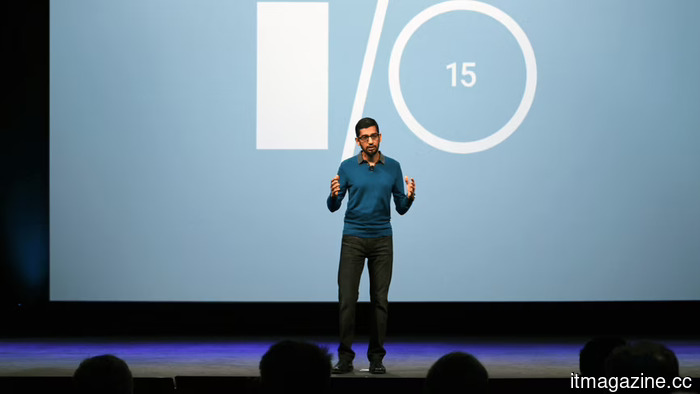
Alphabet plans to raise $80 billion in equity to finance its AI investments.
Alphabet is raising $80 billion in equity, an unusually substantial amount for a company that has seldom needed to seek such funds. The Google parent company announced this initiative on Monday to support what it described as investments in premier AI compute infrastructure to address unprecedented customer demand, and the structure of the raise is as informative as the headline figure.
The fundraising consists of three components. The first part includes $30 billion in concurrent underwritten public offerings, divided equally between mandatory convertible preferred stock and common and capital shares.
The second part is a $40 billion at-the-market program, through which Alphabet will gradually sell shares in the open market, expected to commence in the third quarter.
The third component, which is particularly noteworthy, is a $10 billion private placement to Berkshire Hathaway, consisting of Class A common stock priced at $351.81 and Class C capital stock at $348.20, according to Alphabet’s disclosures.
The Berkshire involvement adds an interesting layer to what could be viewed as a straightforward financing move. Warren Buffett’s firm has historically been cautious about investing in highly valued technology firms and has been slow to write checks for capital-intensive expansions.
A $10 billion investment in Alphabet’s AI initiatives signals confidence from an investor not typically associated with this sector, lending the raise a prominent name that the at-the-market component inherently lacks.
Alphabet indicated it plans to utilize the net proceeds from the underwritten offerings and the private placement for general corporate purposes, including capital expenditures necessary to enhance AI infrastructure and global computing capabilities.
The language used is broad, but the objective is clear. The company has projected capital expenditures of approximately $175 billion to $185 billion in 2026, a figure that has multiplied several times within just a few years as large tech companies race to expand their computing capabilities.
This competitive landscape provides context for the capital raise. Microsoft, Amazon, and Alphabet are each investing tens of billions annually in AI infrastructure, and the costs have escalated to the point where even companies with substantial cash reserves are turning to the equity market to help distribute the financial burden.
Opting to raise equity instead of relying solely on cash or debt allows Alphabet to finance its expansion while maintaining a flexible balance sheet, albeit with some dilution for existing shareholders. The mandatory convertible preferred stock structure is often utilized by companies to mitigate that dilution, as it delays conversion into common shares while still contributing to the capital raised at the present time.
What the announcement does not specify is the timing of the at-the-market sales beyond the planned start in the third quarter, as well as the final size of each tranche, which may fluctuate with the share price.
These details will unfold in the coming quarters. For the moment, the most striking statement is the simplest: Alphabet, a company historically associated with generating cash, is selling $80 billion in stock to keep pace.
Other articles
 Alphabet plans to raise $80 billion in equity to support its AI expenditures.
Alphabet intends to secure $80 billion in equity for AI infrastructure, which includes a $10 billion private placement to Berkshire Hathaway and a $40 billion at-the-market program.
Alphabet plans to raise $80 billion in equity to support its AI expenditures.
Alphabet intends to secure $80 billion in equity for AI infrastructure, which includes a $10 billion private placement to Berkshire Hathaway and a $40 billion at-the-market program.
 Google's first new smart speaker in six years may finally have a launch date.
Google remained silent about its Home Speaker powered by Gemini during the entirety of I/O 2026.
Google's first new smart speaker in six years may finally have a launch date.
Google remained silent about its Home Speaker powered by Gemini during the entirety of I/O 2026.
 Apple may be looking to introduce a feature that allows users to split expenses in iOS 27.
Apple is said to be introducing a feature for built-in bill splitting on iPhones, enabling users to scan receipts and automatically share costs via Apple Cash.
Apple may be looking to introduce a feature that allows users to split expenses in iOS 27.
Apple is said to be introducing a feature for built-in bill splitting on iPhones, enabling users to scan receipts and automatically share costs via Apple Cash.
 SEALSQ acquires a majority stake in WeCan to develop a post-quantum AI compliance co-pilot for private banking institutions.
Swiss post-quantum crypto company SEALSQ has purchased a majority stake in WeCan Group and has pledged CHF 5 million to expedite the development of an AI compliance co-pilot for private banks such as Pictet, Lombard Odier, and Barclays.
SEALSQ acquires a majority stake in WeCan to develop a post-quantum AI compliance co-pilot for private banking institutions.
Swiss post-quantum crypto company SEALSQ has purchased a majority stake in WeCan Group and has pledged CHF 5 million to expedite the development of an AI compliance co-pilot for private banks such as Pictet, Lombard Odier, and Barclays.
 Dell's latest XPS 16 Creator Edition aims to serve as a substitute for your MacBook Pro.
Dell's XPS 16 Creator Edition features Nvidia RTX Spark, a Tandem OLED screen, as much as 128GB of unified memory, and includes the ports that MacBook Pro users have been longing for.
Dell's latest XPS 16 Creator Edition aims to serve as a substitute for your MacBook Pro.
Dell's XPS 16 Creator Edition features Nvidia RTX Spark, a Tandem OLED screen, as much as 128GB of unified memory, and includes the ports that MacBook Pro users have been longing for.
 Australia's largest bank reports that corporate AI is increasing costs and generating subpar work.
CBA CEO Matt Comyn highlighted the rising costs of AI and the "work slop" that comes with increased complexity in production, which is reversing the advantageous per-token AI economics that characterized 2024-2025.
Australia's largest bank reports that corporate AI is increasing costs and generating subpar work.
CBA CEO Matt Comyn highlighted the rising costs of AI and the "work slop" that comes with increased complexity in production, which is reversing the advantageous per-token AI economics that characterized 2024-2025.
Alphabet plans to raise $80 billion in equity to finance its AI investments.
Alphabet intends to generate $80 billion in equity for AI infrastructure, which includes a $10 billion private placement with Berkshire Hathaway and a $40 billion at-the-market program.