
Kawasaki Heavy partners with Nvidia on physical AI, while the rideable robot horse is equipped with a foundation model.
Shares surged by 12% as the Japanese industrial company established a development base in San Jose in collaboration with Nvidia, Analog Devices, Microsoft, and Fujitsu, showcasing its four-legged CORLEO mobility concept as the initial highlight.
On Friday, Kawasaki Heavy Industries announced it would collaborate with Nvidia and several other US and Japanese companies to work on physical AI for robots, launching a joint development facility in San Jose, California.
Following this news, shares of the 130-year-old Japanese industrial firm increased by as much as 12%, marking their most significant rise since February 9. Other Japanese companies exposed to physical AI also saw gains, with Fanuc rising by 8% and Yaskawa Electric increasing by 5.9%.
The San Jose facility will unite Kawasaki, Nvidia, Analog Devices, Microsoft, and Fujitsu, primarily concentrating on applications in healthcare, nursing care, and mobility.
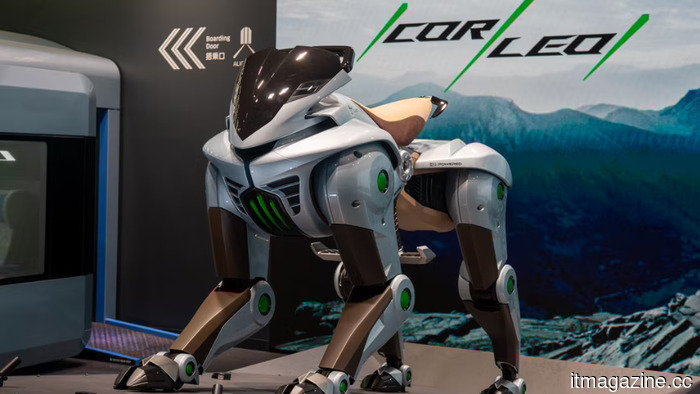
The first product to come through this new development pipeline is CORLEO, a four-legged personal mobility robot that Kawasaki has been creating for off-road applications. Comparable in size to a large motorcycle, it operates on a 150cc hydrogen engine that powers drive units mounted on its legs, designed for straddling and riding, with steering accomplished through weight shifts.
Kawasaki has previously expressed its intention to showcase the vehicle at Expo 2030 in Riyadh and aims to bring it to market by 2035.
The partnership utilizes Nvidia’s simulation tools for CORLEO’s development in addition to medical robotics aimed at creating assistants for healthcare professionals. Nikkei disclosed the plan prior to the official announcement, which Kawasaki confirmed on Friday morning, Tokyo time.
Analysts from Morgan Stanley MUFG, including Takeshi Kitaura, noted in a pre-confirmation report that the partnership “could accelerate its AI robot development initiatives” if the information was accurate.
The same report pointed out that Kawasaki’s investment strategy for the fiscal year ending in March 2027 will include an annual increase of about ¥10 billion ($63 million) for robot-related expenditures, reflecting a proactive approach to AI integration.
In a broader context, the Japanese industrial robotics sector is currently being restructured around partnerships focused on foundation-model technology. Earlier this month, Fanuc partnered with Google to integrate Gemini Enterprise and the Intrinsic robotics platform into its 1.1 million operational industrial robots, causing Fanuc shares to hit a record high. Kawasaki’s agreement aligns with this trend from the Nvidia perspective.
Both of the leading AI stacks tied to hyperscalers now have major partnerships with established Japanese industrial robotics firms.
The CORLEO showcase implies that Kawasaki’s collaboration is initially directed towards consumer-oriented and care-economy applications instead of the welding and pick-and-place operations where Fanuc excels.
Japan faces a demographic challenge that the rest of the OECD will encounter in two decades, making physical AI in elder care a politically supported priority domestically.
From an investment standpoint, the narrative is clear. Robotics is the standout theme in Asian stocks this year, and any credible partnership with Nvidia, Google, or other foundation-model providers is seen as a valuable opportunity for the upcoming market cycle.
Nvidia’s humanoid technology is being tested in real logistics operations with Siemens in Germany, and the company’s discussions with LG Electronics regarding robotics and AI data centers are publicly known. The Kawasaki partnership adds a significant player from Japan’s heavy industry to this roster.
The long-term question remains whether CORLEO will become a viable product or merely an expensive showcase. The robot currently exists as a hydrogen-powered concept, which garnered approximately 1.2 billion social media impressions when Kawasaki revealed it at Expo 2025 in Osaka.
The collaboration with Nvidia offers a pathway to a simulation-based control system that could potentially advance it towards functional hardware. The share price increase on Friday indicates that investors are currently optimistic about this potential trajectory.
Other articles
 Starbucks withdraws its AI inventory tool after nine months due to ongoing issues with misidentifying the milks.
Starbucks has discontinued its AI inventory tool in North American stores nine months after its introduction, citing concerns over reliability and returning to manual counting methods.
Starbucks withdraws its AI inventory tool after nine months due to ongoing issues with misidentifying the milks.
Starbucks has discontinued its AI inventory tool in North American stores nine months after its introduction, citing concerns over reliability and returning to manual counting methods.
 wingtech-nexperia-china-court-dutch-semiconductor-lawsuit
Wingtech is demanding 8 billion yuan in compensation from Nexperia following the Dutch government taking control of the chip manufacturer, citing China's Anti-Foreign Sanctions Law.
wingtech-nexperia-china-court-dutch-semiconductor-lawsuit
Wingtech is demanding 8 billion yuan in compensation from Nexperia following the Dutch government taking control of the chip manufacturer, citing China's Anti-Foreign Sanctions Law.
 wingtech-nexperia-china-court-dutch-semiconductor-legal-case
Wingtech is demanding 8 billion yuan in damages from Nexperia following the Dutch government's takeover of the chipmaker, citing China's Anti-Foreign Sanctions Law.
wingtech-nexperia-china-court-dutch-semiconductor-legal-case
Wingtech is demanding 8 billion yuan in damages from Nexperia following the Dutch government's takeover of the chipmaker, citing China's Anti-Foreign Sanctions Law.
 The excitement surrounding Salesforce's Agentforce exceeds what it has actually delivered.
Salesforce finalized 29,000 Agentforce agreements, but its stock has declined by 30% in 2026, and demonstration showcases continue to reveal themselves as ongoing projects.
The excitement surrounding Salesforce's Agentforce exceeds what it has actually delivered.
Salesforce finalized 29,000 Agentforce agreements, but its stock has declined by 30% in 2026, and demonstration showcases continue to reveal themselves as ongoing projects.
 The excitement surrounding Salesforce's Agentforce exceeds its actual delivery.
Salesforce secured 29,000 Agentforce agreements, yet its stock has decreased by 30% in 2026, and demonstration showcases continue to be unfinished projects.
The excitement surrounding Salesforce's Agentforce exceeds its actual delivery.
Salesforce secured 29,000 Agentforce agreements, yet its stock has decreased by 30% in 2026, and demonstration showcases continue to be unfinished projects.
Kawasaki Heavy partners with Nvidia on physical AI, while the rideable robot horse is equipped with a foundation model.
Kawasaki Heavy Industries surged 12% following the announcement of a partnership in physical-AI with Nvidia, Microsoft, Fujitsu, and Analog Devices, featuring its CORLEO robot as the highlight of the presentation.