
Kawasaki Heavy partners with Nvidia on physical AI, and the rideable robotic horse receives a foundational model.
Shares rose by 12% following the announcement of the Japanese industrial group's new development center in San Jose, created in collaboration with Nvidia, Analog Devices, Microsoft, and Fujitsu, featuring the four-legged CORLEO mobility concept as its first highlight. Kawasaki Heavy Industries announced on Friday its plans to collaborate with Nvidia and a selection of both US and Japanese companies on physical AI for robotics, establishing a joint development facility in San Jose, California.
The stock of the 130-year-old Japanese industrial firm surged by as much as 12% in response to the news, marking its largest gain since February 9. Other Japanese companies involved in physical AI also saw increases, with Fanuc rising 8% and Yaskawa Electric climbing 5.9%.
The San Jose facility will unite Kawasaki, Nvidia, Analog Devices, Microsoft, and Fujitsu, with initial efforts directed towards healthcare, nursing care, and mobility applications. The first product to undergo development at this new center is CORLEO, a four-legged personal mobility robot designed by Kawasaki for off-road use. It is approximately the size of a large motorcycle and operates on a 150cc hydrogen engine that powers drive units attached to its legs. The robot is intended for riders who will steer it through weight shifts.
Kawasaki previously indicated that it aims to use the vehicle during Expo 2030 in Riyadh and plans to have it commercially available by 2035. The partnership will leverage Nvidia’s simulation tools in the development of CORLEO, alongside work in medical robotics intended to create helpers for healthcare professionals. Nikkei had circulated news of the plans prior to the official announcement, which Kawasaki confirmed Friday morning in Tokyo.
Analysts from Morgan Stanley MUFG, including Takeshi Kitaura, noted in a note before the official announcement that the partnership "could lead to an acceleration in its AI robot development efforts" should the report prove correct. The same note highlighted that Kawasaki's investment strategy for the fiscal year ending March 2027 would see an increase of around ¥10 billion ($63 million), which includes spending on robotics, demonstrating a proactive approach to adopting AI.
In a broader context, Japan's industrial robotics sector is being reorganized in real-time through partnerships linked to foundational models. Earlier this month, Fanuc announced a collaboration with Google to integrate Gemini Enterprise and the Intrinsic robotics platform into its 1.1 million industrial robots, propelling Fanuc shares to a record high. Kawasaki's agreement aligns with similar themes from Nvidia's side.
The two largest hyperscaler-adjacent AI infrastructures now have key partners among Japan's established industrial robotics companies. The CORLEO demonstration indicates that Kawasaki's partnership is initially focused on consumer-related and care-economy applications rather than the industrial sectors dominated by Fanuc.
Japan faces demographic challenges that much of the OECD will confront in the coming decades, and advancements in physical AI for elder care represent a politically prioritized focus domestically.
From an investment perspective, the situation is clear: robotics has become a significant theme in Asian markets this year, and any credible collaboration with Nvidia, Google, or other foundational model providers is viewed as a valuable opportunity for the next phase of market growth.
Nvidia’s humanoid platform is already being tested in live logistics operations with Siemens in Germany, and Nvidia's public discussions with LG Electronics regarding robotics and AI data centers are well-known. The Kawasaki deal introduces a major Japanese partner in heavy industry to this growing network.
The ultimate fate of CORLEO—whether it becomes a viable product or merely an expensive prototype—remains to be seen. Currently, the robot exists as a hydrogen-powered concept that garnered around 1.2 billion social media impressions after its unveiling at Expo 2025 in Osaka. The partnership with Nvidia provides a pathway toward a simulation-trained control system that may effectively advance it closer to functional hardware. The stock market's reaction on Friday indicates that investors are currently factoring in this potential.
Other articles
 The AI era didn't eliminate trust in marketing; instead, it elevated the standards for achieving it.
Consumers have transitioned from looking for information to desiring certainty. An experienced marketer discusses why brands that fail to withstand the verification phase will be outperformed by those that succeed.
The AI era didn't eliminate trust in marketing; instead, it elevated the standards for achieving it.
Consumers have transitioned from looking for information to desiring certainty. An experienced marketer discusses why brands that fail to withstand the verification phase will be outperformed by those that succeed.
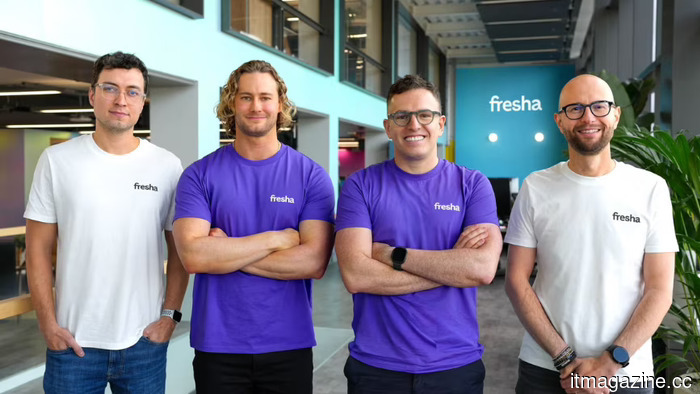 Fresha in London achieves unicorn status following an $80M funding round led by KKR.
Fresha, a beauty and wellness booking platform located in London, has secured $80 million from KKR, achieving a valuation exceeding $1 billion and entering the ranks of UK unicorns.
Fresha in London achieves unicorn status following an $80M funding round led by KKR.
Fresha, a beauty and wellness booking platform located in London, has secured $80 million from KKR, achieving a valuation exceeding $1 billion and entering the ranks of UK unicorns.
 The excitement surrounding Salesforce's Agentforce exceeds its actual performance.
Salesforce finalized 29,000 Agentforce transactions, yet its stock has declined by 30% in 2026, and demonstration showcases continue to be under development.
Forum is Meta's new app for Facebook Groups, and it resembles Reddit quite closely.
Meta has quietly launched Forum, a standalone app similar to Reddit that is based on Facebook Groups, featuring an AI "Ask" tab and an administrative assistant.
The excitement surrounding Salesforce's Agentforce exceeds its actual performance.
Salesforce finalized 29,000 Agentforce transactions, yet its stock has declined by 30% in 2026, and demonstration showcases continue to be under development.
Forum is Meta's new app for Facebook Groups, and it resembles Reddit quite closely.
Meta has quietly launched Forum, a standalone app similar to Reddit that is based on Facebook Groups, featuring an AI "Ask" tab and an administrative assistant.
 Starbucks withdraws its AI inventory tool after nine months due to ongoing confusion over the types of milk.
Starbucks has discontinued its AI inventory tool in North American stores nine months after its introduction, mentioning reliability concerns and returning to manual counting methods.
Starbucks withdraws its AI inventory tool after nine months due to ongoing confusion over the types of milk.
Starbucks has discontinued its AI inventory tool in North American stores nine months after its introduction, mentioning reliability concerns and returning to manual counting methods.
 Norway's $2.3 trillion fund opposes Elkann's position on the Meta board.
Norway's sovereign wealth fund abstained from voting on Elkann's reappointment to the Meta board and supported shareholder initiatives regarding AI data privacy and hate speech.
Norway's $2.3 trillion fund opposes Elkann's position on the Meta board.
Norway's sovereign wealth fund abstained from voting on Elkann's reappointment to the Meta board and supported shareholder initiatives regarding AI data privacy and hate speech.
Kawasaki Heavy partners with Nvidia on physical AI, and the rideable robotic horse receives a foundational model.
Kawasaki Heavy Industries surged 12% following the announcement of a collaboration in physical-AI with Nvidia, Microsoft, Fujitsu, and Analog Devices, with its CORLEO robot taking center stage in the display.