

The excitement surrounding Salesforce's Agentforce exceeds what it has actually delivered.
TL;DR: Salesforce has secured 29,000 Agentforce deals and reported $800 million in annual recurring revenue (ARR), yet its stock has fallen 30% in 2026 due to the SaaSpocalypse selloff. Showcase demonstrations from Williams-Sonoma, UChicago Medicine, and SharkNinja were revealed to be works in progress rather than operational implementations.
Salesforce faces a challenge that marketing can’t resolve. The entire narrative revolves around Agentforce, its AI agent platform, and the stats look good on paper: 29,000 closed deals, $800 million in ARR, and a roadmap promising to replace various human roles. However, Wall Street is unconvinced, and the disparity between Salesforce's presentations and actual customer usage continues to grow.
The stock performance reflects this situation. Salesforce shares dropped nearly 21% in 2025 and have plummeted an additional 30% in 2026. This decline corresponds with a larger sell-off in software-as-a-service companies, referred to as the SaaSpocalypse, where approximately $285 billion in SaaS market capitalization disappeared in just 48 hours in February. The rationale is clear: if one AI agent can accomplish the work of ten employees, there’s little reason for companies to pay for ten licenses.
Salesforce has attempted to counter this perception by branding itself as a provider of agents rather than seats. CEO Marc Benioff labeled Agentforce as a “digital labour platform” and during earnings calls, the company highlights the 29,000 deals and ARR as indicators of enterprise acceptance.
However, the showcased examples often crumble under scrutiny. At Dreamforce, Salesforce displayed a Williams-Sonoma AI agent named Olive, intended to function as a sous chef, assisting customers with meal planning and product searches. In reality, Olive faltered with specific queries and recommendations, and its advanced features were framed in future tense with claims of what it “will soon be able to” do instead of presenting live functionalities.
A similar issue arose with UChicago Medicine, which Salesforce hailed as a leading Agentforce for Health example. In truth, UChicago Medicine's first AI agent was limited to web chat for basic inquiries such as parking directions and clinic availability, while more ambitious features, like voice-driven patient support, were still under development.
SharkNinja, known for Shark vacuums and Ninja kitchen appliances, was another prominent client. Salesforce claimed that Agentforce would improve customer service efficiency, bolstering an assertion from Bloomberg about a 20% cut in support calls. Yet, this deployment was also forward-looking, envisioning agents that would “guide customers through the buying process” and “manage returns,” rather than detailing completed outcomes.
This situation is significant as Salesforce is not alone in overstating AI capabilities. Apple recently settled a $250 million class action lawsuit for allegedly exaggerating the capabilities of Apple Intelligence and a smarter Siri upon launching the iPhone 16, addressing claims that its marketing exceeded the technology's actual performance.
Adding complexity, Salesforce's financial path reveals a decline in revenue growth from around 25% a few years back to approximately 10% in fiscal 2026, when it reported total revenue of $41.5 billion. While it's still a substantial business and the company recorded a strong fourth quarter with 12% growth, the slowdown raises concerns for investors who fear that AI agents will reduce the number of human users needing software licenses.
To tackle pricing issues, Salesforce has implemented a consumption-based model for Agentforce rather than traditional per-seat pricing, billing for what it terms “agentic work units.” It has processed nearly 20 trillion tokens, converting them into over 2.4 billion of these units. Whether this model can expand sufficiently to counter the fundamental threat to seat-based revenue is a critical gamble.
Smaller customers highlight both the potential and the cost. The city of Kyle, Texas, implemented Agentforce for its 311 service, addressing over 12,000 resident requests since March 2025 with nearly 90% resolved on the first call. Bloomberg noted that the city doubled its Salesforce expenditure to $300,000. While this investment may be reasonable for a rapidly growing city, the economics are less evident for larger clients considering similar decisions at scale.
Competitive pressures are intensifying. SAP introduced its Autonomous Enterprise featuring over 200 AI agents and a partnership with Anthropic at Sapphire 2026. Companies like ServiceNow, Google, and Microsoft are also developing agent platforms. The question has shifted from whether AI agents will transform enterprise software to whether Salesforce can maintain its standing as the market evolves.
Benioff has responded confidently, setting a new revenue target of $60 billion by fiscal 2030. He has also pledged $50 billion for share buybacks, signaling to investors that the company views its stock as undervalued. Slack's evolution into an agentic platform with over 30 new AI features, mandated for every new Salesforce account starting this summer, forms part
Other articles
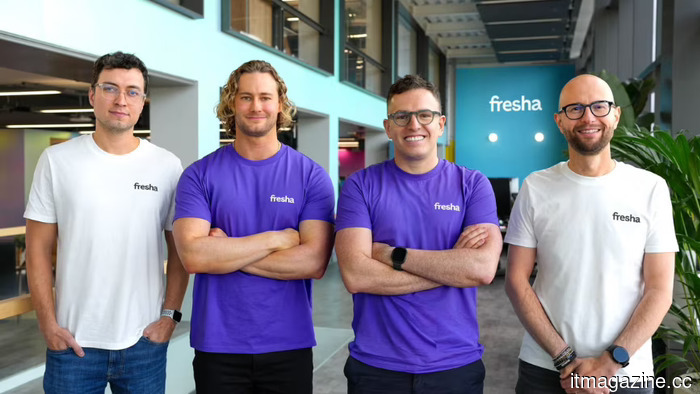 Fresha, based in London, achieves unicorn status following an $80 million funding round led by KKR.
Fresha, a beauty and wellness booking platform based in London, has secured $80 million from KKR, achieving a valuation of over $1 billion and gaining entry into the UK unicorn club.
Fresha, based in London, achieves unicorn status following an $80 million funding round led by KKR.
Fresha, a beauty and wellness booking platform based in London, has secured $80 million from KKR, achieving a valuation of over $1 billion and gaining entry into the UK unicorn club.
 Norway's $2.3 trillion fund opposes Elkann's position on the Meta board.
Norway's sovereign wealth fund abstained from voting on Elkann's reappointment to the Meta board and supported shareholder initiatives regarding AI data privacy and hate speech.
Norway's $2.3 trillion fund opposes Elkann's position on the Meta board.
Norway's sovereign wealth fund abstained from voting on Elkann's reappointment to the Meta board and supported shareholder initiatives regarding AI data privacy and hate speech.
 The majority of data breaches begin with a compromised password. Here's how to address that issue.
Stolen credentials account for 80% of breaches, but many teams continue to share passwords via Slack. Proton Pass for Business encrypts all data starting at $1.99 per user per month.
The majority of data breaches begin with a compromised password. Here's how to address that issue.
Stolen credentials account for 80% of breaches, but many teams continue to share passwords via Slack. Proton Pass for Business encrypts all data starting at $1.99 per user per month.
 The majority of data breaches begin with a compromised password. Here’s how to address this issue.
Stolen credentials account for 80% of security breaches, yet many teams continue to share passwords via Slack. Proton Pass for Business offers encryption for all data starting at $1.99 per user per month.
The majority of data breaches begin with a compromised password. Here’s how to address this issue.
Stolen credentials account for 80% of security breaches, yet many teams continue to share passwords via Slack. Proton Pass for Business offers encryption for all data starting at $1.99 per user per month.
 Kawasaki Heavy partners with Nvidia on physical AI, while the rideable robot horse is equipped with a foundation model.
Kawasaki Heavy Industries surged 12% following the announcement of a partnership in physical-AI with Nvidia, Microsoft, Fujitsu, and Analog Devices, featuring its CORLEO robot as the highlight of the presentation.
Kawasaki Heavy partners with Nvidia on physical AI, while the rideable robot horse is equipped with a foundation model.
Kawasaki Heavy Industries surged 12% following the announcement of a partnership in physical-AI with Nvidia, Microsoft, Fujitsu, and Analog Devices, featuring its CORLEO robot as the highlight of the presentation.
 The excitement surrounding Salesforce's Agentforce exceeds its actual delivery.
Salesforce secured 29,000 Agentforce agreements, yet its stock has decreased by 30% in 2026, and demonstration showcases continue to be unfinished projects.
The excitement surrounding Salesforce's Agentforce exceeds its actual delivery.
Salesforce secured 29,000 Agentforce agreements, yet its stock has decreased by 30% in 2026, and demonstration showcases continue to be unfinished projects.
The excitement surrounding Salesforce's Agentforce exceeds what it has actually delivered.
Salesforce finalized 29,000 Agentforce agreements, but its stock has declined by 30% in 2026, and demonstration showcases continue to reveal themselves as ongoing projects.