

ClickUp reduces its workforce by 22% and proposes $1 million salaries as part of its AI restructuring efforts.
TL;DR ClickUp has reduced its workforce by 22 per cent and implemented $1 million salary bands for the remaining employees. CEO Zeb Evans stated that the company is restructuring based on a "100x org" model where AI agents outnumber staff by 3:1.
ClickUp, valued at $4 billion, has downsized 22 per cent of its workforce. CEO Zeb Evans shared the news of the layoffs on X, indicating that this isn't merely a cost-saving measure but a strategic pivot towards AI. He mentioned that the savings will benefit the remaining staff through new million-dollar salary bands.
Evans described the new organizational structure as a "100x org," emphasizing that AI agents have fundamentally altered the approach to software development and the skills necessary for high-level performance. He argued that merely improving existing systems won't suffice; the company needs to rebuild from the ground up.
This restructuring follows months of rapid AI integration at ClickUp. A recent profile in Fortune disclosed that there are now around 3,000 internal AI agents across the company, resulting in a 3:1 ratio of agents to employees. Evans had already required that employees consult an AI agent trained to represent him before reaching out directly.
Evans identified three essential categories of employees for the new model. The first group is "builders," divided into 10x engineers and 10x product managers. He asserted that top engineers no longer write code themselves; instead, they manage AI agents that do. The key skill now is judgment and the ability to coordinate and assess, as AI allows top engineers to be significantly more productive, whereas others using AI may hinder progress.
He referred to this as the "great reckoning of AI coding," predicting that all companies will confront this challenge soon. He criticized businesses celebrating a surge in pull requests, arguing that more code does not equate to better outcomes, but rather leads to new bottlenecks.
The second group involves "system managers," or agent managers, who automate their jobs with AI and oversee the resultant systems. Evans contended that individuals who can automate their roles will always find work, as the focus should be on the systems rather than specific tasks.
The third category is "front-liners," those who interact with customers. In a landscape filled with AI communication, Evans argued that human interactions should not be replaced and that front-liners should dedicate almost all their time to meeting customers, while the processes surrounding those meetings become automated.
He also noted a merging of product management and design; designers increasingly resemble product managers, and product managers are becoming more design-oriented. He claimed the barrier of user research has been removed, as a single query to an agent can initiate and evaluate a research cycle.
The most notable change is the high compensation structure; ClickUp will offer salary bands that can reach $1 million annually. This opportunity is open to nearly any employee who generates "100x impact" through the creation or management of AI systems. In a scenario where top talent can produce significantly more output, Evans believes companies need to retain these individuals for the long term.
This announcement coincides with a challenging time for tech workers, with more than 100,000 jobs lost across approximately 250 events in 2026 to date. Major companies like Meta and Oracle have also made significant cuts while reporting record revenues, shifting savings towards AI.
Evans is more forthright than many CEOs. While others may use vague terms like "efficiency," he directly claims the roles being eliminated have become obsolete. Whether this approach is seen as honesty or arrogance will hinge on the success of the 100x organization in achieving the results he anticipates.
As of 2025, ClickUp reported around $300 million in annual recurring revenue and has been considering an IPO. The company acquired AI coding platform Codegen late last year. With AI revolutionizing the economics of developer tools and productivity software, Evans is wagering that a smaller, better-compensated workforce directing numerous agents will outperform the previous model.
However, skepticism remains. In China, courts have ruled that replacing employees with AI does not constitute lawful grounds for termination. In the US, there are no such protections. For the 22 per cent of ClickUp employees who were laid off this week, this distinction is significant.
Other articles
 Ubisoft aims for a resurgence with Assassin’s Creed, Far Cry, Ghost Recon, along with an AI project that has players concerned.
Ubisoft's plan for a comeback features new titles in the Assassin’s Creed, Far Cry, and Ghost Recon franchises, along with a playable generative AI initiative named Teammates.
Ubisoft aims for a resurgence with Assassin’s Creed, Far Cry, Ghost Recon, along with an AI project that has players concerned.
Ubisoft's plan for a comeback features new titles in the Assassin’s Creed, Far Cry, and Ghost Recon franchises, along with a playable generative AI initiative named Teammates.
 ByteDance’s Seedance 2.0 arrives in Cannes with a 95-minute AI film titled Hell Grind.
During the 79th Cannes Film Festival, an event renowned for its rich cinematic narratives, one of the year's most unexpected highlights emerged from artificial intelligence. On
ByteDance’s Seedance 2.0 arrives in Cannes with a 95-minute AI film titled Hell Grind.
During the 79th Cannes Film Festival, an event renowned for its rich cinematic narratives, one of the year's most unexpected highlights emerged from artificial intelligence. On
 ByteDance's Seedance 2.0 premieres at Cannes with the 95-minute AI film Hell Grind.
During the 79th Cannes Film Festival, renowned for its abundance of cinematic storytelling, one of the most unexpected highlights this year emerged from artificial intelligence.
ByteDance's Seedance 2.0 premieres at Cannes with the 95-minute AI film Hell Grind.
During the 79th Cannes Film Festival, renowned for its abundance of cinematic storytelling, one of the most unexpected highlights this year emerged from artificial intelligence.
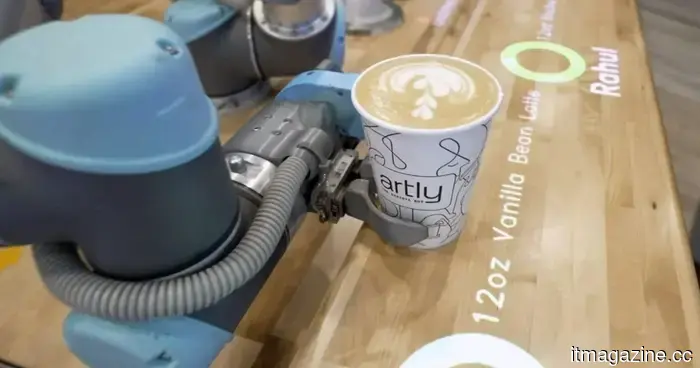 This robotic barista aims to transform award-winning coffee into a business that can grow.
Artly's robotic barista system, named Jarvis, is currently serving coffee in Portland and employs computer vision and motion capture technology that has been honed using champion barista Joe Yang's expertise. The company is confident that automation can enhance craftsmanship instead of eliminating it.
This robotic barista aims to transform award-winning coffee into a business that can grow.
Artly's robotic barista system, named Jarvis, is currently serving coffee in Portland and employs computer vision and motion capture technology that has been honed using champion barista Joe Yang's expertise. The company is confident that automation can enhance craftsmanship instead of eliminating it.
 Spotify will allow you to use AI to create covers and remixes of your favorite songs, for an additional cost.
Spotify and Universal Music Group revealed an agreement that enables Premium subscribers to utilize AI for creating covers and remixes of their favorite tracks.
GitLab 19.0 aims to bridge the divide between coding and delivery.
GitLab 19.0 enhances agentic AI throughout the entire development lifecycle by incorporating SBOM dependency scanning, support for Claude Opus 4.7, and a credit-based pricing model for agents.
Spotify will allow you to use AI to create covers and remixes of your favorite songs, for an additional cost.
Spotify and Universal Music Group revealed an agreement that enables Premium subscribers to utilize AI for creating covers and remixes of their favorite tracks.
GitLab 19.0 aims to bridge the divide between coding and delivery.
GitLab 19.0 enhances agentic AI throughout the entire development lifecycle by incorporating SBOM dependency scanning, support for Claude Opus 4.7, and a credit-based pricing model for agents.
ClickUp reduces its workforce by 22% and proposes $1 million salaries as part of its AI restructuring efforts.
ClickUp’s CEO, Zeb Evans, has reduced the workforce by 22% and implemented salary bands of $1 million for a "100x organization" where AI agents surpass the number of employees by three to one.