
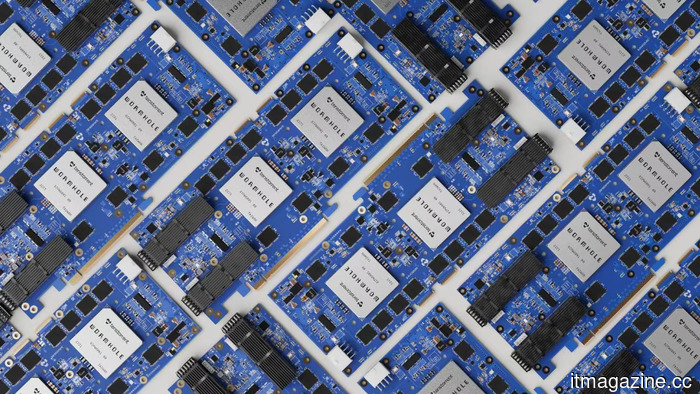
Intel and Qualcomm are focusing on Tenstorrent as the alternative to NVIDIA as the market shifts.
Bloomberg has reported that early-stage takeover discussions are taking place involving Tenstorrent, the AI chip startup led by Jim Keller, which raised $800 million last year at a valuation of $3.2 billion, backed by investors such as Bezos Expeditions and Samsung.
According to Bloomberg's Monday report, Tenstorrent has been in preliminary discussions with Intel and Qualcomm, referencing sources familiar with the situation. These talks are at a conversational phase rather than a transactional one, as described by the news outlet. Tenstorrent has chosen not to comment on the matter, and neither Intel nor Qualcomm has publicly confirmed the discussions.
The valuation background is significant. In November 2025, Tenstorrent was in negotiations to secure $800 million at a $3.2 billion pre-money valuation, led by Fidelity Management, an increase from the $693 million Series D round it completed in December 2024, which had a $2.6 billion valuation.
Existing investors include Bezos Expeditions, LG Electronics, Baillie Gifford, and the Healthcare of Ontario Pension Plan. The company is reportedly holding around $150 million in customer contracts, with manufacturing agreements with Samsung and automotive AI projects with Hyundai.
The technical positioning adds to the interest in a potential takeover. Tenstorrent develops RISC-V-based AI accelerators (Ascalon CPU cores and Tensix AI cores), offering them both as packaged silicon and as licensable intellectual property, which is a unique hybrid model for a chip startup.
Keller, who has an extensive track record that includes Apple’s A-series chips, Tesla’s autopilot silicon, AMD’s Zen architecture, and Intel’s CPU division, joined as Chief Technology Officer in 2020 and became CEO in 2025.
The appeal to the identified acquirers is based on the fact that instead of developing a competitor to NVIDIA from scratch, they could acquire the only credible RISC-V AI platform currently available.
The rationale for buyers differs. Intel needs anything that can help it reposition itself against NVIDIA in the AI training market, having spent the last two years restructuring its discrete-accelerator strategy after the Gaudi line fell short of expectations. Qualcomm represents an even more intriguing buyer, having traditionally not competed in data-center AI with its smartphone system-on-chip (SoC) and Arm-architecture business. By acquiring Tenstorrent, Qualcomm would gain both a licensable IP block and a viable non-Arm CPU roadmap simultaneously.
Bloomberg did not clarify whether either potential buyer is considering a full acquisition or merely a minority strategic investment.
In the broader market context, there is an ongoing re-rating of NVIDIA alternatives. NVIDIA itself has committed over $40 billion to AI equity in 2026 to secure long-term GPU supply agreements with notable customers. Google’s TPU initiative demonstrates that alternate architecture can gain customer support on a large scale; Cerebras has filed to go public focusing on optimized inference; and Groq has been securing funding at increasing valuations through 2025.
The conversations surrounding Tenstorrent are taking place within this competitive landscape. Either acquirer would be paying not just for technology but also for the market position.
Bloomberg’s report does not disclose details on the potential transaction structure, indicative price range, or whether Tenstorrent's previously mentioned IPO plans remain viable alongside its discussions with strategic buyers.
Companies often pursue dual-track processes at this stage; thus, an $800 million primary round and takeover conversations are not necessarily mutually exclusive.
The most likely outcome, based on available evidence, is that Tenstorrent will continue its primary fundraising efforts while allowing strategic discussions to define the upper limit of its public market exit valuation.
From a corporate finance perspective, Tenstorrent’s Ascalon RISC-V CPU and Tensix AI core programs are marketable assets that align well with either Intel’s data-center strategy or Qualcomm’s diversification plans.
The valuation will be a crucial factor, with the $3.2 billion secured in its last fundraising round establishing a baseline that either buyer would need to meet, plus a typical strategic acquisition premium.
The question of whether these discussions will lead to formal bids in the coming months will depend on the developments in Tenstorrent’s product offerings and customer announcements over the next two quarters.
Other articles
 Blackstone acquires a majority stake in Google’s new TPU cloud.
Google and Blackstone have revealed a partnership to develop a TPU compute-as-a-service operation based in the US, featuring $5 billion in Blackstone equity, approximately $25 billion in total valuation, and a target of having 500 MW of capacity operational by 2027.
Blackstone acquires a majority stake in Google’s new TPU cloud.
Google and Blackstone have revealed a partnership to develop a TPU compute-as-a-service operation based in the US, featuring $5 billion in Blackstone equity, approximately $25 billion in total valuation, and a target of having 500 MW of capacity operational by 2027.
 Apple's iOS 27 may introduce AI writing features, an upgraded Siri, and personalized wallpapers.
Apple's iOS 27 could bring in AI writing features, more advanced Siri connections, natural-language shortcuts, and AI-created wallpapers as the company enhances its AI ecosystem.
Apple's iOS 27 may introduce AI writing features, an upgraded Siri, and personalized wallpapers.
Apple's iOS 27 could bring in AI writing features, more advanced Siri connections, natural-language shortcuts, and AI-created wallpapers as the company enhances its AI ecosystem.
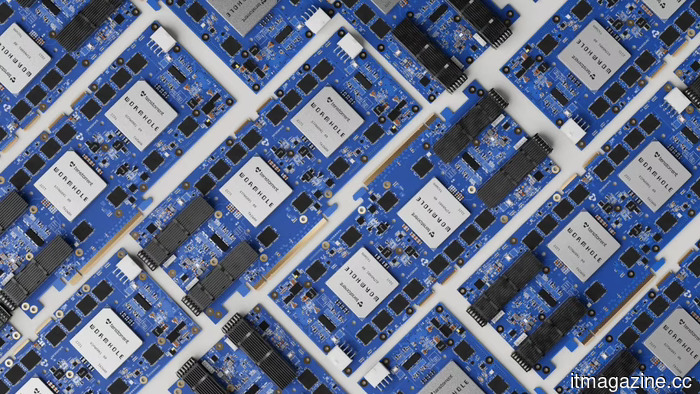 Intel and Qualcomm are eyeing Tenstorrent as NVIDIA's rival trade comes to fruition.
Tenstorrent, the RISC-V AI chip startup led by Jim Keller, has engaged in preliminary discussions regarding a potential acquisition with Intel and Qualcomm, according to Bloomberg.
Intel and Qualcomm are eyeing Tenstorrent as NVIDIA's rival trade comes to fruition.
Tenstorrent, the RISC-V AI chip startup led by Jim Keller, has engaged in preliminary discussions regarding a potential acquisition with Intel and Qualcomm, according to Bloomberg.
 Revopoint POP 4 is now available on Kickstarter: the first AI-driven 3D scanner featuring photorealistic 3D Gaussian Splatting export.
Promoted as the first high-precision and versatile 3D scanner powered by AI, the POP 4 features real-time AI segmentation and 3D Gaussian Splatting on a hybrid blue-laser-and-infrared platform. As the latest and most sophisticated addition to the POP series, the POP 4 is designed to accommodate a range of tasks, from complex geometries to larger objects, including black and [...]
Revopoint POP 4 is now available on Kickstarter: the first AI-driven 3D scanner featuring photorealistic 3D Gaussian Splatting export.
Promoted as the first high-precision and versatile 3D scanner powered by AI, the POP 4 features real-time AI segmentation and 3D Gaussian Splatting on a hybrid blue-laser-and-infrared platform. As the latest and most sophisticated addition to the POP series, the POP 4 is designed to accommodate a range of tasks, from complex geometries to larger objects, including black and [...]
 Meta transitions 7,000 employees into AI positions during the same week it announces a 10% workforce reduction.
According to an internal memo from Chief People Officer Janelle Gale that was reviewed by Bloomberg, Meta is reallocating 7,000 employees to roles centered on AI in advance of a 10% reduction in its workforce later this week.
Meta transitions 7,000 employees into AI positions during the same week it announces a 10% workforce reduction.
According to an internal memo from Chief People Officer Janelle Gale that was reviewed by Bloomberg, Meta is reallocating 7,000 employees to roles centered on AI in advance of a 10% reduction in its workforce later this week.
 Mistral acquires Emmi AI from Vienna to incorporate physics into its industrial offering.
Mistral AI has purchased the Vienna-based physics-AI startup Emmi for an undisclosed amount, focusing on manufacturers in the aerospace, automotive, and semiconductor sectors. This marks Mistral's second acquisition in 2026, following Koyeb.
Mistral acquires Emmi AI from Vienna to incorporate physics into its industrial offering.
Mistral AI has purchased the Vienna-based physics-AI startup Emmi for an undisclosed amount, focusing on manufacturers in the aerospace, automotive, and semiconductor sectors. This marks Mistral's second acquisition in 2026, following Koyeb.
Intel and Qualcomm are focusing on Tenstorrent as the alternative to NVIDIA as the market shifts.
According to Bloomberg, Tenstorrent, the RISC-V AI chip startup led by Jim Keller, has engaged in initial takeover discussions with Intel and Qualcomm.