
Meta transitions 7,000 employees into AI positions during the same week it announces a 10% workforce reduction.
In her memo on Monday, Chief People Officer Janelle Gale outlined a new organizational structure featuring ‘smaller teams’ and a ‘flatter’ hierarchy centered around newly formed AI groups for agents, applications, and infrastructure. Layoffs are expected to occur later this week.
The narrative at Meta continues with job cuts and “reassignments.” According to an internal memo reviewed by Bloomberg, Meta Platforms is reallocating 7,000 positions to focus on artificial intelligence as part of a major corporate restructuring.
These reassessments come ahead of reported staff reductions targeting 10% of the workforce, which is set to take place later this week. The memo from Janelle Gale framed this restructuring in terms of a ‘flatter’ organization with ‘smaller teams’.
This transformation establishes multiple new groups centered on AI products, including agents and apps. However, Meta has not publicly clarified how these 7,000 reassigned employees fit into these categories or how the AI-product reassignment correlates with the impending layoffs.
The timing of these announcements, with redeployment occurring first, shapes the overall move: employees with institutional knowledge are transitioning into AI roles while another group of workers is being let go.
This restructuring is taking place against a backdrop that has been evident for the past three quarters, with Meta’s projected capital expenditure for Q1 2026 rising to $145 billion. In the same quarter, the number of daily active users also dropped for the first time.
Mark Zuckerberg indicated on the earnings call that spending on AI infrastructure is the company’s primary operational focus, while the restructuring of personnel is a secondary aspect of this strategy.
The 8,000-job reduction confirmed by Meta in late April represents the visible cost, while the redeployment of 7,000 employees aims to ensure that there is an AI-aligned workforce to support this capital expenditure.
This positioning within the broader tech labor cycle is significant. Klarna serves as a prominent European example of a similar strategy, pausing hiring by claiming that AI enables the company to achieve more with fewer employees. Meta’s approach reflects a further progression along this trend.
The company isn’t simply hiring fewer new employees; it’s reallocating existing staff to focus on AI, based on the assumption that those familiar with the codebase are best suited to develop applications, agents, and infrastructure.
The political and reputational implications are more pronounced than the operational ones. Transferring 7,000 employees to AI roles while also implementing a 10% workforce reduction presents an optics challenge for Meta, which has historically conducted layoffs alongside continued hiring in specific areas.
The April 2026 announcement was the first instance of Meta framing the cuts as part of a broader initiative for efficiency, which today’s redeployment makes tangible.
However, the company has not clarified the functional composition of the workers being reassigned compared to those being laid off, nor has it indicated whether the redeployment is a singular event or the start of ongoing reorganization.
Janelle Gale's memo did not provide details on when the new structure would take effect. Reporting from Bloomberg suggests that layoffs are expected this week, potentially aligning the conclusion of the current organizational structure with the initiation of the new AI-focused framework.
Meta did not respond to requests for comments beyond the information in the memo.
What remains unresolved is the inquiry from several Meta analysts during the spring earnings cycle regarding whether the company’s commitment to AI spending ($145 billion in Q1 capital expenditure and increasing) aligns with the productivity metrics supporting a 10% workforce reduction.
Recent actions in Meta’s share price over the past three weeks have not offered a clear interpretation in either direction. The initial releases of AI products under the new organizational structure will serve as the first assessment of whether the redeployment results in deliverable output within the timeframe implied by Meta’s capital expenditure commitments.
Other articles
 Apple's iOS 27 may introduce AI writing features, an upgraded Siri, and personalized wallpapers.
Apple's iOS 27 could bring in AI writing features, more advanced Siri connections, natural-language shortcuts, and AI-created wallpapers as the company enhances its AI ecosystem.
Apple's iOS 27 may introduce AI writing features, an upgraded Siri, and personalized wallpapers.
Apple's iOS 27 could bring in AI writing features, more advanced Siri connections, natural-language shortcuts, and AI-created wallpapers as the company enhances its AI ecosystem.
 The Samsung Galaxy Z Fold 8 might finally address the most significant issue with foldable devices.
A recent leak regarding the Galaxy Z Fold 8 indicates that Samsung might enhance foldable battery life while also offering slimmer designs and improved camera features.
The Samsung Galaxy Z Fold 8 might finally address the most significant issue with foldable devices.
A recent leak regarding the Galaxy Z Fold 8 indicates that Samsung might enhance foldable battery life while also offering slimmer designs and improved camera features.
 Analog Devices approaches a $1.5 billion cash agreement for Empower Semiconductor's AI power chips.
Analog Devices is currently in advanced negotiations to purchase AI power chip manufacturer Empower Semiconductor for $1.5 billion in cash. The announcement of the deal could come as soon as Tuesday.
Analog Devices approaches a $1.5 billion cash agreement for Empower Semiconductor's AI power chips.
Analog Devices is currently in advanced negotiations to purchase AI power chip manufacturer Empower Semiconductor for $1.5 billion in cash. The announcement of the deal could come as soon as Tuesday.
 Mistral acquires Emmi AI from Vienna to incorporate physics into its industrial offering.
Mistral AI has purchased the Vienna-based physics-AI startup Emmi for an undisclosed amount, focusing on manufacturers in the aerospace, automotive, and semiconductor sectors. This marks Mistral's second acquisition in 2026, following Koyeb.
Mistral acquires Emmi AI from Vienna to incorporate physics into its industrial offering.
Mistral AI has purchased the Vienna-based physics-AI startup Emmi for an undisclosed amount, focusing on manufacturers in the aerospace, automotive, and semiconductor sectors. This marks Mistral's second acquisition in 2026, following Koyeb.
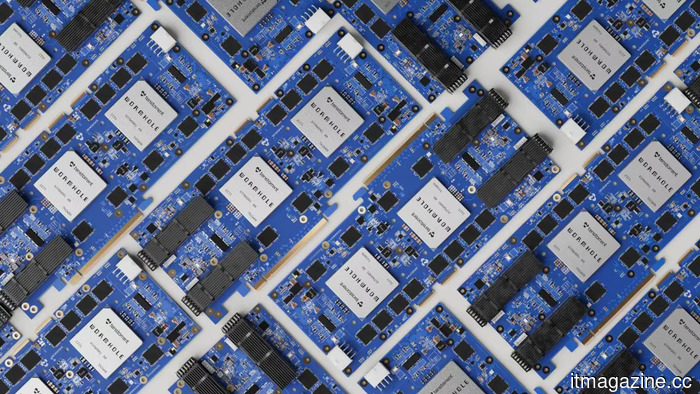 Intel and Qualcomm are eyeing Tenstorrent as an alternative to NVIDIA as the market evolves.
According to Bloomberg, Tenstorrent, the AI chip startup founded by Jim Keller that focuses on RISC-V, has engaged in preliminary discussions about a potential acquisition with Intel and Qualcomm.
Intel and Qualcomm are eyeing Tenstorrent as an alternative to NVIDIA as the market evolves.
According to Bloomberg, Tenstorrent, the AI chip startup founded by Jim Keller that focuses on RISC-V, has engaged in preliminary discussions about a potential acquisition with Intel and Qualcomm.
 The iGarden Pool Cleaner M1-AI Series is effortlessly elevating modern outdoor living to a level of luxury.
Having a pool might seem glamorous, but the ongoing maintenance can rapidly turn into a demanding task that disrupts weekend leisure. The iGarden Pool Cleaner M1-AI Series seeks to alleviate this issue with its AI-driven cleaning, adaptive suction, and smart navigation, all intended to make regular pool upkeep a much easier, hands-free process.
The iGarden Pool Cleaner M1-AI Series is effortlessly elevating modern outdoor living to a level of luxury.
Having a pool might seem glamorous, but the ongoing maintenance can rapidly turn into a demanding task that disrupts weekend leisure. The iGarden Pool Cleaner M1-AI Series seeks to alleviate this issue with its AI-driven cleaning, adaptive suction, and smart navigation, all intended to make regular pool upkeep a much easier, hands-free process.
Meta transitions 7,000 employees into AI positions during the same week it announces a 10% workforce reduction.
According to an internal memo from Chief People Officer Janelle Gale that was reviewed by Bloomberg, Meta is reallocating 7,000 employees to roles centered on AI in advance of a 10% reduction in its workforce later this week.