

Oh, shall we? In Russia, they released the "Shalyapin" acoustic system based on the "Russian bass."
A fresh perspective has emerged in the country regarding what should play in a car. The brand "Ural" has introduced the AK-3 "Shalyapin" acoustic system. The main feature is the so-called "Russian sound," which the developers have separated from merely high-quality music and tied to cultural tradition. It is rumored that now in any "Granta," one will be able to hear not just "boom-boom," but the entire depth of the national spirit.
Cars age, but music remains
According to "Autostat," Russians are not in a hurry to part with their iron horses. The average ownership period for a car has crawled up to 7.5 years, and almost 70% of the entire vehicle fleet consists of cars that are already over ten years old. There is no point in waiting for a brand-new crossover, so people are tinkering with what they have: applying sound insulation, changing radios, and, of course, trying to improve the sound.
By the way, factory acoustics in cars older than ten are often perceived merely as a source of sound, nothing more. Music seems to play, but there is usually no feeling that someone alive is singing inside the car. It sounds flat, boring, and is not at all enjoyable to listen to in traffic.
The AK-3 "Shalyapin" was created as a response to this longing for volume. The core concept is the idea of the Russian bass as a foundation. The name Fyodor Ivanovich was chosen not just for aesthetics on the box, but as a symbol of power, volume, and that very charisma that breaks through any door cards.
What "Russian sound" means according to the engineers
The company explains that this is not about deafening loudness or pressure on the ears. It is about a dense low-frequency cushion, a lively midrange, and clear vocals. Considering that speakers are usually hidden in car doors and directed who knows where, the acoustics must be able to sound despite the circumstances. Culturally, this is a sound without ostentatious hysteria, but with inner strength and scale.
The bass here is not meant to make the neighbor at the traffic light lose their mirror. The rich bass, as the developers assert, is the foundation of sound perception as a whole. Its absence is what makes ordinary systems flat and unexpressive.
The AK-3 "Shalyapin" consists of coaxial speakers with a built-in tweeter, which can be installed instead of the factory ones without any special fuss.
"When we say 'Russian sound,' we primarily mean bass. Not crude loudness, not pressure for the sake of pressure, but depth, support, and overtones. Russian bass was born not only on stage—it grew from the temple, from the voice of the deacon, from the ringing of bells, from that tradition where sound does not scream but carries space. For us, the AK-3 'Shalyapin' is an attempt to translate this voice of Russia into the language of modern mass technology," says brand president Yuri Loginov.
Well, now owners of old foreign cars and new products from the domestic automotive industry have a chance to replace their usual tweeters with something that references bell ringing. Whether the voice of the deacon will truly resonate there or just a decent bass will be revealed by tests. But the choice between "just music" and "cultural code in the doors" seems at least unusual.
Technical specifications:
Installation depth 70 mm
Mounting hole diameter 144 mm
Fastening distance 155 mm
Height (overall) 75 mm
Magnetic system diameter 90 mm
Frequency range 40-20500 Hz
Maximum power 210 W
Sensitivity 91 dB
External diameter 165 mm
Nominal power 100 W
Voice coil 1 inch
Additionally
Nominal impedance, 4 Ohm
Size 6.5 inches (16.5 cm)
Other articles
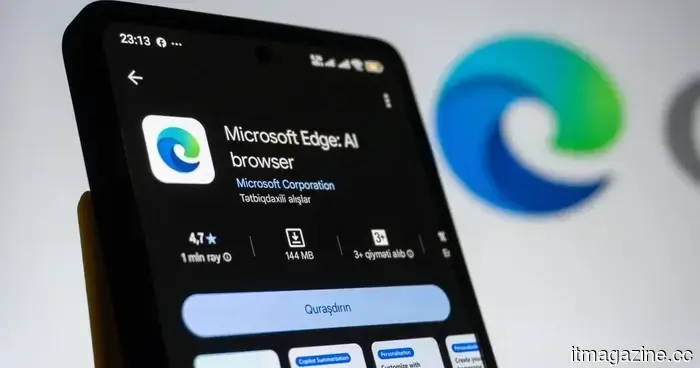 The mobile Edge browser receives a significant update, making it a strong contender against Chrome.
Microsoft Edge is introducing Copilot tab reasoning, Journeys, Voice, and Vision to mobile devices, providing smartphone users with a compelling reason to try it out ahead of Chrome's Gemini upgrade.
The mobile Edge browser receives a significant update, making it a strong contender against Chrome.
Microsoft Edge is introducing Copilot tab reasoning, Journeys, Voice, and Vision to mobile devices, providing smartphone users with a compelling reason to try it out ahead of Chrome's Gemini upgrade.
 Oh, shall we? In Russia, they released the "Shalyapin" acoustic system based on the "Russian bass."
A fresh perspective on what should be played in cars has emerged in the country. The brand "Ural" has introduced the AK-3 "Shalyapin" acoustic system. The main feature is the so-called "Russian sound," which the developers have separated from just quality music and tied to cultural tradition.
Oh, shall we? In Russia, they released the "Shalyapin" acoustic system based on the "Russian bass."
A fresh perspective on what should be played in cars has emerged in the country. The brand "Ural" has introduced the AK-3 "Shalyapin" acoustic system. The main feature is the so-called "Russian sound," which the developers have separated from just quality music and tied to cultural tradition.
 The mobile Edge browser has received a significant upgrade that makes it a strong competitor against Chrome.
Microsoft Edge is introducing features like Copilot tab reasoning, Journeys, Voice, and Vision for mobile, offering smartphone users a genuine incentive to give it a try before the launch of Chrome's Gemini upgrade.
The mobile Edge browser has received a significant upgrade that makes it a strong competitor against Chrome.
Microsoft Edge is introducing features like Copilot tab reasoning, Journeys, Voice, and Vision for mobile, offering smartphone users a genuine incentive to give it a try before the launch of Chrome's Gemini upgrade.
 Meta will permit third-party applications for Ray-Ban Display glasses. You need to keep your focus on digital reality.
Meta is allowing third-party developers to access the Ray-Ban Display glasses, which may enhance the practicality of smart glasses in your everyday activities.
Meta will permit third-party applications for Ray-Ban Display glasses. You need to keep your focus on digital reality.
Meta is allowing third-party developers to access the Ray-Ban Display glasses, which may enhance the practicality of smart glasses in your everyday activities.
 OpenAI is introducing the powerful Codex tool to the ChatGPT application on your mobile device.
OpenAI has integrated its Codex coding agent into the ChatGPT mobile application for both iOS and Android, enabling users to handle coding tasks remotely from their smartphones.
OpenAI is introducing the powerful Codex tool to the ChatGPT application on your mobile device.
OpenAI has integrated its Codex coding agent into the ChatGPT mobile application for both iOS and Android, enabling users to handle coding tasks remotely from their smartphones.
 Windows 11 will take care of its own driver issues so you won't have to worry about it.
Microsoft's new Cloud-Initiated Driver Recovery feature automatically reverts malfunctioning drivers sent via Windows Update, without the need for manual corrections or involvement from hardware partners.
Windows 11 will take care of its own driver issues so you won't have to worry about it.
Microsoft's new Cloud-Initiated Driver Recovery feature automatically reverts malfunctioning drivers sent via Windows Update, without the need for manual corrections or involvement from hardware partners.
Oh, shall we? In Russia, they released the "Shalyapin" acoustic system based on the "Russian bass."
A fresh perspective on what should play in cars has emerged in the country. The brand "Ural" has introduced the AK-3 "Shalyapin" acoustic system. The main feature is the so-called "Russian sound," which the developers have separated from just high-quality music and tied to cultural tradition.