
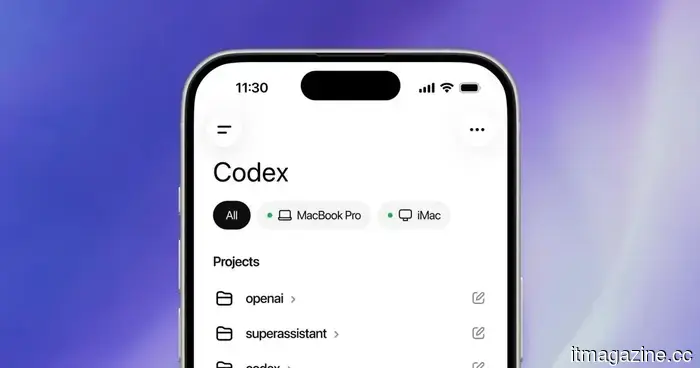
OpenAI is introducing the powerful Codex tool to the ChatGPT application on your mobile device.
The ChatGPT mobile application now includes Codex, allowing you to handle coding tasks from anywhere.
If you have ever wished for Codex to help you debug and manage pull requests while you enjoy coffee or travel, OpenAI has made that a reality. The AI-driven coding assistant, Codex, is now accessible via the ChatGPT mobile app for both iOS and Android.
This feature is currently being rolled out in preview mode for all subscription plans, including Free and Go, across all supported regions. For the moment, mobile compatibility is only available with the macOS Codex app, while Windows support will be introduced shortly.
What functionalities does Codex provide from your phone?
The mobile version is not designed for creating full applications on a small touchscreen. Instead, think of it as a remote control for AI-driven coding sessions that are already active on your computer.
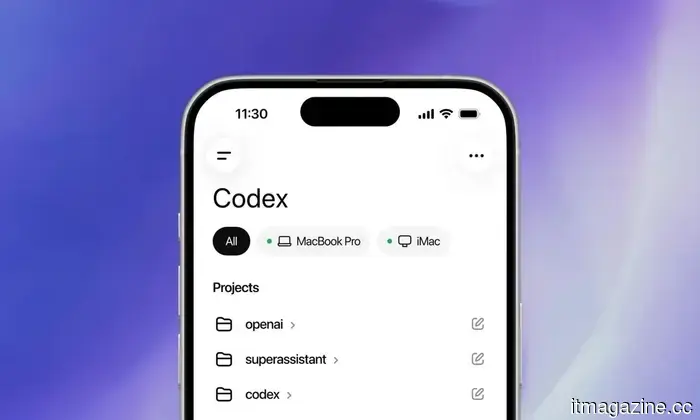
When you link your phone to any device running Codex—whether that’s your laptop, a dedicated Mac mini, or a remote development environment—the app retrieves the live status from that setup.
From this point, you can assess active threads, approve commands, switch between models, view terminal output, check test results, and examine diffs, all without needing to be at your desk.
Your files, credentials, and local configurations remain on the device performing the tasks, while real-time updates are sent to your phone as Codex progresses.
OpenAI employs a secure relay layer to ensure your trusted devices are accessible across platforms without being exposed to the public internet.
OpenAI clearly views Codex as significant.
The company has been integrating Codex into its products, with plans to merge ChatGPT, Codex, and its Atlas browser into a single, larger AI “superapp.”
Recently, OpenAI incorporated Codex into Chrome, allowing its coding assistant to function directly within the browser. Additionally, it unveiled unique “Codex Pets” that display live updates while AI coding tasks are being processed in the background.
The competition is intensifying, especially with rivals like Anthropic’s Claude Code, which added a remote monitoring feature back in February. OpenAI is making its own advancements and clearly aims to keep pace.
Manisha Priyadarshini is a technology and entertainment journalist with over nine years of editorial experience.
A new ChatGPT privacy lawsuit alleges that OpenAI shared user conversations with Google and Meta.
A class action lawsuit claims that OpenAI allowed Google and Meta tracking tools to collect sensitive user data without appropriate consent. Filed in California, the lawsuit, reported by Futurism, contends that data associated with ChatGPT users—including chat queries, emails, and user IDs—was transmitted through tools such as Meta Pixel and Google Analytics. The case accuses the organization of violating California privacy laws and federal wiretap regulations.
Dell has broadened its AI PC offerings with the introduction of the new slim Dell 14s and 16s laptops.
Your potential new Dell laptop could have all-day battery life without needing a charge. Dell has launched the Dell 14S and Dell 16S laptops, expanding its line of AI-centric Copilot+ PCs with more streamlined designs, upgraded Intel processors, and enhanced battery performance. The company is marketing both laptops as high-end productivity devices that integrate AI capabilities, portability, and multimedia functions within a sleeker profile.
These new laptops are equipped with Intel Core Ultra Series 3 processors, which can go up to the Intel Core Ultra 9 386H chipset. Dell states that both systems feature on-device AI acceleration, permitting up to 50 TOPS NPU performance, enabling AI tasks to be performed locally without depending solely on cloud processing. AMD Ryzen AI 400 Series variants are also anticipated to launch later this month.
Intel appears to have begun producing chips for Apple, though not of the most advanced variety.
The anticipated Apple-Intel chip agreement seems to be occurring, with some significant caveats that the sensational headlines have largely overlooked. Ming-Chi Kuo reports that Apple has initiated the production of processors for entry-level iPhones, iPads, and Macs at Intel, using its 18A-P process node with Foveros packaging. These are not the A-series chips found in the iPhone Pro or the M-series silicon used in MacBook Pro. Rather, they consist of legacy and mid-range products—the reliable workhorses that are produced in large volumes but do not carry the same prestige. The order composition is approximately 80% iPhone, which closely aligns with Apple's device sales distribution. This aspect is more significant than it might initially seem.





Other articles
 Federal judge delays decision on Anthropic's $1.5 billion author settlement.
Judge Araceli Martínez-Olguín on Thursday refused to give final approval to Anthropic's $1.5 billion settlement with the authors, requesting additional information regarding attorney fees and payments to the lead plaintiff.
Federal judge delays decision on Anthropic's $1.5 billion author settlement.
Judge Araceli Martínez-Olguín on Thursday refused to give final approval to Anthropic's $1.5 billion settlement with the authors, requesting additional information regarding attorney fees and payments to the lead plaintiff.
 Razer's latest Blade 18 features the Arrow Lake update and has a starting price of $3,999.99.
Razer's Blade 18 for 2026 features Intel's Core Ultra 9 290HX Plus, a dual-mode display capable of 440Hz or 240Hz at 4K resolution, and offers up to an RTX 5090 with 24GB GDDR7.
Razer's latest Blade 18 features the Arrow Lake update and has a starting price of $3,999.99.
Razer's Blade 18 for 2026 features Intel's Core Ultra 9 290HX Plus, a dual-mode display capable of 440Hz or 240Hz at 4K resolution, and offers up to an RTX 5090 with 24GB GDDR7.
 Your Android device can now transfer files to any iPhone by utilizing a Quick Share QR code.
Google is introducing a new QR code sharing feature in Quick Share, enabling Android users to transfer files to iPhones without the need for an additional app.
Your Android device can now transfer files to any iPhone by utilizing a Quick Share QR code.
Google is introducing a new QR code sharing feature in Quick Share, enabling Android users to transfer files to iPhones without the need for an additional app.
 Forget about smart glasses; these earbuds can see, hear, and remember everything on your behalf.
AI wearables might be taking a distinct path. These emerging smart earbuds are designed to see, hear, and even retain information for you — all without requiring an additional screen to be in front of you.
Forget about smart glasses; these earbuds can see, hear, and remember everything on your behalf.
AI wearables might be taking a distinct path. These emerging smart earbuds are designed to see, hear, and even retain information for you — all without requiring an additional screen to be in front of you.
 Netflix has established its own AI studio, and AI-generated content will soon be appearing in your feed, regardless of your preference.
Netflix has been quietly establishing an AI animation studio named INKubator to create animated shorts and specials utilizing generative AI technologies.
Netflix has established its own AI studio, and AI-generated content will soon be appearing in your feed, regardless of your preference.
Netflix has been quietly establishing an AI animation studio named INKubator to create animated shorts and specials utilizing generative AI technologies.
 Federal judge delays approval of Anthropic's $1.5 billion author settlement.
On Thursday, Judge Araceli Martínez-Olguín refused to give final approval to Anthropic's $1.5 billion settlement with the authors, requesting additional information regarding attorney fees and payments to the lead plaintiff.
Federal judge delays approval of Anthropic's $1.5 billion author settlement.
On Thursday, Judge Araceli Martínez-Olguín refused to give final approval to Anthropic's $1.5 billion settlement with the authors, requesting additional information regarding attorney fees and payments to the lead plaintiff.
OpenAI is introducing the powerful Codex tool to the ChatGPT application on your mobile device.
OpenAI has integrated its Codex coding agent into the ChatGPT mobile application for both iOS and Android, enabling users to handle coding tasks remotely from their smartphones.