
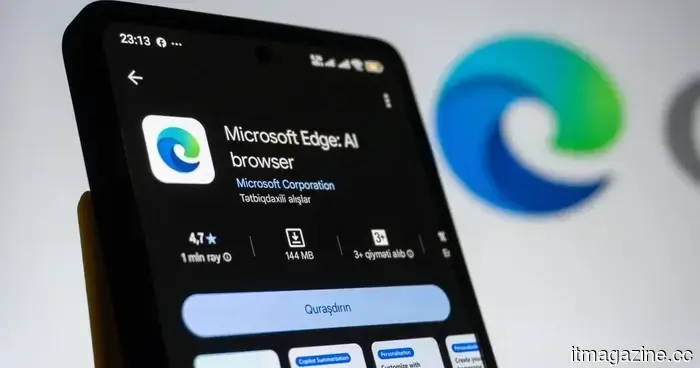
The mobile Edge browser receives a significant update, making it a strong contender against Chrome.
Edge mobile becomes more advanced just prior to Chrome’s significant Gemini update.
Chrome remains the preferred browser for numerous smartphone users, yet Microsoft’s latest Edge update provides a compelling reason to explore alternatives.
Microsoft has introduced a significant Copilot update for both Edge desktop and mobile. This release occurs before Google’s Gemini-enhanced Chrome upgrade for Android, anticipated in June, presenting Edge with an opportunity to differentiate itself on mobile devices ahead of Chrome’s upcoming AI innovations.
Alongside the mobile update, Edge desktop is also receiving enhancements where Copilot can assist with open tabs and browsing history. However, the mobile rollout may prove more beneficial on a daily basis due to the challenges of managing multiple tabs on a smaller screen.
What are the major new Edge mobile features?
The most advantageous upgrade is Copilot’s capability to analyze open tabs on mobile. This allows users to request Edge to compare information from various pages instead of having to switch manually between tabs.
This feature could be valuable for routine activities like planning trips, comparing smartphones, exploring dining options, researching purchases, or understanding several articles. I tested the feature, and it was intuitive from the start. Edge enables users to select which tabs Copilot should reference or type @all to encompass every open tab for inquiries, comparisons, or planning.
Another helpful feature is Journeys, now being introduced to the Edge mobile app after its desktop availability. It organizes browsing history into topic-based cards with summaries and suggested actions, enabling users to pick up incomplete searches without sifting through their history or reopening arbitrary tabs. For those who start a plan on their phone and then lose track of it, this could be one of the more practical enhancements.
Should you consider trying Edge mobile before Chrome’s Gemini update?
Voice and Vision features are also being added to mobile, allowing users to verbally describe what they see on the screen. The new tab page has been revamped as well, merging chat, search, and browsing into a more streamlined interface.
While Chrome continues to be the default browser for most Android users, Edge now offers something that Chrome has yet to replicate on mobile. Its Copilot features are already being rolled out, while Chrome’s significant Gemini update is anticipated next month. After experiencing the new Edge functionalities, I am genuinely considering it as my primary mobile browser.
I've accumulated around four years of experience, primarily focusing on gaming, PC hardware, and smartphones. In my spare time, I enjoy…
Ultra-thin transparent solar cells offer the promise of invisible charging for wearables, vehicles, and homes.
Your vehicle windows and smart glasses may eventually be able to harness sunlight. Researchers at Nanyang Technological University in Singapore have created ultrathin transparent perovskite solar cells that are approximately 10,000 times thinner than a human hair and about 50 times thinner than traditional perovskite solar cells. The research team, led by Associate Professor Annalisa Bruno, shared their findings in ACS Energy Letters (via TechXplore).
Apple aims to introduce AI agents on the App Store following issues with Siri. One challenge revolves around finances, as Apple is hesitant to rule out future charges. The other concerns controlling AI agents, which Apple is struggling to navigate. WWDC needs to address both concerns.
Apple is grappling with issues surrounding Siri that extend beyond the virtual assistant itself. As WWDC 2026 approaches, reports indicate that the company is actively seeking developers to integrate their applications with a revamped Siri set to launch with iOS 27. The core technology behind the new Siri, App Intents, is an API that allows Siri to perform actions within third-party apps without needing to open them first, which is notably advantageous. However, major developers are hesitant to adopt it, not due to difficulties, but because Apple has left the possibility of charging for it in the future open.
Research indicates that AI nudges can significantly enhance EV battery life by 23%.
Finding the right balance between fast charging and prolonged battery lifespan has been a perennial challenge for EV battery technology. If charging occurs too rapidly, it depletes the battery more quickly; if it’s too slow, users are dissatisfied. Researchers Meng Yuan from Victoria University of Wellington and Changfu Zou from Chalmers University of Technology in Sweden may have solved this ongoing challenge through an AI strategy called deep reinforcement learning, with promising results.



Other articles
 Your Android device can now transfer files to any iPhone by using a Quick Share QR code.
Google is introducing a new QR code sharing capability in Quick Share, enabling Android users to send files to iPhones without requiring any additional applications.
Your Android device can now transfer files to any iPhone by using a Quick Share QR code.
Google is introducing a new QR code sharing capability in Quick Share, enabling Android users to send files to iPhones without requiring any additional applications.
 Netflix has established its own AI studio, and AI-generated content will soon be appearing in your feed, regardless of your preference.
Netflix has been quietly establishing an AI animation studio named INKubator to create animated shorts and specials utilizing generative AI technologies.
Netflix has established its own AI studio, and AI-generated content will soon be appearing in your feed, regardless of your preference.
Netflix has been quietly establishing an AI animation studio named INKubator to create animated shorts and specials utilizing generative AI technologies.
 Samsung proposes discussions; the union responds with June, following the strike.
On Friday, Samsung proposed unconditional negotiations with the union. The NSEU agreed on June 7, just three days following the conclusion of its 18-day strike. Shares dropped by as much as 7.6%.
Samsung proposes discussions; the union responds with June, following the strike.
On Friday, Samsung proposed unconditional negotiations with the union. The NSEU agreed on June 7, just three days following the conclusion of its 18-day strike. Shares dropped by as much as 7.6%.
 Oh, shall we? In Russia, they released the "Shalyapin" acoustic system based on the "Russian bass."
A fresh perspective on what should play in cars has emerged in the country. The brand "Ural" has introduced the AK-3 "Shalyapin" acoustic system. The main feature is the so-called "Russian sound," which the developers have separated from just high-quality music and tied to cultural tradition.
Oh, shall we? In Russia, they released the "Shalyapin" acoustic system based on the "Russian bass."
A fresh perspective on what should play in cars has emerged in the country. The brand "Ural" has introduced the AK-3 "Shalyapin" acoustic system. The main feature is the so-called "Russian sound," which the developers have separated from just high-quality music and tied to cultural tradition.
 Multiverse secures $70 million at a $2.1 billion valuation to promote its AI adoption strategy throughout Europe.
Multiverse secured $70 million in a funding round led by Schroders Capital, achieving a valuation of $2.1 billion. The company noted a year-over-year revenue growth of 50%, highlighted its acquisition of StackFuel in January, and expressed its goal to establish itself as Europe's AI adoption platform.
Multiverse secures $70 million at a $2.1 billion valuation to promote its AI adoption strategy throughout Europe.
Multiverse secured $70 million in a funding round led by Schroders Capital, achieving a valuation of $2.1 billion. The company noted a year-over-year revenue growth of 50%, highlighted its acquisition of StackFuel in January, and expressed its goal to establish itself as Europe's AI adoption platform.
 Bill Ackman invests in Microsoft, with details on the investment size to be revealed today.
On Friday, Bill Ackman announced that Pershing Square has acquired a new position in Microsoft following the stock's 16% decline since the beginning of the year. The 13F filing revealing the size of the stake is anticipated later in the day.
Bill Ackman invests in Microsoft, with details on the investment size to be revealed today.
On Friday, Bill Ackman announced that Pershing Square has acquired a new position in Microsoft following the stock's 16% decline since the beginning of the year. The 13F filing revealing the size of the stake is anticipated later in the day.
The mobile Edge browser receives a significant update, making it a strong contender against Chrome.
Microsoft Edge is introducing Copilot tab reasoning, Journeys, Voice, and Vision to mobile devices, providing smartphone users with a compelling reason to try it out ahead of Chrome's Gemini upgrade.