
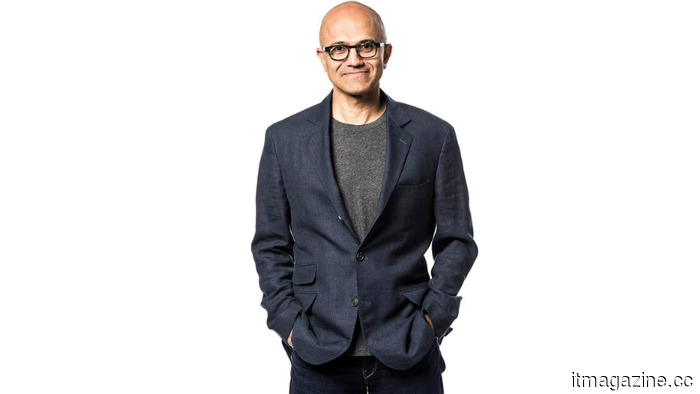
Nadella was concerned that Microsoft might end up being 'the next IBM' following the unveiling of a $92 billion return projection for OpenAI during the trial.
TL;DR: Satya Nadella testified in the Musk v. Altman trial, expressing his concern that Microsoft could become “the next IBM,” indicating that the $13 billion investment in OpenAI was more about survival than a commitment to a nonprofit mission, with a projected return of $92 billion.
On Monday, Satya Nadella informed a federal jury of his worries that Microsoft might turn into “the next IBM” as OpenAI evolved into the next Microsoft. This revelation, derived from an internal email from April 2022 introduced by Elon Musk’s lead attorney, highlights the strategic fears that motivated the largest corporate investment in AI ever. Microsoft's $13 billion investment in OpenAI stemmed not from a belief in the nonprofit's mission for safe AI development, but from a conviction that Microsoft could become irrelevant without it.
A memo from Microsoft president Brad Smith to the board, shared with the jury, anticipated a $92 billion return on that investment with a 20% annual increase starting in 2025. This shifts the understanding of the Microsoft-OpenAI partnership from a technological alliance to potentially the largest financial hedge in corporate history: a strategic move by the world’s leading software company to ensure its survival in the AI age.
The email’s analogy to IBM is significant. In the 1980s, IBM created the personal computer and outsourced its operating system to a small software firm in Redmond, Washington, a decision that led to Microsoft's rise and IBM's decline. Nadella indicated that a similar situation was emerging in the AI sector, with OpenAI developing core AI technology while Microsoft built the cloud infrastructure. If OpenAI became the leading platform and Microsoft just a commodity, the latter could face the same fate as IBM, which dominated enterprise hardware for three decades.
Musk’s attorneys used this email to argue that Microsoft's initial motivations were commercially driven, contradicting OpenAI's nonprofit roots. Nadella defended the partnership as beneficial for both sides, yet his email focused on survival rather than enhancing AI safety.
Smith's $92 billion projection reached the Microsoft board one month prior to the company's announcement of a $10 billion investment in OpenAI. This memo indicated a rising projected return as OpenAI's technology gained commercial significance, occurring shortly after ChatGPT was publicly launched.
The financial aspect was clear. Microsoft served as the exclusive cloud provider for OpenAI's models and had exclusive rights to resell them via Azure. The $13 billion was thus not a charitable contribution but an investment for a distribution monopoly over a key technology.
OpenAI's current valuation stands at $852 billion, with Microsoft owning 27% of the for-profit entity that arose from its conversion in October 2025, while the nonprofit foundation that was supposed to oversee it retains only 26%. The balance between mission and revenue that OpenAI's founders promised has been overtaken by financial interests.
During cross-examination, Nadella admitted he was unaware of any full-time employees at the OpenAI nonprofit before March 2026 and could not identify any grants, research, or open-source technology produced by the nonprofit. He was not informed ahead of time about the board's decision to terminate Sam Altman in November 2023 and lacked clarity on the reasons behind Altman's dismissal.
These admissions suggest a partnership in which the investor had thorough knowledge of the commercial activities but was uninformed about the nonprofit governance. Musk’s legal team aims to convince the jury that the nonprofit was merely a facade, a perspective reinforced by Nadella’s testimony, which highlights the company's commercial interests.
The trial has also seen testimony that questions the motives of all parties involved. Greg Brockman, OpenAI’s co-founder and president, disputed Musk's interpretation of the company's early days, claiming that Musk had employees work discreetly on Tesla's self-driving technology. Brockman's journals contained entries labeling the nonprofit mission as “a lie,” undercutting Musk's portrayal of the mission as sacred and OpenAI's claims of its preservation.
Former board members Helen Toner and Natasha McCauley testified about their distrust of Altman, characterizing him as secretive and sometimes deceptive. McCauley detailed concerns about Altman, including a specific incident where he inaccurately claimed that OpenAI's legal department had approved the GPT-4 Turbo launch in India without safety oversight. The reasons given for Altman's termination in November 2023 were unrelated to Musk’s lawsuit.
Musk testified in the trial's first week, claiming that OpenAI's leadership misled him into financing the organization. He reiterated that “You can’t just steal a charity,” and expressed that while he supported having a small for-profit entity to fund the nonprofit, he lost trust in Altman after learning about Microsoft’s $10 billion investment, texting Altman: “What the hell is going on? This is a bait and switch.”
When questioned about whether xAI utilized OpenAI’s models for training Grok, Musk indicated it was a common industry practice and somewhat ambiguously confirmed
Other articles
 AI voice conversations often come across as uncomfortable because assistants struggle with timing their responses.
Thinking Machines Lab is evaluating full duplex AI capable of listening and responding simultaneously, but the true assessment will be how beneficial faster voice conversations seem once individuals have the opportunity to experience them.
AI voice conversations often come across as uncomfortable because assistants struggle with timing their responses.
Thinking Machines Lab is evaluating full duplex AI capable of listening and responding simultaneously, but the true assessment will be how beneficial faster voice conversations seem once individuals have the opportunity to experience them.
 Signal Messenger aims to safeguard you against phishing through these new changes within the app.
Signal has introduced new safety features within the app to assist users in identifying and steering clear of phishing and social engineering attacks, including individuals pretending to be Signal.
Signal Messenger aims to safeguard you against phishing through these new changes within the app.
Signal has introduced new safety features within the app to assist users in identifying and steering clear of phishing and social engineering attacks, including individuals pretending to be Signal.
 6 actions Gemini Intelligence is set to take on your Android devices.
Google is introducing these Gemini features to Android, broadening their availability across applications and devices to automate daily activities, streamline browsing, and enhance your phone's helpfulness while ensuring you remain in control.
6 actions Gemini Intelligence is set to take on your Android devices.
Google is introducing these Gemini features to Android, broadening their availability across applications and devices to automate daily activities, streamline browsing, and enhance your phone's helpfulness while ensuring you remain in control.
 The release date for season 3 of The Rings of Power has been announced, and the One Ring will be making its appearance sooner than anticipated.
Prime Video has announced the release date for season 3 of Rings of Power, featuring new cast members and the introduction of the One Ring into the narrative.
The release date for season 3 of The Rings of Power has been announced, and the One Ring will be making its appearance sooner than anticipated.
Prime Video has announced the release date for season 3 of Rings of Power, featuring new cast members and the introduction of the One Ring into the narrative.
 AI voice chats often feel uncomfortable because the assistants struggle to determine when to speak.
Thinking Machines Lab is experimenting with full duplex AI that can both listen and reply simultaneously, but the true evaluation will be whether quicker voice conversations feel beneficial when people get the chance to use them.
AI voice chats often feel uncomfortable because the assistants struggle to determine when to speak.
Thinking Machines Lab is experimenting with full duplex AI that can both listen and reply simultaneously, but the true evaluation will be whether quicker voice conversations feel beneficial when people get the chance to use them.
 Google has discovered the first zero-day exploit developed by AI and has successfully prevented a planned large-scale exploitation event.
Google's GTIG discovered the first zero-day exploit created with AI and prevented a widespread exploitation incident. The report indicates that state actors are leveraging AI for vulnerability research and autonomous malware development.
Google has discovered the first zero-day exploit developed by AI and has successfully prevented a planned large-scale exploitation event.
Google's GTIG discovered the first zero-day exploit created with AI and prevented a widespread exploitation incident. The report indicates that state actors are leveraging AI for vulnerability research and autonomous malware development.
Nadella was concerned that Microsoft might end up being 'the next IBM' following the unveiling of a $92 billion return projection for OpenAI during the trial.
Microsoft CEO Satya Nadella stated during the Musk v. Altman trial that he was concerned his company might follow in IBM's footsteps. A memo from Brad Smith estimated that OpenAI's $13 billion investment could yield a $92 billion return.