
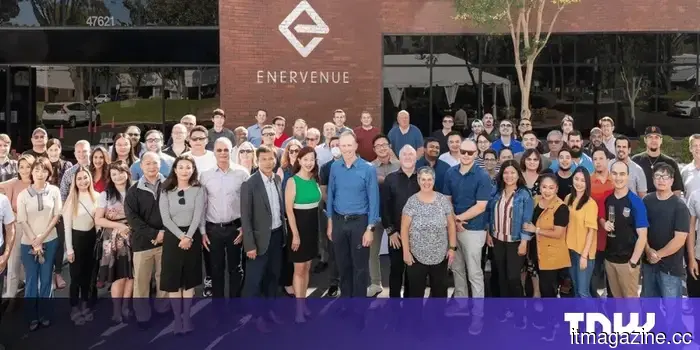
EnerVenue secures $300 million to expand the use of metal-hydrogen batteries, validated by NASA, for grid storage solutions.
For many years, nickel-hydrogen batteries have been the unsung workhorses of space, providing power to the International Space Station and the Hubble Space Telescope under extreme orbital conditions. Now, a startup from California aims to harness this same technology on Earth and has just secured considerable funding to pursue that goal.
EnerVenue has raised $300 million in a Series B extension led by Full Vision Capital, the family office of billionaire Peter Lee Ka-kit from Hong Kong. This funding round brings the company's total financing to $445 million, according to Crunchbase, and will support the scaling up of its non-lithium metal-hydrogen energy storage systems at a factory in Changzhou, China, aspiring to achieve gigawatt-scale production capacity.
The company has also appointed Henning Rath, a seasoned technology executive who previously helped to build the German renewable energy equipment company Enpal, as its new global CEO. Additionally, plans have been announced for a regional headquarters and innovation center in Hong Kong, with support from the government-backed Hong Kong Investment Corporation.
“The capital is essential for advancing research and development of our core technologies, expanding large-scale manufacturing, strengthening supply-chain resilience, and increasing our global commercial presence,” Rath stated in a statement reported by the South China Morning Post.
Founded in 2020 by Yi Cui, a professor of materials science and engineering at Stanford University, EnerVenue has focused its business on adapting nickel-hydrogen cells, a technology validated through decades of aerospace applications, for large-scale grid storage. The batteries utilize a water-based electrolyte instead of the flammable organic solvents typically found in lithium-ion systems, thereby eliminating fire hazards and enabling operation across a temperature range of -40 to 50 degrees Celsius.
The appeal lies not in raw energy density but in longevity and overall cost of ownership. While lithium-ion batteries generally degrade after a few thousand charge cycles, EnerVenue asserts that its metal-hydrogen cells can withstand tens of thousands of cycles while maintaining safety and cost-effectiveness throughout their lifespan.
This proposition has attracted interest from notable investors. Among the company's early backers is Aramco Ventures, the investment arm of Saudi Arabia’s oil giant, alongside NEOM Investment Fund, SAIC Capital, and IDG Capital, according to Crunchbase and PitchBook data. In 2021, Towngas, also known as Hong Kong and China Gas Company, secured an exclusive distribution agreement for EnerVenue’s products in mainland China. Towngas, where Lee serves as chairman, is a minority stakeholder in the company.
The investment comes at a time when the global energy storage market is facing significant pressure to move beyond lithium-ion technology. The rapid growth of AI-driven data centers, combined with the ongoing expansion of renewable energy generation, has resulted in soaring demand for reliable, long-lasting, and safe grid-scale storage solutions. EnerVenue’s nickel-hydrogen technology competes in this arena against various alternatives, including iron-air batteries from Form Energy, vanadium flow batteries from companies such as ESS Inc. and Invinity, as well as established lithium-ion providers and pumped hydro storage.
EnerVenue’s immediate growth strategy focuses on its Changzhou facility in Jiangsu province, China, where it plans to launch a 250 MWh production line by 2026, eventually targeting an annual capacity of one gigawatt-hour. Beyond manufacturing, the company aims to leverage Hong Kong as a foothold to penetrate the Asia-Pacific, Middle Eastern, and European markets, concentrating on utility-scale projects, industrial applications, and infrastructure requiring reliable, long-duration power.
Time magazine recognized EnerVenue as one of the top 10 US green technology companies in 2025, highlighting the growing interest in alternatives to lithium's supremacy. The key question remains whether the company can transition its aerospace heritage and billionaire support into a legitimate contender in grid-scale storage. The $300 million investment and the new leadership to utilize it suggest that its investors are optimistic about the prospects.
Other articles
 How to update your old Gmail username?
Thank you, Google, for finally introducing this feature.
How to update your old Gmail username?
Thank you, Google, for finally introducing this feature.
 Meta introduces AI glasses that are ready for prescriptions to integrate wearables into daily life.
Meta has introduced smart glasses powered by AI that offer prescription support, enhancing the practicality and accessibility of wearable technology for everyday use.
Meta introduces AI glasses that are ready for prescriptions to integrate wearables into daily life.
Meta has introduced smart glasses powered by AI that offer prescription support, enhancing the practicality and accessibility of wearable technology for everyday use.
 Samsung is increasing the prices of its Galaxy foldable phones domestically. Be prepared for similar changes in other markets as well.
Samsung is said to be considering price hikes for certain Galaxy foldables in its domestic market, attributed to rising component and logistics expenses, which may indicate possible price increases for older models worldwide.
Samsung is increasing the prices of its Galaxy foldable phones domestically. Be prepared for similar changes in other markets as well.
Samsung is said to be considering price hikes for certain Galaxy foldables in its domestic market, attributed to rising component and logistics expenses, which may indicate possible price increases for older models worldwide.
 The Nvidia DLSS 4.5 update featuring 6x frame generation is now available for RTX graphics cards today.
Nvidia's DLSS 4.5 update has officially launched, introducing Dynamic Multi Frame Generation along with a new 6x mode capable of producing up to five additional frames for each rendered frame on RTX 50 Series GPUs.
The Nvidia DLSS 4.5 update featuring 6x frame generation is now available for RTX graphics cards today.
Nvidia's DLSS 4.5 update has officially launched, introducing Dynamic Multi Frame Generation along with a new 6x mode capable of producing up to five additional frames for each rendered frame on RTX 50 Series GPUs.
 South Korea is relying on Russian naphtha as the semiconductor supply chain confronts a crisis in the Middle East.
South Korea is bringing in 27,000 tonnes of Russian naphtha due to the closure of the Strait of Hormuz, which is affecting the essential petrochemical supplies needed for semiconductor production throughout Asia.
South Korea is relying on Russian naphtha as the semiconductor supply chain confronts a crisis in the Middle East.
South Korea is bringing in 27,000 tonnes of Russian naphtha due to the closure of the Strait of Hormuz, which is affecting the essential petrochemical supplies needed for semiconductor production throughout Asia.
 Alexa+ can now place your food orders through Grubhub and Uber Eats with a human touch.
Alexa, you know the routine. Give me something to eat.
Alexa+ can now place your food orders through Grubhub and Uber Eats with a human touch.
Alexa, you know the routine. Give me something to eat.
EnerVenue secures $300 million to expand the use of metal-hydrogen batteries, validated by NASA, for grid storage solutions.
California-based startup EnerVenue has secured $300 million in funding, with Full Vision Capital leading the investment, to expand its nickel-hydrogen battery technology from space applications to large-scale energy storage solutions.