
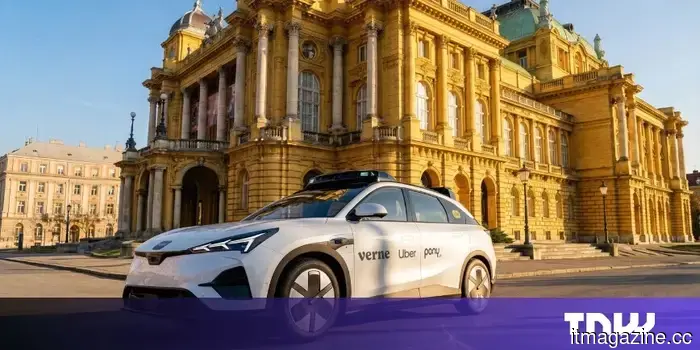
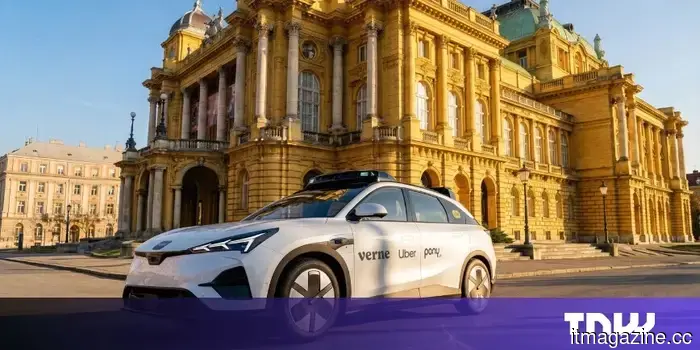
Zagreb will soon welcome Europe’s inaugural commercial robotaxi.
On-road testing in the capital of Croatia is currently in progress with Pony.ai’s Gen-7 system being utilized on the Arcfox Alpha T5, a robotaxi produced in China. Uber has plans to invest in Verne. The three organizations aim to expand to thousands of vehicles throughout Europe, but they have not disclosed a timeline for the commercial launch.
Mate Rimac established his reputation by creating electric hypercars that are priced over two million dollars and can accelerate so quickly it causes physical discomfort. His newest endeavor is a taxi.
Verne, the Croatian startup he co-founded with CEO Marko Pejkovic, is conceived based on a contrasting philosophy: a specially designed two-seat electric pod that lacks a steering wheel and pedals, offering legroom comparable to that of the back of a Rolls-Royce, aimed to be more affordable than Uber or Bolt.
That vehicle has yet to hit the public roads. However, the company made significant progress toward commercialization on Thursday by announcing a tripartite partnership with Pony.ai and Uber to establish what the companies describe as Europe’s first commercial robotaxi service, starting in Zagreb.
The partnership involves Pony.ai, the Chinese autonomous driving firm listed on NASDAQ and the HKEX, providing the technology and the vehicle, specifically its Gen-7 autonomous driving system featured on the Arcfox Alpha T5, a robotaxi developed in collaboration with the Chinese automaker BAIC.
Verne will take ownership and management of the fleet and oversee service aspects, including obtaining regulatory approvals. Uber will integrate this service into its global ride-hailing platform, which will operate alongside Verne’s own customer app. Testing with the Pony.ai vehicle has already commenced in Zagreb, although a date for the commencement of fare-charging has not been provided.
Uber also stated its intention to invest an undisclosed amount in Verne, supporting the startup’s future growth as a strategic ally. The commercial aspirations are considerable: the companies revealed plans to expand to “a fleet of thousands of robotaxis in the coming years,” moving beyond Zagreb to other European cities and various markets.
Verne has previously established agreements with 11 cities across Europe and the Middle East, prioritizing the UK and Germany following Zagreb.
Since its inception in 2019, Verne raised €100 million in a Series A round of private funding. Construction of its custom factory in Lučko, near Zagreb, started in February 2025 on a 28,500-square-metre area at VGP Park Zagreb, with operations anticipated to begin this year.
This factory is set to create up to 400 jobs and is intended to produce Verne’s own two-seat autonomous vehicles for global deployment. For its initial commercial launch, however, the service will utilize Pony.ai’s Arcfox Alpha T5 instead of Verne’s specially designed vehicle, which remains in prototype testing.
This partnership aligns with Uber’s broader strategy of creating an autonomous vehicle network through external collaborations rather than developing its own technology, a direction the company opted for after selling its self-driving division, ATG, to Aurora in 2020.
Uber has similar agreements in other markets with Momenta and WeRide. For Pony.ai, which has reportedly reached unit economics breakeven in Guangzhou and Shenzhen, according to CEO Dr. James Peng, the launch in Zagreb will represent its first commercial operation in Europe.
Additionally, the company has teamed up with Bolt for its European expansion. For Verne, the collaboration with Uber offers not only platform accessibility, a strategic investor, and credibility needed for the regulatory approvals required to transition from testing to fare-charging operations in Croatia and beyond.
Other articles
 The first trailer for the Harry Potter TV series has been released, and it feels like a replay I never requested.
HBO's Harry Potter reboot aimed to reinterpret the books, yet the initial trailer appears to closely resemble the films, prompting a straightforward doubt: If nothing is altered, what is the purpose of this?
The first trailer for the Harry Potter TV series has been released, and it feels like a replay I never requested.
HBO's Harry Potter reboot aimed to reinterpret the books, yet the initial trailer appears to closely resemble the films, prompting a straightforward doubt: If nothing is altered, what is the purpose of this?
 The first trailer for the Harry Potter TV series has been released, and it gives off a sense of a sequel that I didn't request.
HBO’s reboot of Harry Potter was intended to reinterpret the books, but the initial trailer appears to closely mirror the films, prompting a straightforward question: If nothing is different, what is the purpose of this?
The first trailer for the Harry Potter TV series has been released, and it gives off a sense of a sequel that I didn't request.
HBO’s reboot of Harry Potter was intended to reinterpret the books, but the initial trailer appears to closely mirror the films, prompting a straightforward question: If nothing is different, what is the purpose of this?
 It's not only the amount of time spent on the screen, but also the frequency with which you reach for your phone that's detrimental to your mind.
According to researchers, it's not the duration of phone use that causes mental overload, but rather the frequency of checking it.
It's not only the amount of time spent on the screen, but also the frequency with which you reach for your phone that's detrimental to your mind.
According to researchers, it's not the duration of phone use that causes mental overload, but rather the frequency of checking it.
 Theia Insights secures $8 million to develop an alternative to traditional static industry classification systems.
Theia Insights, an AI startup based in Cambridge, has secured $8 million in funding to expand its dynamic company classification platform for financial markets, with MiddleGame Ventures leading the investment.
Theia Insights secures $8 million to develop an alternative to traditional static industry classification systems.
Theia Insights, an AI startup based in Cambridge, has secured $8 million in funding to expand its dynamic company classification platform for financial markets, with MiddleGame Ventures leading the investment.
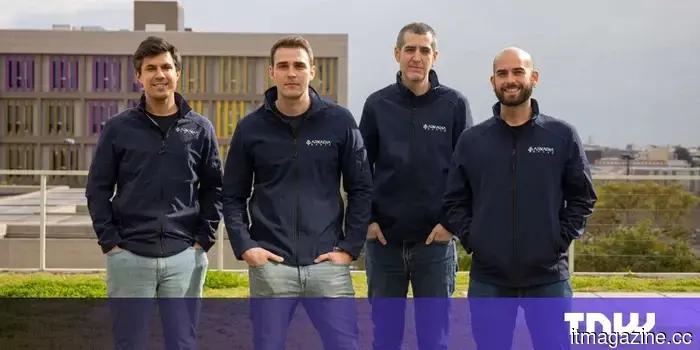 Arkadia Space secures €14.5M for eco-friendly propulsion technology.
Arkadia Space has obtained €14.5 million from the EIC Accelerator to bring its hydrogen peroxide propulsion system to market.
Arkadia Space secures €14.5M for eco-friendly propulsion technology.
Arkadia Space has obtained €14.5 million from the EIC Accelerator to bring its hydrogen peroxide propulsion system to market.
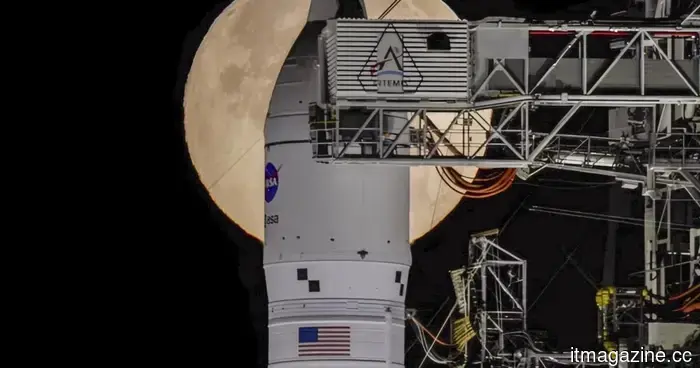 It has arrived! NASA announces the complete livestream timetable for the crewed lunar mission.
The anticipation is growing as NASA approaches the launch of four astronauts on a mission around the moon in just a few days. On Wednesday, the agency released its schedule for the final preparations and the main event, which includes a Q&A session with the astronauts this Friday, the launch taking place on Wednesday, April 1, and ongoing updates […]
It has arrived! NASA announces the complete livestream timetable for the crewed lunar mission.
The anticipation is growing as NASA approaches the launch of four astronauts on a mission around the moon in just a few days. On Wednesday, the agency released its schedule for the final preparations and the main event, which includes a Q&A session with the astronauts this Friday, the launch taking place on Wednesday, April 1, and ongoing updates […]
Zagreb will soon welcome Europe’s inaugural commercial robotaxi.
Uber, Pony.ai, and Rimac's Verne have revealed the launch of Europe’s inaugural commercial robotaxi service, beginning in Zagreb. Testing on the roads is currently in progress.