
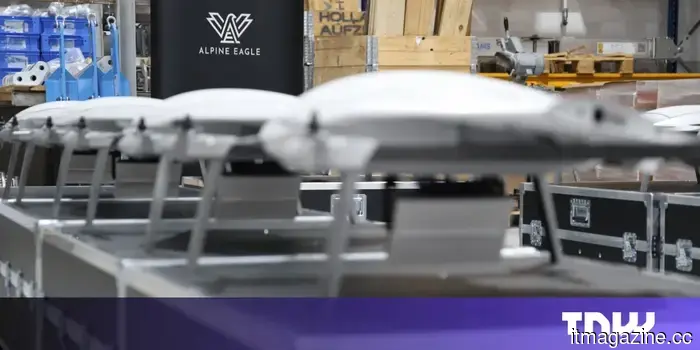
Alpine Eagle is ramping up its production of counter-drone systems.
The Munich-based startup Alpine Eagle is scaling up its airborne Sentinel system, which has been tested in Ukraine as well as with US and UK forces, and is planning to establish a 2,000-square-metre production facility while also increasing its workforce fourfold. The cost disparity characterizing modern drone warfare is already well-recognized. In April 2024, Iran launched around 300 drones and missiles at Israel, most of which were intercepted by defenders at an estimated cost exceeding $1.5 billion, while the attacking drones were produced at a vastly lower cost.
This same scenario occurs daily in Ukraine, where inexpensive first-person-view drones can overwhelm defenses that are not suited for handling high volumes. The strategic takeaway is clear: whoever possesses effective counter-drone systems that are affordable enough to neutralize low-cost drones gains a significant edge.
Alpine Eagle is focusing on addressing this issue. On Thursday, the Munich-based defense technology startup announced it would ramp up production of its Sentinel counter-UAS system as European nations intensify their efforts to improve drone defense capabilities. The company plans to open a 2,000-square-metre production facility near Munich for its home-developed interceptors and has partnered with Dutch UAV manufacturer DeltaQuad to enhance the overall Sentinel platform through industrial production capabilities within a European supply chain.
Founded in 2023 by Jan-Hendrik Boelens, a Dutch aerospace engineer with ten years of experience at Airbus Helicopters—where he was the chief engineer on international helicopter development initiatives—and who later served as CTO at electric air taxi startup Volocopter and autonomous UAV company Quantum Systems, Alpine Eagle was co-founded with Timo Breuer, a scientist with a background at Microsoft Research and the Fraunhofer Gesellschaft.
Sentinel is unique as an airborne counter-drone system, distinguishing it from most competitors that operate on land. The main system employs a mothership UAV equipped with airborne interceptors—smaller drones capable of capturing hostile targets using nets or destroying them. This is backed by an AI-enhanced radar and sensor network. Operating from an altitude allows Sentinel to avoid being obstructed by terrain that can obscure low-flying drones from ground-based radars, preventing it from becoming a stationary target.
The Sentinel-OS software platform is designed to be hardware-independent, allowing integration with both off-the-shelf and custom platforms. The company has quickly established operational credibility; the German Bundeswehr became the first customer for Sentinel in 2024. Alpine Eagle later conducted trials in Ukraine—currently the only place where counter-drone systems face sustained attacks under disrupted GPS conditions—and took part in Project Vanaheim, a counter-UAS trial with the US and UK armed forces.
Participation in the Ukraine trials was confirmed by TechCrunch in March 2025, following the company’s €10.25 million seed funding round. Since then, Alpine Eagle has reportedly added three more European customers and expanded into the UK and the Netherlands, where it is currently involved in a Dutch defense innovation program, although these customer and program claims have not been independently verified.
The seed round, which concluded in March 2025, was led by IQ Capital with contributions from HTGF, Expeditions Fund, and Sentris Capital. General Catalyst and HCVC, who had previously led Alpine Eagle’s pre-seed round, also participated again. The total funding now exceeds €10 million, as stated by the company.
“Defense ministries are increasingly seeking systems that can be rapidly delivered and scaled as operational needs rise,” said Jan-Hendrik Boelens, founder and CEO, in a statement. “The reality is that the threats facing Europe are greater than they have been in decades and drones are transforming the battlefield more swiftly than traditional defense systems can adapt.”
The broader context is well understood within European defense communities. Ground-based air defense systems created for Cold War threats, along with the missiles that intercept modern drones, are expensive per engagement. The advantage of being first to market is with those who can produce interceptors cheaply and in sufficient volume for prolonged operations. Alpine Eagle’s airborne model represents one of several competing structures being tested among allied nations; the planned 2,000-square-metre facility near Munich signals the company’s belief that it is nearing production-readiness for scaling up operations.
Other articles
 Microsoft's MAI-Image-2 ranks among the top three AI image generators.
Microsoft's MAI-Image-2 launches at #3 on Arena.ai's text-to-image leaderboard, trailing Google and OpenAI, and starts to be implemented on Copilot.
Microsoft's MAI-Image-2 ranks among the top three AI image generators.
Microsoft's MAI-Image-2 launches at #3 on Arena.ai's text-to-image leaderboard, trailing Google and OpenAI, and starts to be implemented on Copilot.
 Uber and Rivian finalize a $1.25 billion agreement for robotaxis.
Uber plans to invest as much as $1.25 billion in Rivian by 2031, aiming for a fleet of up to 50,000 autonomous R2 robotaxis in 25 cities.
Uber and Rivian finalize a $1.25 billion agreement for robotaxis.
Uber plans to invest as much as $1.25 billion in Rivian by 2031, aiming for a fleet of up to 50,000 autonomous R2 robotaxis in 25 cities.
 Your inbox serves as a revenue stream for others. It doesn’t have to be that way.
Free email could end up being more costly than you realize. We examine why investing in a paid email service might be the most prudent privacy choice you make this year.
Your inbox serves as a revenue stream for others. It doesn’t have to be that way.
Free email could end up being more costly than you realize. We examine why investing in a paid email service might be the most prudent privacy choice you make this year.
 AI analytics agents require boundaries instead of an increase in model size.
AI analytics agents require boundaries rather than larger models. Discover why managed data, common definitions, and semantic layers are more important than the size of the model.
AI analytics agents require boundaries instead of an increase in model size.
AI analytics agents require boundaries rather than larger models. Discover why managed data, common definitions, and semantic layers are more important than the size of the model.
 The German agritech company eternal.ag has secured €8 million in funding.
eternal.ag has secured €8 million to implement autonomous tomato harvesting robots that have been trained in virtual greenhouses prior to their actual deployment in the field.
The German agritech company eternal.ag has secured €8 million in funding.
eternal.ag has secured €8 million to implement autonomous tomato harvesting robots that have been trained in virtual greenhouses prior to their actual deployment in the field.
 Your inbox is a business model for someone else. It doesn't have to be that way.
Free email services can be more expensive than you realize. We explore why investing in a paid email service could be the wisest choice for your privacy this year.
Your inbox is a business model for someone else. It doesn't have to be that way.
Free email services can be more expensive than you realize. We explore why investing in a paid email service could be the wisest choice for your privacy this year.
Alpine Eagle is ramping up its production of counter-drone systems.
The Munich-based counter-drone company Alpine Eagle is expanding its production of the Sentinel by opening a new facility and partnering with DeltaQuad.