

The German agritech company eternal.ag has secured €8 million in funding.
The Cologne-based startup is employing a simulation-first strategy to train robots in virtual greenhouses prior to their deployment in actual greenhouses, striving to solve a long-standing deployment challenge that has plagued the industry for years.
The greenhouse automation market has seen a number of startups with promising concepts that ultimately falter. The engineering challenges are notably complex: harvesting crops like tomatoes or cucumbers involves dealing with fragile, irregular fruit in a humid setting where each plant varies slightly and grows differently with the seasons.
Numerous companies have introduced robots that perform well in controlled demonstrations but fail when scaled for commercial use. Bridging the gap between success in a lab setting and reliable performance in a real grower’s greenhouse operating for 22 hours a day has proven to be extremely challenging.
Renji John has encountered this issue previously. He co-founded Honest AgTech, a Dutch startup focused on creating autonomous greenhouse robots, which went bankrupt in July 2023 due to liquidity problems.
Now, he is making another attempt. Eternal.ag, the German agritech startup he co-founded with Sherry Kunjachan in 2025, announced on Thursday that it secured €8 million from Simon Capital, Oyster Bay Venture Capital, EquityPitcher Ventures, and Backbone Ventures. The company is based in Cologne and also has an office in Bengaluru.
The key technical difference this time lies in the development methodology. Eternal.ag employs simulation-first development, constructing and validating robots in virtual greenhouses through NVIDIA Isaac Sim before introducing hardware into actual environments.
This approach is claimed to shorten iteration cycles from months to days, enabling the company to test failure scenarios economically in software rather than through costly physical trials with equipment and produce.
Once the robots are in operation, every action generates data that is fed back into the system for ongoing improvement. Both the claim of operating 22 hours a day and the accelerated iteration cycles are assertions that have not been independently verified, though the foundational strategy aligns with how leading robotics firms mitigate hardware development risks.
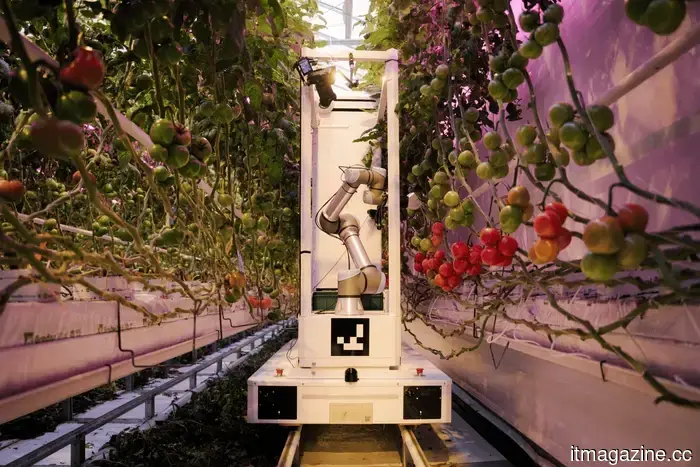
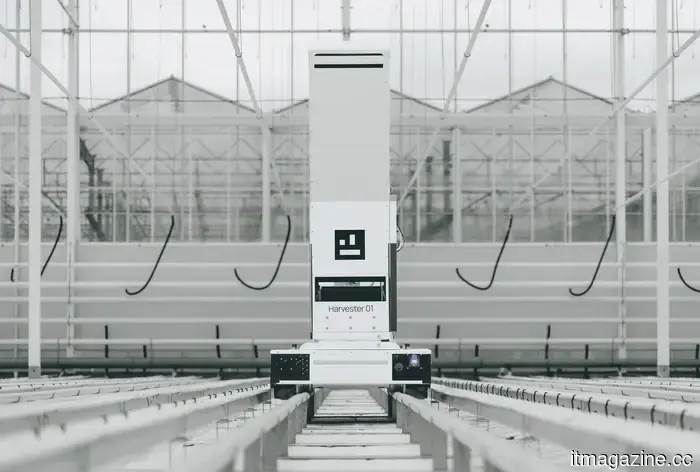
The company's inaugural commercial offering is Harvester, an autonomous robot specifically designed for tomato harvesting, which integrates into an AI-powered system that oversees cut quality and consistency of produce. The system is intended to be a modular platform that can be expanded to include additional greenhouse tasks over time. Eternal.ag aims for fully autonomous greenhouse operations by 2040, eliminating the need for human operators.
John’s background includes experience at the Boston Consulting Group focusing on technology strategy, an MBA from INSEAD, and prior work at Tata Consultancy Services. Sherry Kunjachan, the co-founder and CTO, does not have documented roles outside of what is mentioned in press materials.
The investor consortium is well-suited to the sector. Oyster Bay Venture Capital is a Hamburg-based fund in Food and AgTech, managing over €100 million in its second vehicle, backed by the European Investment Fund and KfW. This firm typically leads funding rounds with initial investments between €1 million and €5 million. Simon Capital, located in Düsseldorf, is an early-stage fund with a portfolio that includes waterdrop and Just Spices. EquityPitcher Ventures and Backbone Ventures are early-stage funds based in Switzerland and Germany, respectively.
"Greenhouse horticulture represents one of the most efficient and sustainable methods for growing fresh produce year-round," stated Niklas Leske, Principal at Simon Capital. "Labour shortages endanger the industry, and robotics stands as the only viable solution to establish a decentralized and resilient food supply chain for future generations."
Leske highlights a structural labor issue. For decades, European greenhouse growers have relied on seasonal workers from Eastern Europe and beyond. As this workforce diminishes—cited as a 30% decline since 2010 in the press release, though this number remains unverified—growers encounter real operational challenges.
Unlike outdoor farms, greenhouses operate year-round and require steady labor for physically demanding and repetitive tasks, making a compelling case for automation, despite the continuous difficulties in execution.
The €8 million funding will be directed towards speeding up product development, broadening commercial deployments throughout Europe, and expanding the platform to include additional crop types beyond tomatoes. For John, this second venture carries the lessons learned from the first failure.
The simulation-first approach, the modular design, and the gradual expansion for different crops all indicate a conscious effort to grow more cautiously and thoughtfully compared to a startup that raised pre-seed funding and attempted to expand too rapidly. Whether this disciplined strategy will succeed at a commercial scale will be revealed in the coming years.
Other articles
 Bluesky secures $100 million in Series B funding as a new CEO steps in.
Bluesky announced a $100M Series B funding round led by Bain Capital Crypto, which concluded last April, and has appointed a new CEO.
Bluesky secures $100 million in Series B funding as a new CEO steps in.
Bluesky announced a $100M Series B funding round led by Bain Capital Crypto, which concluded last April, and has appointed a new CEO.
 Alpine Eagle is increasing its production of counter-drone systems.
The Munich-based counter-drone startup Alpine Eagle is expanding its Sentinel production through a new facility and a partnership with DeltaQuad.
Alpine Eagle is increasing its production of counter-drone systems.
The Munich-based counter-drone startup Alpine Eagle is expanding its Sentinel production through a new facility and a partnership with DeltaQuad.
 Alpine Eagle is ramping up its production of counter-drone systems.
The Munich-based counter-drone company Alpine Eagle is expanding its production of the Sentinel by opening a new facility and partnering with DeltaQuad.
Alpine Eagle is ramping up its production of counter-drone systems.
The Munich-based counter-drone company Alpine Eagle is expanding its production of the Sentinel by opening a new facility and partnering with DeltaQuad.
 German agritech company eternal.ag secures €8 million in funding.
eternal.ag has secured €8M to implement autonomous tomato harvesting robots that have been trained in virtual greenhouses prior to being deployed in real-world settings.
German agritech company eternal.ag secures €8 million in funding.
eternal.ag has secured €8M to implement autonomous tomato harvesting robots that have been trained in virtual greenhouses prior to being deployed in real-world settings.
 Your inbox serves as a revenue stream for others. It doesn’t have to be that way.
Free email could end up being more costly than you realize. We examine why investing in a paid email service might be the most prudent privacy choice you make this year.
Your inbox serves as a revenue stream for others. It doesn’t have to be that way.
Free email could end up being more costly than you realize. We examine why investing in a paid email service might be the most prudent privacy choice you make this year.
 Microsoft's MAI-Image-2 ranks among the top three AI image generators.
Microsoft's MAI-Image-2 launches at #3 on Arena.ai's text-to-image leaderboard, trailing Google and OpenAI, and starts to be implemented on Copilot.
Microsoft's MAI-Image-2 ranks among the top three AI image generators.
Microsoft's MAI-Image-2 launches at #3 on Arena.ai's text-to-image leaderboard, trailing Google and OpenAI, and starts to be implemented on Copilot.
The German agritech company eternal.ag has secured €8 million in funding.
eternal.ag has secured €8 million to implement autonomous tomato harvesting robots that have been trained in virtual greenhouses prior to their actual deployment in the field.