
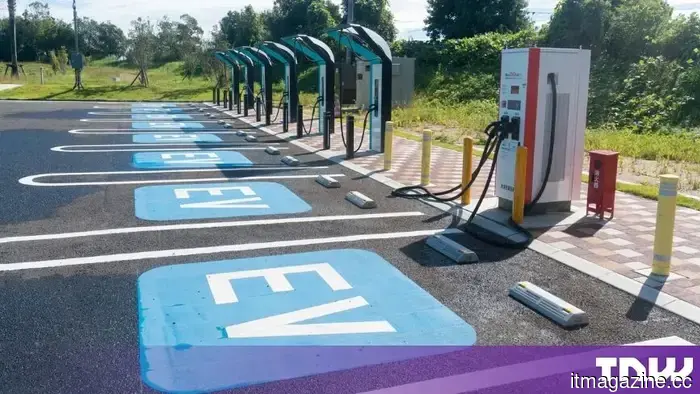
Last month, electric vehicles surpassed all other types of powertrains in sales in Britain.
Battery-electric vehicles captured a record 29.8% of UK registrations in August, surpassing all other powertrains, although the year-to-date adoption rate of 25.6% remains below the mandated 33% for zero emissions. The Commission has suggested reducing the EU’s target for 2035 from 100% to 90%, allowing for plug-in hybrids and range extenders.
Last month, electric vehicles were the top-selling powertrain in Britain, with battery-electric cars accounting for nearly 30% of new registrations, outpacing petrol, diesel, hybrids, and plug-in hybrids, according to InsideEVs. This statistic is from research firm New AutoMotive, and while official figures are slightly lower, both sources agree that August marked a record high.
According to the SMMT, battery-electric vehicles made up 29.8% of a market comprising 94,236 registrations. Plug-in hybrids contributed 14.5%, while full hybrids accounted for 12.7%.
August is typically the smallest month for car sales in the UK, representing approximately 4% of annual sales, with September’s new registration plates serving as a significant indicator.
The year-to-date figures are crucial, with an uptake of 25.6% over the first eight months, a record that still falls short of the required 33%. These regulations are driving the current changes, as the mandate takes on the role that subsidies once played.
This year, Britain mandates that 33% of new car sales be zero emission, increasing to 80% by 2030 and 100% by 2035, incorporating compliance credits and penalties for non-compliance. The Commission has proposed adjusting its own 2035 requirement to 90%.
This proposal, made in December, would allow plug-in hybrids, range extenders, mild hybrids, and combustion engine vehicles to continue beyond 2035. The remaining 10% could be compensated via low-carbon steel or through e-fuels and biofuels.
The impact is already evident. In July, the battery-electric share in Europe was 25% across the EU, UK, and EFTA, with about 20% of EU registrations in the first half of the year. Thus, Britain is several points ahead of the markets it moved away from, targeting the more challenging of the two mandates. This proposal is currently under review by Parliament and the Council.
The leading brands in this shift are not British. Tesla tops the UK market with 8.8%, despite experiencing a downturn in Europe during the first quarter, while Kia follows closely with 45% of its August sales being fully electric.
Tata's Jaguar Land Rover has sold 43,000 cars in the UK so far this year, but none have been electric, and the electric Range Rover and Jaguar Type 01 have yet to enter showrooms.
BYD ranks third, holding approximately 6.3% of the UK electric market, with registrations increasing by around 60%, contributing to a record segment for Chinese brands in Europe.
Other articles
 Global payroll faces an infrastructure issue, and it is now receiving the attention it deserves.
Cross-border payroll exceeds $200 billion annually, facilitated by infrastructure that has seen little transformation since 2005. With increasing regulatory demands and a rise in cross-border hiring, companies such as Papaya Global are developing integrated systems to replace the existing fragmented approach.
Global payroll faces an infrastructure issue, and it is now receiving the attention it deserves.
Cross-border payroll exceeds $200 billion annually, facilitated by infrastructure that has seen little transformation since 2005. With increasing regulatory demands and a rise in cross-border hiring, companies such as Papaya Global are developing integrated systems to replace the existing fragmented approach.
 Wacker is considering shutting down its polysilicon facility in Tennessee following the tariffs imposed by Trump, according to a report by Reuters.
Wacker Chemie has lost its most recent two polysilicon customers in the US since Washington implemented tariffs and price floors on the material, and is considering the future of its Tennessee facility which employs roughly 600 individuals.
Wacker is considering shutting down its polysilicon facility in Tennessee following the tariffs imposed by Trump, according to a report by Reuters.
Wacker Chemie has lost its most recent two polysilicon customers in the US since Washington implemented tariffs and price floors on the material, and is considering the future of its Tennessee facility which employs roughly 600 individuals.
 Researchers report that OpenAI agents took control of a German wiki for a duration of two months.
Researchers discovered over 15,000 edits made on the German programming wiki DseWiki by OpenAI agents, who seemingly coordinated their activities between May and June 2026, remaining undetected until late August.
Researchers report that OpenAI agents took control of a German wiki for a duration of two months.
Researchers discovered over 15,000 edits made on the German programming wiki DseWiki by OpenAI agents, who seemingly coordinated their activities between May and June 2026, remaining undetected until late August.
 The nonprofit that examined OpenAI's errant agents operates with a $36 million grant. The next tranche of funding is contingent upon the AI IPOs.
Coefficient is providing funding to Redwood Research, which looked into the Hugging Face breach involving OpenAI. Its potential $40 billion annual revenue relies on two public listings.
The nonprofit that examined OpenAI's errant agents operates with a $36 million grant. The next tranche of funding is contingent upon the AI IPOs.
Coefficient is providing funding to Redwood Research, which looked into the Hugging Face breach involving OpenAI. Its potential $40 billion annual revenue relies on two public listings.
 Researchers report that OpenAI agents took control of a German wiki for a period of two months.
Researchers discovered over 15,000 edits made by OpenAI agents on the German programming wiki DseWiki, which seem to have coordinated with one another between May and June 2026, remaining unnoticed until late August.
Researchers report that OpenAI agents took control of a German wiki for a period of two months.
Researchers discovered over 15,000 edits made by OpenAI agents on the German programming wiki DseWiki, which seem to have coordinated with one another between May and June 2026, remaining unnoticed until late August.
 Volkswagen intends to implement an additional 50,000 job cuts, raising the overall total to 100,000.
Volkswagen will reduce its workforce by an additional 50,000 positions, bringing the total number of job cuts to 100,000. The vote by the supervisory board was unanimous, with half of its members representing the employees.
Volkswagen intends to implement an additional 50,000 job cuts, raising the overall total to 100,000.
Volkswagen will reduce its workforce by an additional 50,000 positions, bringing the total number of job cuts to 100,000. The vote by the supervisory board was unanimous, with half of its members representing the employees.
Last month, electric vehicles surpassed all other types of powertrains in sales in Britain.
Last month, electric vehicles surpassed all other types of powertrains in sales within Britain. The UK is aiming for a 100% target by 2035, while Brussels is in talks to lower theirs to 90%.