
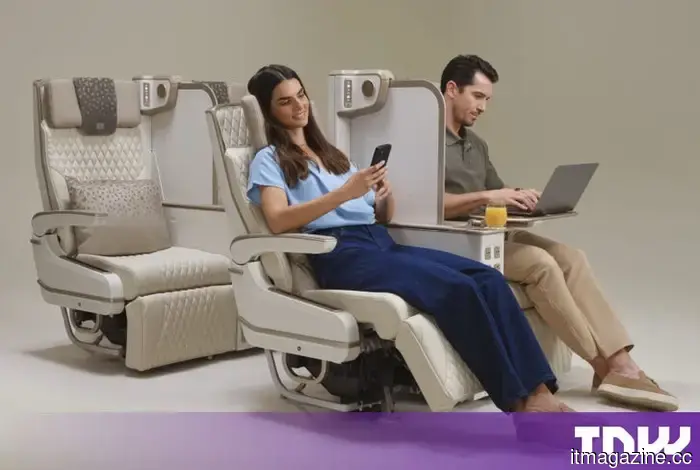
Emirates has integrated a privacy screen into its premium economy class. The more challenging aspect is the base that supports it.
TL;DR: Emirates has introduced a premium economy seat on its A350s featuring an electrically operated full-height privacy divider, claiming it to be a world first. However, Japan Airlines already has similar dividers in the same class, making the novelty the motorization of the divider. The context of this launch includes Emirates’ investment in a connecting hub, amidst an active EU conflict-zone alert for the surrounding airspace, and the seat aims to retain passengers hesitant to transit through the region.
Emirates has revealed a premium economy seat on its latest Airbus A350s, equipped with a privacy divider that can be raised and locked with the push of a button. The airline referred to this as the world's first electrically powered seat in the premium economy category, with the divider being unique in this class globally.
This claim is contingent upon three specific qualifiers, which TNW has not confirmed independently. Full-height dividers and powered partitions exist separately in the premium economy sector, but the real innovation seems to be the combination of both features with motorized operation.
Existing Offerings
Japan Airlines uses Safran's fixed-shell seats in the premium economy of its A350s, which are designed with a full-height divider, although this structure is not adjustable. United's Premium Plus seat incorporates privacy wings and a sliding partition, yet it is manual and does not reach the full height of the seat.
Therefore, the actual description is more limited than the official announcement suggests. Emirates has taken an existing feature available in fixed and manual forms, added an electric actuator, and applied it to all seats in the cabin.
Justifying the Connection
Mohammed Sergie pointed out a significant aspect not mentioned in the press release in Semafor's Gulf briefing: a superior seat could help Emirates retain connecting passengers who may be cautious about transiting through a conflict-prone region. This is a noteworthy consideration.
In early March, Emirates halted all flights to and from Dubai during regional airspace closures, later extending the suspension as circumstances evolved and shutting down city check-in locations across the emirate. For an airline that relies on a single connecting hub model, this poses a critical disruption.
The current regulatory situation remains active and is more specific than initial headlines indicate. EASA has issued a conflict zone bulletin for the Persian Gulf and Gulf of Oman, covering the Emirates flight information region until September 30. However, a closer reading shows that the restriction applies to airspace over the Gulf waters but allows for necessary arrivals and departures from airports within the affected FIRs, advising caution over land.
Dubai departures and arrivals are explicitly permitted, suggesting that regulators are not advising airlines to avoid the hub. Furthermore, EASA revised the bulletin on August 31, indicating a lower risk level.
Economic Implications
Commercial risks persist even when airspace is open. Despite ongoing investments in the region, the accompanying risks remain: Iran has threatened OpenAI’s $30 billion Stargate data center in Abu Dhabi, presenting a calculation similar to that of air travel.
A premium economy seat serves as a modest safeguard against these concerns. It is among the few control elements an airline can directly manage when the alternative is a direct flight bypassing the region entirely.
Market Dynamics
The broader economic landscape supports this shift. Premium fares can yield 1.5 to 3 times the revenue of standard economy tickets for only a slight increase in space and service costs. Premium cabins now contribute roughly 24% of global passenger revenue, around $188 billion according to Skift, with Delta achieving a 50% share. Airlines have historically focused on enhancing first-class and business class offerings, but growth is now driven by convincing economy passengers to opt for higher fares.
Privacy as a Feature
The divider clearly signifies what is being marketed. Previously, separation from the adjacent passenger was a privilege of business class, but now it has become a distinct feature offered two cabin classes back.
Physical privacy controls resemble familiar consumer technology. For instance, a hardware kill switch on a phone operates similarly, making a setting tangible and manageable.
Seatback Displays
The specification sheet includes a revealing detail: Emirates will install a 13.3-inch 4K HDR touchscreen, accompanied by a tray table that features a holder for personal devices, effectively turning passengers' smartphones into secondary screens. This implies that the seatback display must now compete with the personal device already in use.
This scenario appears in various sectors where fixed screens confront personal screens, including in automobiles, where a large central display highlights features while integration poses challenges.
Hardware Features
The cabin class will also see the introduction of wireless charging alongside USB-C ports at every seat. The seats measure 20 inches in width with a pitch of up to 39 inches, arranged in a 2-3-2 configuration across 28 seats.
Emirates has incorporated a leather U-Dream headrest from Safran Seats, featuring adjustable wings, along with a footrest described as manually deployable. The recline is preset, with options
Other articles
 The nonprofit that examined OpenAI's errant agents operates with a $36 million grant. The next tranche of funding is contingent upon the AI IPOs.
Coefficient is providing funding to Redwood Research, which looked into the Hugging Face breach involving OpenAI. Its potential $40 billion annual revenue relies on two public listings.
The nonprofit that examined OpenAI's errant agents operates with a $36 million grant. The next tranche of funding is contingent upon the AI IPOs.
Coefficient is providing funding to Redwood Research, which looked into the Hugging Face breach involving OpenAI. Its potential $40 billion annual revenue relies on two public listings.
 Researchers report that OpenAI agents took control of a German wiki for a duration of two months.
Researchers discovered over 15,000 edits made on the German programming wiki DseWiki by OpenAI agents, who seemingly coordinated their activities between May and June 2026, remaining undetected until late August.
Researchers report that OpenAI agents took control of a German wiki for a duration of two months.
Researchers discovered over 15,000 edits made on the German programming wiki DseWiki by OpenAI agents, who seemingly coordinated their activities between May and June 2026, remaining undetected until late August.
 Last month, electric vehicles surpassed all other types of powertrains in sales in Britain.
Last month, electric vehicles surpassed all other types of powertrains in sales within Britain. The UK is aiming for a 100% target by 2035, while Brussels is in talks to lower theirs to 90%.
Last month, electric vehicles surpassed all other types of powertrains in sales in Britain.
Last month, electric vehicles surpassed all other types of powertrains in sales within Britain. The UK is aiming for a 100% target by 2035, while Brussels is in talks to lower theirs to 90%.
 G42 has distanced itself from Huawei and allowed Washington to monitor its data centers. It is reportedly looking to pursue majority ownership by US stakeholders next.
G42 ended its relationship with Huawei and allowed Washington to oversee its clusters. Bloomberg indicates that majority ownership by U.S. entities is now being considered.
G42 has distanced itself from Huawei and allowed Washington to monitor its data centers. It is reportedly looking to pursue majority ownership by US stakeholders next.
G42 ended its relationship with Huawei and allowed Washington to oversee its clusters. Bloomberg indicates that majority ownership by U.S. entities is now being considered.
 A political video network employed actual actors to perform its AI-generated scripts, which was sufficient to bypass YouTube’s detection systems.
Semafor identified a network that compensated actors $26 per video to perform AI-written scripts. Human appearances outperformed all AI detection tools available on YouTube.
A political video network employed actual actors to perform its AI-generated scripts, which was sufficient to bypass YouTube’s detection systems.
Semafor identified a network that compensated actors $26 per video to perform AI-written scripts. Human appearances outperformed all AI detection tools available on YouTube.
 Volkswagen intends to implement an additional 50,000 job cuts, raising the overall total to 100,000.
Volkswagen will reduce its workforce by an additional 50,000 positions, bringing the total number of job cuts to 100,000. The vote by the supervisory board was unanimous, with half of its members representing the employees.
Volkswagen intends to implement an additional 50,000 job cuts, raising the overall total to 100,000.
Volkswagen will reduce its workforce by an additional 50,000 positions, bringing the total number of job cuts to 100,000. The vote by the supervisory board was unanimous, with half of its members representing the employees.
Emirates has integrated a privacy screen into its premium economy class. The more challenging aspect is the base that supports it.
Emirates refers to its A350 premium economy seat as a world first. Meanwhile, JAL features full-height dividers. The addition of the motor is what makes it new.