

Emirates has integrated a privacy screen into its premium economy class. The more challenging aspect is the underlying support system.
TL;DR Emirates has introduced a premium economy seat on its A350s that features an electrically operated full-height privacy divider, which they claim is a world first. However, Japan Airlines already has similar dividers in this cabin class, meaning the true innovation is the motorized feature. The more significant aspect is that Emirates is investing in a hub located in an area currently under a live EU conflict-zone bulletin, making this seat part of the justification for maintaining that connection.
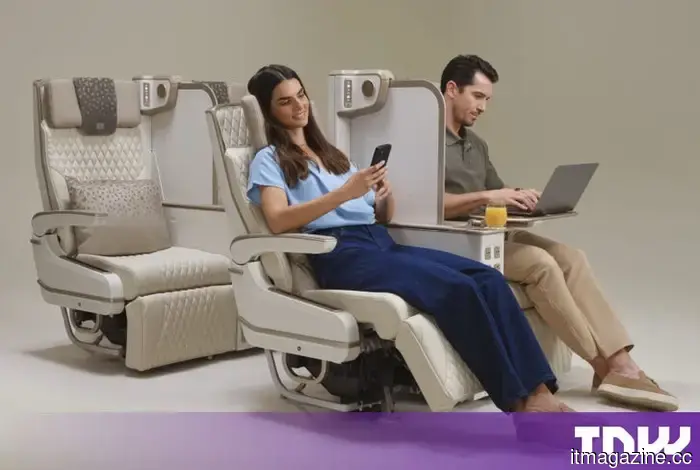
Emirates has unveiled its premium economy seat equipped with a privacy divider that raises and locks at the push of a button in its newly delivered Airbus A350s. The airline stated on Thursday that this is the world’s first electrically powered premium economy seat and that the divider is unique in the global cabin class.
This claim relies on three qualifiers, and TNW has not verified it independently. While full-height dividers and powered partitions exist in premium economy, the real novelty seems to be their combination and the motorized operation.
Previously available options
Japan Airlines has installed fixed-shell seats from Safran in its A350s' premium economy, which, by design, includes a full-height divider between passengers, although its structure is fixed and not adjustable.
United’s Premium Plus seat, based on the Collins Aerospace MiQ platform, features privacy wings and a manual sliding partition that does not cover the full height of the seat.
Thus, the true story is more limited than the announcement implies. Emirates has taken an existing feature that was previously fixed or manual, incorporated an electric actuator, and extended it to all seats in the cabin.
Justifying the connection
Mohammed Sergie pointed out, which the press release did not emphasize, in Semafor’s Gulf briefing, that better seating could help Emirates retain connecting passengers who are hesitant to transit through a conflict-prone region. This concern is significant.
Emirates halted all flights to and from Dubai in early March due to regional airspace closures, extending the suspension as necessary, and closed its city check-in points throughout the emirate. For an airline relying entirely on a single connecting hub, this poses a substantial disruption.
The regulatory situation remains relevant and is more detailed than it appears in the headlines. EASA’s conflict zone bulletin for the Persian Gulf and Gulf of Oman specifically names the Emirates flight information region and is effective until September 30.
However, a closer reading reveals it is less of a blanket warning. The restriction pertains to airspace over the Gulf's waters, “except as necessary for arrivals at or departures from aerodromes within the affected FIRs,” while caution is advised over land.
Arrivals and departures in Dubai are clearly exempt, meaning that this isn’t a directive for airlines to avoid the hub. EASA also updated the bulletin on August 31 to reflect a lower risk level.
The costs of being a connecting hub
Even with open airspace, commercial exposures persist. Capital continues to flow into the region with attached risks: Iran has threatened OpenAI’s $30 billion Stargate data center in Abu Dhabi, representing similar calculations in a different asset class.
A premium economy seat offers a modest defense against these challenges. It remains one of the few options an airline directly controls when the alternative is a direct flight bypassing the region.
Understanding the middle of the plane
Wider economic considerations indicate that premium fares can yield 1.5 to 3 times the revenue of standard economy for only slightly more space and service costs, as reported by Gordon Smith for Skift.
Premium cabins now represent around 24% of global passenger revenue, approximately $188 billion according to Skift, with Delta seeing this proportion reach 50%. For two decades, airlines have competed in first-class suites and business class beds, but the current growth focus is on encouraging economy passengers to spend more.
Privacy as a marketable feature
The divider clearly signifies what is being marketed. Previously, separation from fellow passengers was a luxury of business class, but it is now a feature available two cabin classes below.
Physical privacy tools resemble familiar consumer technology. A hardware kill switch on a phone operates similarly, turning a setting into a tangible control.
The seatback screen's role
The specification sheet subtly reveals another aspect. Emirates will install a 13.3-inch 4K HDR touchscreen, along with a tray table that includes a phone holder, allowing passengers to use their own devices as a second screen.
Interpreting this differently reveals that the seatback display is now effective competition against the personal devices already in passengers' pockets, and the airline has opted to accommodate phones rather than assume dominance.
This trend is evident wherever fixed screens meet personal ones, including in cars that feature large central displays while facing challenges with integration.
Other features of the hardware
For the first time in this cabin class, wireless charging will be available, alongside USB-C ports at every seat. The seat measures 20 inches in width with a pitch of up to 39 inches, arranged in a
Other articles
 Volkswagen intends to implement an additional 50,000 job cuts, raising the overall total to 100,000.
Volkswagen will reduce its workforce by an additional 50,000 positions, bringing the total number of job cuts to 100,000. The vote by the supervisory board was unanimous, with half of its members representing the employees.
Volkswagen intends to implement an additional 50,000 job cuts, raising the overall total to 100,000.
Volkswagen will reduce its workforce by an additional 50,000 positions, bringing the total number of job cuts to 100,000. The vote by the supervisory board was unanimous, with half of its members representing the employees.
 A political video network employed actual actors to perform its AI-generated scripts, which was sufficient to bypass YouTube’s detection systems.
Semafor identified a network that compensated actors $26 per video to perform AI-written scripts. Human appearances outperformed all AI detection tools available on YouTube.
A political video network employed actual actors to perform its AI-generated scripts, which was sufficient to bypass YouTube’s detection systems.
Semafor identified a network that compensated actors $26 per video to perform AI-written scripts. Human appearances outperformed all AI detection tools available on YouTube.
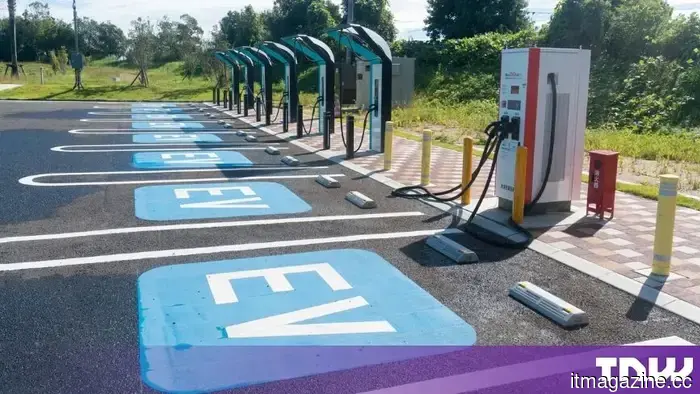 Last month, electric vehicles surpassed all other types of powertrains in sales in Britain.
Last month, electric vehicles surpassed all other types of powertrains in sales within Britain. The UK is aiming for a 100% target by 2035, while Brussels is in talks to lower theirs to 90%.
Last month, electric vehicles surpassed all other types of powertrains in sales in Britain.
Last month, electric vehicles surpassed all other types of powertrains in sales within Britain. The UK is aiming for a 100% target by 2035, while Brussels is in talks to lower theirs to 90%.
 Emirates has integrated a privacy screen into its premium economy class. The more challenging aspect is the base that supports it.
Emirates refers to its A350 premium economy seat as a world first. Meanwhile, JAL features full-height dividers. The addition of the motor is what makes it new.
Emirates has integrated a privacy screen into its premium economy class. The more challenging aspect is the base that supports it.
Emirates refers to its A350 premium economy seat as a world first. Meanwhile, JAL features full-height dividers. The addition of the motor is what makes it new.
 Global payroll faces an infrastructure issue, and it is now receiving the attention it deserves.
Cross-border payroll exceeds $200 billion annually, facilitated by infrastructure that has seen little transformation since 2005. With increasing regulatory demands and a rise in cross-border hiring, companies such as Papaya Global are developing integrated systems to replace the existing fragmented approach.
Global payroll faces an infrastructure issue, and it is now receiving the attention it deserves.
Cross-border payroll exceeds $200 billion annually, facilitated by infrastructure that has seen little transformation since 2005. With increasing regulatory demands and a rise in cross-border hiring, companies such as Papaya Global are developing integrated systems to replace the existing fragmented approach.
 Wacker is considering shutting down its polysilicon facility in Tennessee following the tariffs imposed by Trump, according to a report by Reuters.
Wacker Chemie has lost its most recent two polysilicon customers in the US since Washington implemented tariffs and price floors on the material, and is considering the future of its Tennessee facility which employs roughly 600 individuals.
Wacker is considering shutting down its polysilicon facility in Tennessee following the tariffs imposed by Trump, according to a report by Reuters.
Wacker Chemie has lost its most recent two polysilicon customers in the US since Washington implemented tariffs and price floors on the material, and is considering the future of its Tennessee facility which employs roughly 600 individuals.
Emirates has integrated a privacy screen into its premium economy class. The more challenging aspect is the underlying support system.
Emirates describes its A350 premium economy seat as a world first. JAL already features full-height dividers. The new element is the motor.