
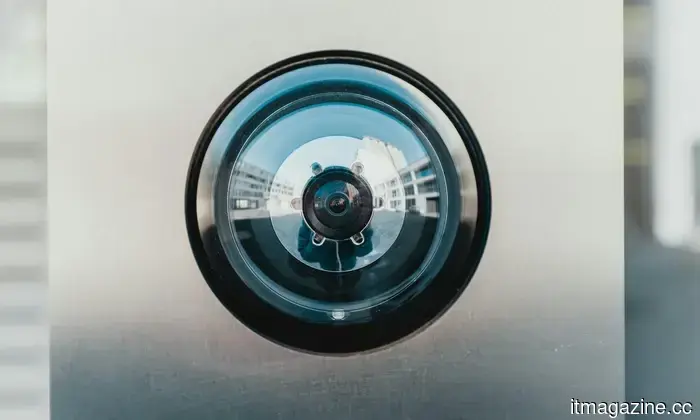
Researchers created a $7 device capable of locating hidden cameras within seconds.
It operates by sweeping light rather than merely shining a spotlight on reflections with a 94% accuracy rate.
Hidden cameras are frequently discovered in discreet locations, concealed in pens, clocks, chargers, or picture frames within hotel rooms and rentals. This prompted researchers at KAIST to create a solution that is more affordable than a good lunch. Their innovative device, known as SweepLED, transforms any smartphone into an effective hidden camera detector using an attachable LED case that costs less than $7 to produce.
Why your existing hidden camera detector might not be effective
Most handheld detectors utilize a straightforward method: shine a light on an object and look for bright reflections bouncing back. The issue is that glass, metal, and shiny plastic also reflect light, leaving you to guess if that gleam is a camera lens or merely a chance occurrence while squinting at chargers and clocks.
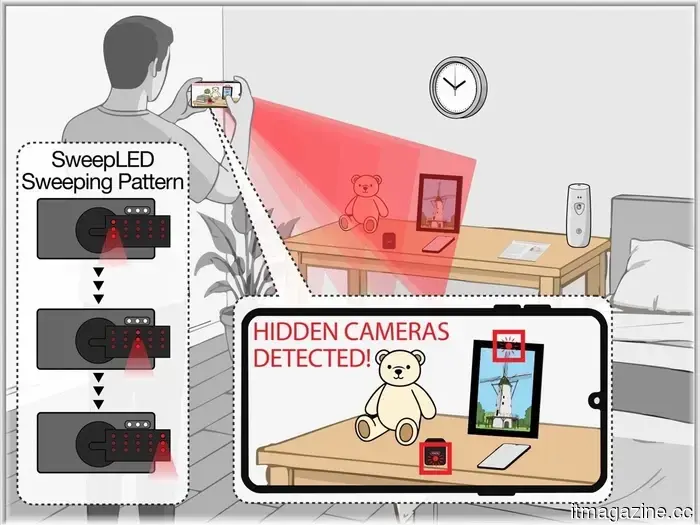
SweepLED removes all uncertainty. Instead of moving both the light and the camera angle simultaneously, it keeps the phone's camera stationary and sweeps the LED light from various angles. This is vital because a camera lens features an internal structure, aperture, sensor, and layered glass, causing its reflection to warp and deform in a specific manner as the angle of light changes. Common shiny surfaces do not exhibit this behavior.
How SweepLED operates
SweepLED captures the entire light sweep as a brief video, which it then processes through an AI model designed to identify the distinctive lens distortions, pinpointing precisely where a hidden camera might be located. Researchers tested it against 30 ordinary items typically found in a hotel room or rental, achieving approximately 94% accuracy in detecting hidden cameras, all within five seconds per object.
A recent study from UCL revealed that users of consumer-grade hidden camera detectors still overlooked 59% of devices during testing, making SweepLED’s 94% accuracy in the lab a promising indicator, with real-world testing anticipated soon.
Led by Professor Jun Han at KAIST’s School of Computing and collaborating with researchers from the National University of Singapore and Singapore Management University, the project was showcased earlier this year at ACM MobiSys 2026. Although it is not yet a consumer product, the concept is straightforward enough that it could feasibly appear in a real device in the near future.
Manisha Priyadarshini is a tech and entertainment writer with over nine years of editorial experience.
Why the Next Generation of Home AI Features Wheels and Emotion
OlloBot is advancing technology from the countertop into everyday life with its expressive new companion. For the past ten years, interacting with home artificial intelligence has adhered to a predictable, rigid framework: a person invokes a wake word, requests the weather or to switch off the lights, the speaker responds, and the interaction concludes. While this system is functional, it keeps smart devices strictly transactional, relegating them to the role of tools activated for specific tasks instead of systems that seamlessly integrate into a living environment.
OlloBot is pursuing a fundamentally different approach with the OlloNi SS1, an embodied AI companion, which refers to artificial intelligence embedded in a physical, mobile form rather than confined to a screen.
AI aims to convert simple phone videos into cycling performance data that serious riders typically pay thousands for
Cycling can be an expensive pastime. However, as a cyclist becomes more serious, the costs can escalate significantly for measuring performance. In professional contexts, equipment such as instrumented pedals, bike computers, and heart-rate monitors become essential, all aimed at extracting more data from each ride. Now, researchers at La Trobe University (via TechXplore) are investigating whether a single piece of equipment that most individuals already possess could potentially manage a surprisingly complex aspect of that task. This isn't specialized equipment; it's a small device that fits in your pocket—your smartphone. Researchers at the Holsworth Biomedical Research Centre are creating AI models capable of estimating the forces exerted by a cyclist on the pedals through video motion capture. Cyclists could simply record themselves with a smartphone and receive biomechanical insights that presently require much more specialized apparatus.
UK health advocates caution that AI transcription tools may put patients in jeopardy
AI scribes are increasingly being adopted in medical offices, promising to reduce boring paperwork and allocate more time for patient care. However, mounting evidence indicates that these tools can introduce new risks for both patients and healthcare providers. AI scribes are distorting diagnoses and prescriptions.







Other articles
 Nvidia acquires Hugging Face for $12.9 billion. Thomas Wolf is placing his bets on Microduck, a robot priced at $399?
Nvidia has reached an agreement to purchase Hugging Face for $12.9 billion. Co-founder Thomas Wolf discusses the reasons behind the victory of open-source AI, the sale of $399 robots, and the future of the platform under Jensen Huang's leadership.
Nvidia acquires Hugging Face for $12.9 billion. Thomas Wolf is placing his bets on Microduck, a robot priced at $399?
Nvidia has reached an agreement to purchase Hugging Face for $12.9 billion. Co-founder Thomas Wolf discusses the reasons behind the victory of open-source AI, the sale of $399 robots, and the future of the platform under Jensen Huang's leadership.
 Samsung might provide the Galaxy S27 and S27+ with a much-needed zoom enhancement.
A recent leak suggests that the Galaxy S27 and S27+ may utilize the same 3x telephoto system as the S27 Pro, possibly replacing the outdated 10MP zoom camera present in the current models.
Samsung might provide the Galaxy S27 and S27+ with a much-needed zoom enhancement.
A recent leak suggests that the Galaxy S27 and S27+ may utilize the same 3x telephoto system as the S27 Pro, possibly replacing the outdated 10MP zoom camera present in the current models.
 Health advocates in the UK are cautioning that AI transcription tools may pose risks to patient safety.
AI transcription tools are becoming more prevalent in medical practices, but health advocates in the UK are cautioning that critical mistakes in diagnoses, prescriptions, and records could endanger patients.
Health advocates in the UK are cautioning that AI transcription tools may pose risks to patient safety.
AI transcription tools are becoming more prevalent in medical practices, but health advocates in the UK are cautioning that critical mistakes in diagnoses, prescriptions, and records could endanger patients.
 Next-generation speaker technology transmits music and speech directly to a single listener without disturbing those around them.
Researchers at POSTECH have created an ultrasound speaker that focuses music and speech towards a single listener, preventing the sound from dispersing broadly in the surrounding area.
Next-generation speaker technology transmits music and speech directly to a single listener without disturbing those around them.
Researchers at POSTECH have created an ultrasound speaker that focuses music and speech towards a single listener, preventing the sound from dispersing broadly in the surrounding area.
 The issue of digital legacy: what becomes of those who created the memories?
Eighty-four percent of adults in the U.S. access YouTube, while seventy-one percent use Facebook; however, digital memories tend to be fragmented across different platforms without any context. The founders of Eternal Memory contend that digital legacy is a developing category in which the act of curation is more significant than the quantity.
The issue of digital legacy: what becomes of those who created the memories?
Eighty-four percent of adults in the U.S. access YouTube, while seventy-one percent use Facebook; however, digital memories tend to be fragmented across different platforms without any context. The founders of Eternal Memory contend that digital legacy is a developing category in which the act of curation is more significant than the quantity.
 The persistent nagging from OneDrive in Windows 11 is set to come to an end.
Windows 11 is introducing a proper option to opt-out of OneDrive backup, replacing the recurring prompts that previously allowed users to continue, postpone, or skip, but never to permanently decline.
The persistent nagging from OneDrive in Windows 11 is set to come to an end.
Windows 11 is introducing a proper option to opt-out of OneDrive backup, replacing the recurring prompts that previously allowed users to continue, postpone, or skip, but never to permanently decline.
Researchers created a $7 device capable of locating hidden cameras within seconds.
Researchers at KAIST developed SweepLED, a $7 smartphone device that can identify hidden cameras with 94% accuracy in just a few seconds.