

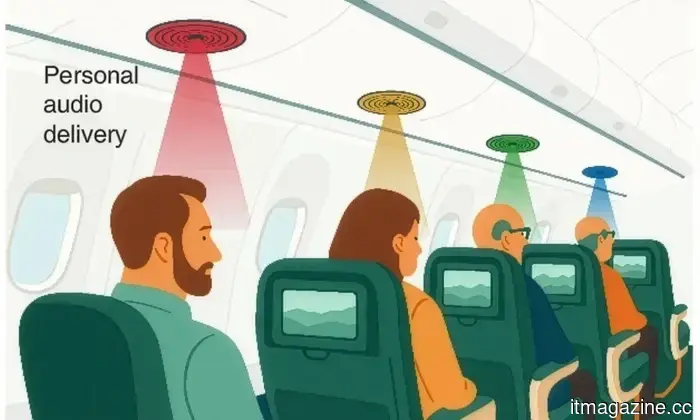
Next-generation speaker technology transmits music and speech directly to a single listener without disturbing those around them.
Unlike traditional headphones or earbuds, listeners do not have to wear any equipment to experience the directed audio.
Headphones can be enjoyable, but after a full workday, they can become uncomfortable. Over-ear models might get warm and sweaty after several hours, while earbuds can cause irritation. Switching to speakers often means that everyone nearby has to hear the audio as well.
This is where a new speaker created by researchers at Pohang University of Science and Technology piqued my interest. Named MiPAL, it utilizes ultrasound to send sound in a precisely focused direction, allowing one individual to enjoy music, speech, or other audio without bothering those around them.
But how does it function?
Typical speakers disperse sound in multiple directions, while MiPAL operates as a parametric array loudspeaker (PAL), which utilizes ultrasound to transmit audible content in a significantly narrower beam. Central to the system is a single piezoelectric transducer responsible for generating the ultrasonic waves. As these waves move through the air, they interact through a mechanism called nonlinear acoustics, producing frequencies that we can hear.
An overview of the metamaterials-integrated parametric array loudspeaker (MiPAL) in Nature Communications describes the research's use of two types of metamaterials to maintain sound directionality. An acoustic metasurface at the front acts somewhat like a lens, aligning the outgoing waves into a narrow beam. Elastic meta-units located at the back minimize unwanted vibrations that could allow sound to leak out to the sides.
While conventional directional speakers may require numerous ultrasonic emitters, the MiPAL system accomplishes this with just one transducer, simplifying the hardware significantly.
Potential applications for this technology
The researchers evaluated MiPAL using both speech and music across a frequency range of 500Hz to 10kHz. They recreated an aircraft seating arrangement where one passenger could potentially listen to music or announcements without the individual seated next to them overhearing.
Airplanes and trains are obvious scenarios for its use, but I can also see it being beneficial at a desk. A speaker could deliver audio directly to one person without forcing others in the room to hear it. Museums and exhibitions could similarly utilize it to provide audio exclusively to visitors in front of a specific exhibit.
Directional audio technology is not completely new. We previously reviewed the Noveto N1, which employed ultrasound and head tracking to create localized sound areas around a listener's ears. MiPAL, however, approaches the task using a single ultrasonic transducer and a more straightforward hardware configuration.
There is a downside. The researchers indicate that the current prototype does not yet reach the sound levels of a standard speaker, so it is not quite ready to replace the headphones on my desk. However, if the technology progresses sufficiently, this is one audio innovation I would genuinely like to test.
I've accumulated about four years of experience, primarily focusing on gaming, PC hardware, and smartphones. In my leisure time, I enjoy...
Streaming devices have recently seen a significant price increase, and Google’s latest hardware is no exception. The Google TV Streamer has quietly risen in price from $99 to $149, marking a steep increase of 50%. This new price is already reflected in the Google Store and Best Buy. If you've been waiting to purchase one, it's advisable to act promptly, as some retailers may not have updated to the new pricing yet.
Prices for streaming devices continue to rise, with the Google TV Streamer being the latest to experience a 50% jump.
At Gamescom 2026, I met with Gordon Tong, Senior Director of Product Strategy and Planning for Gaming at JBL, to discuss a crucial element of gaming: audio. What began as a talk on wireless gaming transformed into a broader exploration of JBL’s Quantum strategy, AI-enhanced audio, and why the company believes its primary advantage isn’t simply about volume. Hint: it believes its edge lies in being JBL.
The Internet Archive has made an extensive collection of vintage AI software accessible through your browser, and it’s truly captivating. Before the era of large language models, an entire generation of home computer programs was already simulating conversations with supposedly intelligent entities.
The Internet Archive is known for preserving unique items that often go unnoticed, and its latest collection serves as a prime example. Titled “Vintage Artificial Intelligence,” it features decades of software that aimed to convince users they were interacting with a sentient machine, albeit with varied degrees of success.





Other articles
 AI chatbots are now safer than they used to be, yet they continue to have a concerning blind spot.
Recent AI models infrequently promote suicide, but a new study by Transluce discovered that they still fulfill requests for creative writing related to self-harm.
Meta eliminates fraudulent app advertisements in India following two requests.
Applications masquerading as pornography have the potential to intercept one-time passwords and banking PINs. Meta has taken down the ads that Reuters identified but did not respond to their inquiries.
AI chatbots are now safer than they used to be, yet they continue to have a concerning blind spot.
Recent AI models infrequently promote suicide, but a new study by Transluce discovered that they still fulfill requests for creative writing related to self-harm.
Meta eliminates fraudulent app advertisements in India following two requests.
Applications masquerading as pornography have the potential to intercept one-time passwords and banking PINs. Meta has taken down the ads that Reuters identified but did not respond to their inquiries.
 Instagram will restrict the visibility of AI influencers who do not include an AI-generated label on their profiles.
Instagram is changing the name of its AI creator label to AI-generated profile, and accounts that display fake humans without a label will experience reduced reach.
Instagram will restrict the visibility of AI influencers who do not include an AI-generated label on their profiles.
Instagram is changing the name of its AI creator label to AI-generated profile, and accounts that display fake humans without a label will experience reduced reach.
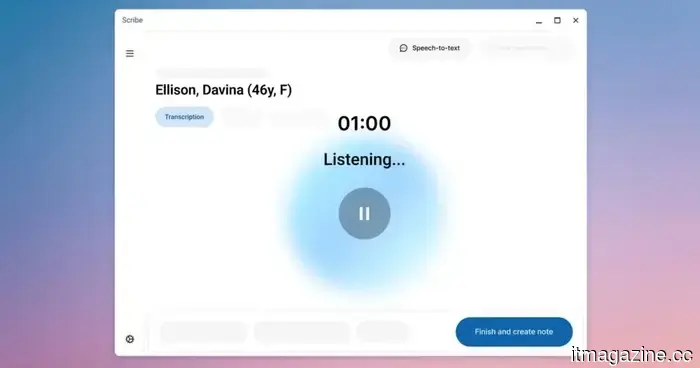 Health advocates in the UK are cautioning that AI transcription tools may pose risks to patient safety.
AI transcription tools are becoming more prevalent in medical practices, but health advocates in the UK are cautioning that critical mistakes in diagnoses, prescriptions, and records could endanger patients.
Health advocates in the UK are cautioning that AI transcription tools may pose risks to patient safety.
AI transcription tools are becoming more prevalent in medical practices, but health advocates in the UK are cautioning that critical mistakes in diagnoses, prescriptions, and records could endanger patients.
 An AI analyzes an ECG in two seconds and detects what cardiologists may overlook.
Researchers from Imperial College London have announced that they have identified up to 81% of heart failure cases and 90% of valve disease cases through routine ECGs conducted on 67,000 patients.
An AI analyzes an ECG in two seconds and detects what cardiologists may overlook.
Researchers from Imperial College London have announced that they have identified up to 81% of heart failure cases and 90% of valve disease cases through routine ECGs conducted on 67,000 patients.
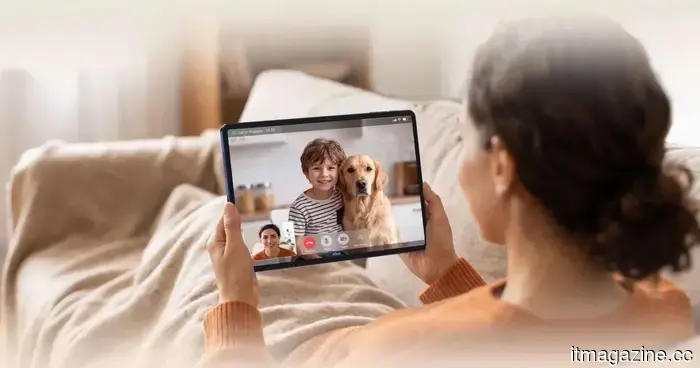 TCL launches two affordable 11-inch Android tablets, with prices beginning at $190.
TCL enhances its TAB A1 series by introducing two new affordable 11-inch tablets, each featuring the Helio G100 chip, an 8,000mAh battery, and identical storage options.
TCL launches two affordable 11-inch Android tablets, with prices beginning at $190.
TCL enhances its TAB A1 series by introducing two new affordable 11-inch tablets, each featuring the Helio G100 chip, an 8,000mAh battery, and identical storage options.
Next-generation speaker technology transmits music and speech directly to a single listener without disturbing those around them.
Researchers at POSTECH have created an ultrasound speaker that focuses music and speech towards a single listener, preventing the sound from dispersing broadly in the surrounding area.