

A snug compression might resolve the most significant challenge facing solid-state batteries for vehicles and electronic devices.
A straightforward mechanical solution could replace complicated chemical methods to enhance the safety, speed, and reliability of solid-state batteries.
Solid-state batteries have traditionally been viewed as the ultimate solution for energy storage. They are believed to offer double the energy density of conventional batteries, significantly reduce charging times, and eliminate the risk of thermal hazards. However, despite these promises, the technology has not seen widespread commercial use, largely due to the issue of dendrites. These tiny, needle-like formations develop within solid-state batteries during charging, penetrate the ceramic electrolyte, and connect the electrodes, resulting in short circuits.
Researchers from SLAC National Accelerator Laboratory and Stanford University have now found an unexpectedly simple solution to this ongoing issue. A study published in the journal Nature reveals that applying controlled mechanical pressure to the ceramic electrolyte can prevent these short circuits, allowing test cells to endure thousands of charge cycles without failure.
Redirecting internal growth
Scientists had debated for years whether dendrites originate at the surface of the electrolyte or from within its internal structure. Using advanced X-ray technology at SLAC, the research team clarified this issue, uncovering that dendrites form at nanoscale pores and defects within the material.
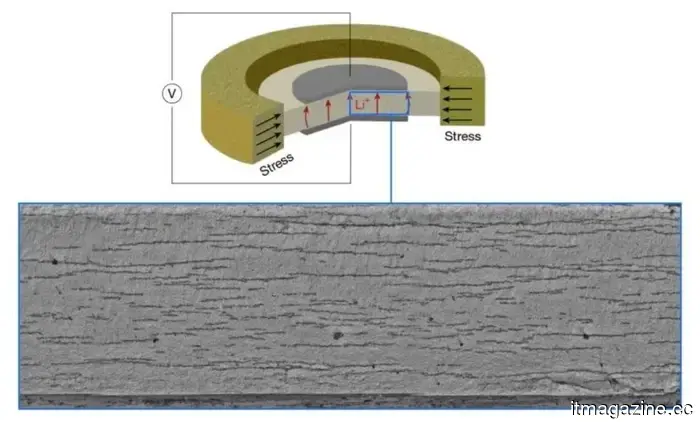
To combat this, the researchers utilized basic principles of fracture mechanics. They encircled the solid electrolyte with a shape-memory alloy ring and heated it to 170 degrees Celsius. As the ring contracted, it applied a strong, continuous lateral pressure on the cell.
A cross-sectional image of the electrolyte illustrates horizontal dendrites throughout the electrolyte's thickness. The vertical positions of these horizontal dendrites indicate the depths at which they initiate within the solid electrolyte. Greg Stewart/SLAC National Accelerator Laboratory.
The outcome was remarkable. With mechanical compression, dendrites continued to develop at internal defect sites, but the physical stress changed their growth trajectory. Instead of growing vertically toward the electrodes and causing short circuits, the dendrites expanded horizontally. Confined safely within the electrolyte, they could no longer bridge the gap between the components and compromise the battery.
Impact on everyday tech
While this research is still in the laboratory phase, applying mechanical pressure to prevent dendrites provides a clear avenue for practical applications across several critical industries.
Electric vehicles: For EVs, increased energy density translates to significantly extended driving ranges and lighter vehicle designs. Preventing short circuits enables these battery packs to accommodate rapid charging protocols, alleviating range anxiety for drivers.
Consumer electronics: Smartphones, laptops, and wearables could see substantially longer battery life in slimmer forms once mass production begins.
Grid energy storage: Large-scale energy grids require storage solutions that endure thousands of cycles. Solid ceramic electrolytes will offer stable, non-flammable performance, and mechanical compression can help ensure long-term reliability.
This research demonstrates that eliminating dendrites may not necessitate flawless, defect-free ceramic materials. By leveraging simple mechanical pressure, it provides engineers with a clear and more feasible pathway forward. Designing batteries with integrated compression mechanisms could be the crucial breakthrough needed to transition solid-state batteries from laboratory environments to practical use.





Other articles
 A snug compression might resolve the main challenge for solid-state batteries in vehicles and electronic devices.
Solid-state batteries promised increased safety and quicker charging capabilities, but microscopic dendrites continue to cause short circuits. Researchers at Stanford found that applying continuous mechanical pressure encourages dendrites to grow in a harmless sideways manner, providing a straightforward engineering solution to advance next-generation batteries for electric vehicles and portable devices.
A snug compression might resolve the main challenge for solid-state batteries in vehicles and electronic devices.
Solid-state batteries promised increased safety and quicker charging capabilities, but microscopic dendrites continue to cause short circuits. Researchers at Stanford found that applying continuous mechanical pressure encourages dendrites to grow in a harmless sideways manner, providing a straightforward engineering solution to advance next-generation batteries for electric vehicles and portable devices.
 This battery, which does not use graphite, has the potential to disrupt China's dominance in the electric vehicle supply chain.
Pure Lithium reports that its graphite-free cell completed 9,315 cycles. By 2030, Europe aims to process 40% of its own graphite, while China processes more than 90% of it.
This battery, which does not use graphite, has the potential to disrupt China's dominance in the electric vehicle supply chain.
Pure Lithium reports that its graphite-free cell completed 9,315 cycles. By 2030, Europe aims to process 40% of its own graphite, while China processes more than 90% of it.
 Apple TV secures the highly praised drama series "Small Prophets."
Apple TV has obtained the worldwide streaming rights for the popular British comedy-drama series "Small Prophets," which will be available for viewing starting October 7.
Apple TV secures the highly praised drama series "Small Prophets."
Apple TV has obtained the worldwide streaming rights for the popular British comedy-drama series "Small Prophets," which will be available for viewing starting October 7.
 The trend of banning Meta smart glasses is gaining momentum in the US, with a nightclub in New York taking the initiative.
A nightclub in New York City has prohibited smart glasses due to growing concerns over covert recordings, echoing similar measures implemented in the UK.
The trend of banning Meta smart glasses is gaining momentum in the US, with a nightclub in New York taking the initiative.
A nightclub in New York City has prohibited smart glasses due to growing concerns over covert recordings, echoing similar measures implemented in the UK.
 China’s car manufacturers are urged by regulators to prioritize quality improvements rather than simply adding new features.
Four Chinese ministries launched a yearlong initiative focused on automobile quality that prohibits manufacturers from altering vehicle specifications through over-the-air updates without prior approval.
China’s car manufacturers are urged by regulators to prioritize quality improvements rather than simply adding new features.
Four Chinese ministries launched a yearlong initiative focused on automobile quality that prohibits manufacturers from altering vehicle specifications through over-the-air updates without prior approval.
 Meta claims that its glasses can no longer record you secretly, at least not in this manner.
Meta is addressing a privacy issue that permitted users of smart glasses to turn off the recording indicator while still recording video.
Meta claims that its glasses can no longer record you secretly, at least not in this manner.
Meta is addressing a privacy issue that permitted users of smart glasses to turn off the recording indicator while still recording video.
A snug compression might resolve the most significant challenge facing solid-state batteries for vehicles and electronic devices.
Solid-state batteries offer the potential for safer and quicker charging power, but tiny dendrites often cause short circuits. Researchers at Stanford found that by applying constant mechanical pressure, dendrites can grow laterally in a non-harmful way, providing a straightforward engineering solution to advance the development of next-generation batteries for electric vehicles and portable devices.