

A snug compression might resolve the main challenge for solid-state batteries in vehicles and electronic devices.
A straightforward mechanical solution could replace complicated chemical methods to enhance the safety, speed, and reliability of solid-state batteries.
Solid-state batteries have long been hailed as the ultimate solution for energy storage, promising to double the energy density compared to conventional alternatives, significantly reduce charging times, and eliminate the risk of thermal fires. However, despite these promises, the technology has not seen widespread commercial use, primarily due to dendrites. These tiny, needle-like formations develop inside solid-state batteries during charging, penetrating the solid ceramic electrolyte and connecting the electrodes, which leads to short circuits.
Recently, researchers from SLAC National Accelerator Laboratory and Stanford University have identified an unexpectedly simple remedy for this ongoing issue. A study published in the journal Nature reveals that applying controlled mechanical pressure to the ceramic electrolyte can prevent these short circuits, enabling test cells to endure thousands of charge cycles without failure.
Redirecting internal growth
Researchers have debated for years whether dendrites initiate at the electrolyte's surface or deep within its internal structure. Utilizing advanced X-ray techniques at SLAC, the team resolved this question, demonstrating that dendrites actually originate from nanoscopic internal pores and defects within the material.
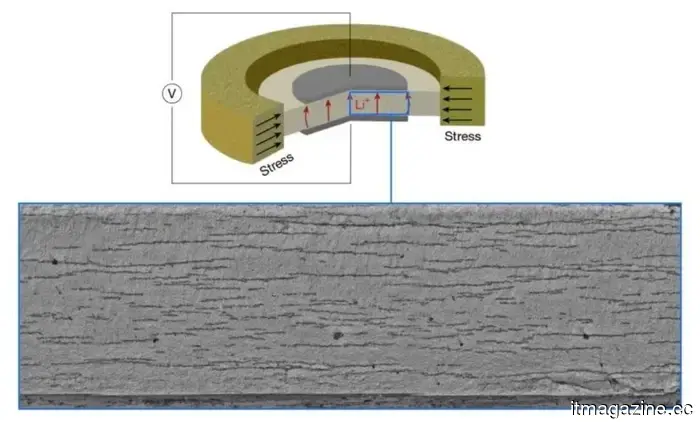
To address this, the researchers employed basic principles of fracture mechanics. They placed a shape-memory alloy ring around the solid electrolyte and heated it to 170 degrees Celsius. As the ring contracted, it applied a strong, continuous lateral pressure on the cell.
A cross-sectional view of the electrolyte shows horizontal dendrites throughout its thickness. The vertical positioning of these horizontal dendrites indicates the depth at which they begin within the solid electrolyte. Greg Stewart/SLAC National Accelerator Laboratory
The outcome was impressive. Although dendrites still developed at internal defect locations under mechanical compression, the applied physical stress altered their growth trajectory. Instead of growing vertically towards the electrodes and causing short circuits, the dendrites grew horizontally. Confined safely within the electrolyte, they were unable to bridge the gap between the components and compromise the battery.
Impact on everyday technology
Although the research is currently in the laboratory phase, utilizing mechanical pressure to inhibit dendrites presents a clear opportunity for practical applications across several critical sectors.
Electric vehicles: For electric vehicles, increased energy density translates to significantly longer driving ranges and reduced vehicle weight. Preventing short circuits allows these battery packs to accommodate rapid charging protocols while alleviating drivers' range anxiety.
Consumer electronics: Smartphones, laptops, and wearables could see markedly extended battery life in slimmer designs once manufacturing scales up.
Grid energy storage: Large energy grids necessitate storage capable of lasting thousands of cycles. Solid ceramic electrolytes will provide non-flammable stability, and mechanical compression could help guarantee long-term reliability.
This research demonstrates that eliminating dendrites may not require an ideal, defect-free ceramic material. By utilizing fundamental mechanical pressure, it offers engineers a practical and achievable path forward. Creating batteries with an integrated compression mechanism could be the necessary shortcut to advance solid-state batteries from lab conditions into real-world applications.





Other articles
 A Meta patent reveals a hardware kill switch for its camera glasses. This feature couldn't arrive at a better time.
A recently awarded patent to Meta unveils a hardware kill switch for its smart glasses, responding to months of criticism regarding covert recording and breaches of privacy.
A Meta patent reveals a hardware kill switch for its camera glasses. This feature couldn't arrive at a better time.
A recently awarded patent to Meta unveils a hardware kill switch for its smart glasses, responding to months of criticism regarding covert recording and breaches of privacy.
 Meta claims that its glasses can no longer record you secretly, at least not in this manner.
Meta is addressing a privacy issue that permitted users of smart glasses to turn off the recording indicator while still recording video.
Meta claims that its glasses can no longer record you secretly, at least not in this manner.
Meta is addressing a privacy issue that permitted users of smart glasses to turn off the recording indicator while still recording video.
 Nvidia has delivered its initial H200 chips to China; however, it anticipates that there will be no revenue from data centers resulting from these shipments.
Nvidia has sent its initial H200 units to China while still predicting no revenue from data centers in that region. In response, Europe plans to invest €30 billion in gigafactories, although most of the funding remains unallocated.
Nvidia has delivered its initial H200 chips to China; however, it anticipates that there will be no revenue from data centers resulting from these shipments.
Nvidia has sent its initial H200 units to China while still predicting no revenue from data centers in that region. In response, Europe plans to invest €30 billion in gigafactories, although most of the funding remains unallocated.
 A two-step AI technique can finally address the challenges of low-light photography in smartphone cameras.
Researchers have created a two-step AI system that improves ultra-high-definition images taken in low light while maintaining fine textures, edges, and scene details.
A two-step AI technique can finally address the challenges of low-light photography in smartphone cameras.
Researchers have created a two-step AI system that improves ultra-high-definition images taken in low light while maintaining fine textures, edges, and scene details.
 China’s car manufacturers are urged by regulators to prioritize quality improvements rather than simply adding new features.
Four Chinese ministries launched a yearlong initiative focused on automobile quality that prohibits manufacturers from altering vehicle specifications through over-the-air updates without prior approval.
China’s car manufacturers are urged by regulators to prioritize quality improvements rather than simply adding new features.
Four Chinese ministries launched a yearlong initiative focused on automobile quality that prohibits manufacturers from altering vehicle specifications through over-the-air updates without prior approval.
 The trend of banning Meta smart glasses is gaining momentum in the US, with a nightclub in New York taking the initiative.
A nightclub in New York City has prohibited smart glasses due to growing concerns over covert recordings, echoing similar measures implemented in the UK.
The trend of banning Meta smart glasses is gaining momentum in the US, with a nightclub in New York taking the initiative.
A nightclub in New York City has prohibited smart glasses due to growing concerns over covert recordings, echoing similar measures implemented in the UK.
A snug compression might resolve the main challenge for solid-state batteries in vehicles and electronic devices.
Solid-state batteries promised increased safety and quicker charging capabilities, but microscopic dendrites continue to cause short circuits. Researchers at Stanford found that applying continuous mechanical pressure encourages dendrites to grow in a harmless sideways manner, providing a straightforward engineering solution to advance next-generation batteries for electric vehicles and portable devices.