

Nvidia has suspended certain aspects of the revenue-sharing program it introduced in July.
Nvidia has suspended certain transactions under its financing program, which was launched eight weeks ago to provide credit to AI cloud companies purchasing its chips and take a share of the revenue those chips generate, according to a report by the Wall Street Journal on Thursday.
The program, announced on July 1, is notable for the extensive arrangements it includes. Nvidia sells the chips, guarantees to lease back any capacity that a customer cannot resell, and then collects a percentage of the revenue generated from the cloud services tied to those chips. This means Nvidia gets paid at the initial sale and again through subsequent earnings.
Internally, two main concerns were raised, as reported by the Wall Street Journal. Employees expressed that the current structure might invite antitrust scrutiny and questioned how much influence Nvidia could have over its customers' business operations. This latter concern became practical as the company had been limiting the types of parties allowed to lease the chips, favoring a distribution of capacity among multiple smaller AI companies rather than allowing it to be dominated by one large customer, which left some partners feeling more restricted than anticipated.
While Nvidia has not confirmed the pause, it has also not denied the existence of the program. A spokesperson stated, “The new business model we introduced in July that opens up compute access to the fast-growing AI ecosystem is still in place and continues to evolve due to high demand,” according to the Wall Street Journal. This phrasing allows for the possibility of modifying the terms or integrating the program into an existing one, both of which the Journal noted are currently being considered. TNW has not verified the report independently, which relies on unnamed sources.
The two deals announced at the program's launch convey the scale involved. Sharon AI, an Australian company, signed on for up to 40,000 Grace Blackwell GB300 chips, while Firmus secured commitments for up to 170,000, totaling approximately 210,000 accelerators between them. At that time, Firmus indicated it anticipated customer commitments worth between $25 billion and $30 billion during the first six years of its rollout. In June, Sharon AI had raised $1.6 billion in a private placement to support its endeavors.
The specific revenue-sharing percentages have never been disclosed, which is one of the reasons for limited external analysis of the program. What is understood pertains more to the structure than the financial details.
Neither Sharon AI nor Firmus has publicly stated if their agreements are among those impacted, and the reports did not specify which deals were paused, leaving the status of the two largest known commitments uncertain.
Nvidia has been developing this framework for some time, backing $6.3 billion in CoreWeave capacity in September 2025. It has since provided startups with computing resources on deferred payment terms and established a $500 billion financing platform supported by six major financial institutions.
Together, these actions align the chipmaker more closely with the roles of lender and landlord in the AI expansion rather than merely as a supplier. This scenario is particularly likely to draw the attention of competition lawyers, especially since Nvidia also holds over $40 billion in AI equity investments made this year.
So far, no regulatory inquiry into the program has been initiated, and there is no indication that one is expected soon. The pause appears to have originated from internal concerns.
The timing of this pause is notable in that Nvidia designed the program to facilitate purchases by cloud operators who lacked the capital to buy chips outright, and halting it removes a crucial path for those companies least likely to find alternatives. The hyperscalers are not impacted, as they were never the primary target—those with significant financial resources to buy accelerators outright have been doing just that under standard commercial terms all year.
What happens next is primarily a commercial issue rather than a legal one at this stage. Demand for the chips remains strong, the financing gap the program aimed to address is still present, and Nvidia has indicated that the model is still in development.
Other articles
 a16z has collected $1.1 billion to invest in the physical infrastructure of AI.
The Machine Age Fund will invest in chips, memory, networking, storage, data centers, robotics, and home AI devices, a16z announced today.
a16z has collected $1.1 billion to invest in the physical infrastructure of AI.
The Machine Age Fund will invest in chips, memory, networking, storage, data centers, robotics, and home AI devices, a16z announced today.
 OpenAI appoints Sandhya Devanathan from Meta to oversee its operations in Southeast Asia and Australia.
OpenAI has brought on a Meta executive to oversee operations in Southeast Asia and Australia, marking its third high-level appointment in Asia within six months. In contrast, Europe has received a headquarters.
OpenAI appoints Sandhya Devanathan from Meta to oversee its operations in Southeast Asia and Australia.
OpenAI has brought on a Meta executive to oversee operations in Southeast Asia and Australia, marking its third high-level appointment in Asia within six months. In contrast, Europe has received a headquarters.
 Lovable now owns the .com domain, which was previously associated with an Italian lingerie brand.
All URLs on lovable.com now redirect to lovable.dev. There has been no official announcement or pricing information provided.
Lovable now owns the .com domain, which was previously associated with an Italian lingerie brand.
All URLs on lovable.com now redirect to lovable.dev. There has been no official announcement or pricing information provided.
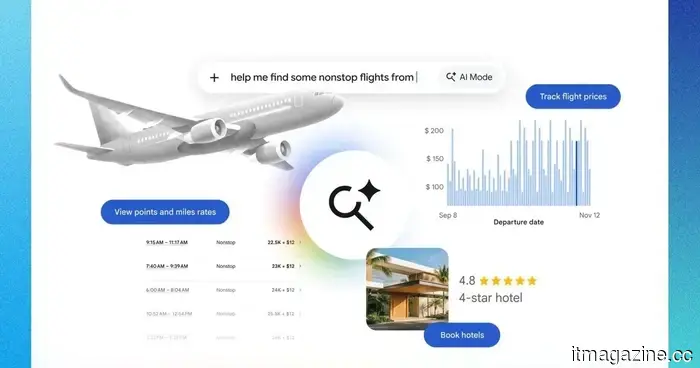 Google AI Mode can now inform you about flight price drops and assist you in booking your hotel.
Google has introduced three new travel features in AI Mode, allowing you to monitor flight prices, compare rewards points, and make hotel reservations, all within a single chat.
Google AI Mode can now inform you about flight price drops and assist you in booking your hotel.
Google has introduced three new travel features in AI Mode, allowing you to monitor flight prices, compare rewards points, and make hotel reservations, all within a single chat.
 OpenAI has appointed Sandhya Devanathan from Meta to oversee operations in Southeast Asia and Australia.
OpenAI has appointed a Meta executive to lead operations in Southeast Asia and Australia, marking its third senior appointment in Asia within six months. In contrast, Europe has received a headquarters.
OpenAI has appointed Sandhya Devanathan from Meta to oversee operations in Southeast Asia and Australia.
OpenAI has appointed a Meta executive to lead operations in Southeast Asia and Australia, marking its third senior appointment in Asia within six months. In contrast, Europe has received a headquarters.
 Google is taking action against Android applications that consume excessive memory due to a RAM shortage driven by AI developments.
In response to a worldwide RAM shortage driven by AI needs, Google will implement new memory limits for Android applications beginning in February 2027, along with penalties for those that do not adhere to these standards.
Google is taking action against Android applications that consume excessive memory due to a RAM shortage driven by AI developments.
In response to a worldwide RAM shortage driven by AI needs, Google will implement new memory limits for Android applications beginning in February 2027, along with penalties for those that do not adhere to these standards.
Nvidia has suspended certain aspects of the revenue-sharing program it introduced in July.
According to the Wall Street Journal, Nvidia has suspended certain agreements within its AI cloud credit-support program following antitrust concerns raised by employees and objections from partners.