
Nvidia has paid Poolside $6 billion to obtain a license for its model factory and to employ 109 workers.
Nvidia has agreed to pay Poolside $6 billion to secure the software used by the startup for developing AI models and will offer jobs to 109 of its employees. Additionally, Nvidia is investing $1 billion for the remaining equity, valuing the company at $12 billion before this investment. These terms were detailed in a letter sent by Poolside to its investors, as first reported by Newcomer. The licensing agreement is non-exclusive, and the three founders will remain in their roles.
The agreement is described in the letter as “not an acquisition and it is not an acquihire.” Poolside plans to distribute the $6 billion to its investors by the end of next year.
This marks the third similar deal Nvidia has executed. In each case, the company secures a license, hires staff, takes an equity stake, and allows the original company to continue operating. The licenses in these agreements have all been non-exclusive, and none of the three startups has been fully acquired.
TNW highlighted this business model back in May, when Nvidia paid Groq $20 billion for its inference technology and recruited its top engineers. Groq retained its independence and successfully raised $650 million for its remaining operations. This month, it closed a $350 million funding round at a valuation of $3.5 billion, with Nvidia participating.
In December, Nvidia invested $20 billion for both technology and personnel from Groq, which continues to operate independently with a valuation of $3.5 billion as of this month. A similar arrangement was reached with the hardware startup Enfabrica for approximately $900 million, according to The Decoder. These types of deals allow large technology companies to acquire expertise and personnel without fully purchasing a company, thereby avoiding the regulatory scrutiny that can accompany such transactions.
Regarding personnel, while Nvidia recruited Groq's leading engineers, Groq appointed new management. In contrast, Poolside will retain its three founders and offer positions to 109 employees.
Poolside's CEO, Eiso Kant, discussed the team's size on the Latent Space podcast last month, noting that “less than 70 people built this model” and that fewer than 115 individuals contributed across engineering and research.
Latent Space described this situation as a reverse-execuhire, reflecting that Poolside’s team was quite small. The software Nvidia is licensing is known as the Model Factory, which Poolside used to create its models.
Poolside began as a developer of a coding AI agent, transitioned to data centers, and later released an open-source model on Nvidia server chips, according to The Information. Nvidia had already invested up to $1 billion in Poolside last October, and the newly announced license is non-exclusive, allowing Poolside to license the same software to others.
The letter explains the reasons behind the decision to cease developing frontier models. It notes, “For the last 3 1/2 years we've been directionally correct in a race where capital requirements escalated dramatically,” and details a missed opportunity to raise $2 billion in a six-week window to fund a 40,000 GB300 cluster, which resulted in losing that cluster. It asserts that Poolside could have built a competitive model using 10,000 to 20,000 of those chips and that next year’s frontier will require “a cluster far larger than an order of magnitude.” The constraints are identified as not only financial but also related to physical data center space and contracted computing resources.
The letter further states that the company has been “directionally correct” for three and a half years and that the transition to AI has barely begun, with the world “not yet reaching 0.1%.”
Nvidia also develops open models within the Nemotron line and is reportedly working towards a trillion-parameter open model. Poolside’s Laguna, created by the same team, was presented as the West’s answer to DeepSeek and Qwen, and it was trained on Nvidia server chips.
Recently, Nvidia scaled back a $250 billion investment commitment to OpenAI. The reasons for the $6 billion licensing fee have not been disclosed, and neither Nvidia nor Poolside has publicly commented on the details of the deal.
Regarding the future of Poolside, the founders have indicated they are “not ready to share the updated vision.” Poolside Infrastructure Company, established in January, is constructing a 1.2GW data center in Texas and has appointed a new CEO two months ago and a CFO this week, both of whom were hired prior to the recent announcement.
The letter argues that human-level capability will be “fully commoditized by open source models,” while superintelligence will not be. It categorizes valuable problems into two types: intelligence-bound and experiment-bound, asserting that the former, including software and accounting, will become “a low margin commodity,” whereas challenges like curing cancer belong in the second category, where intelligence alone cannot replace the need for real-world experimentation. The letter concludes by stating, “AI
Otros artículos
 Patreon acknowledges that the issue of discoverability for smaller creators is a result of its own shortcomings.
Patreon's discovery network has favored larger creators. Jack Conte acknowledges that this is a flaw on Patreon's part, and indicates that the algorithm will now assess posts rather than creators.
Patreon acknowledges that the issue of discoverability for smaller creators is a result of its own shortcomings.
Patreon's discovery network has favored larger creators. Jack Conte acknowledges that this is a flaw on Patreon's part, and indicates that the algorithm will now assess posts rather than creators.
 Adobe intends for Firefly to manage the complete soundtrack for your videos.
Adobe Firefly has dedicated the last few years to mastering image and video creation. Now, Adobe aims for it to also manage soundtracks. The features Generate Music, Generate Speech, and Generate Sound Effects are now widely accessible in Firefly, offering creators the ability to produce music, narration, and custom sound effects all within Adobe’s AI environment. Adobe states that Generate Music […]
Adobe intends for Firefly to manage the complete soundtrack for your videos.
Adobe Firefly has dedicated the last few years to mastering image and video creation. Now, Adobe aims for it to also manage soundtracks. The features Generate Music, Generate Speech, and Generate Sound Effects are now widely accessible in Firefly, offering creators the ability to produce music, narration, and custom sound effects all within Adobe’s AI environment. Adobe states that Generate Music […]
 Mark Zuckerberg purchased a castle, while the rest of us settle for a sandcastle once a year.
Mark Zuckerberg purchased a 440-acre estate in Ireland during the week Meta faced trial regarding issues related to children. However, the castle itself is not the issue at hand.
Mark Zuckerberg purchased a castle, while the rest of us settle for a sandcastle once a year.
Mark Zuckerberg purchased a 440-acre estate in Ireland during the week Meta faced trial regarding issues related to children. However, the castle itself is not the issue at hand.
 For the first time, New York has surpassed San Francisco in the number of tech workers.
In CBRE's 2026 report, New York surpassed the Bay Area in terms of tech headcount, primarily due to San Francisco losing 23,900 jobs. However, it remains at the top of the rankings.
For the first time, New York has surpassed San Francisco in the number of tech workers.
In CBRE's 2026 report, New York surpassed the Bay Area in terms of tech headcount, primarily due to San Francisco losing 23,900 jobs. However, it remains at the top of the rankings.
 Nothing’s new CMF earbuds provide noise cancellation at a price point similar to that of Apple’s wired EarPods.
CMF has introduced its most affordable earbuds to date, featuring ANC, spatial audio, and extended battery life, but U.S. consumers currently do not have access to them.
Nothing’s new CMF earbuds provide noise cancellation at a price point similar to that of Apple’s wired EarPods.
CMF has introduced its most affordable earbuds to date, featuring ANC, spatial audio, and extended battery life, but U.S. consumers currently do not have access to them.
 DeepSeek unveils an experimental multimodal model to compete with Anthropic.
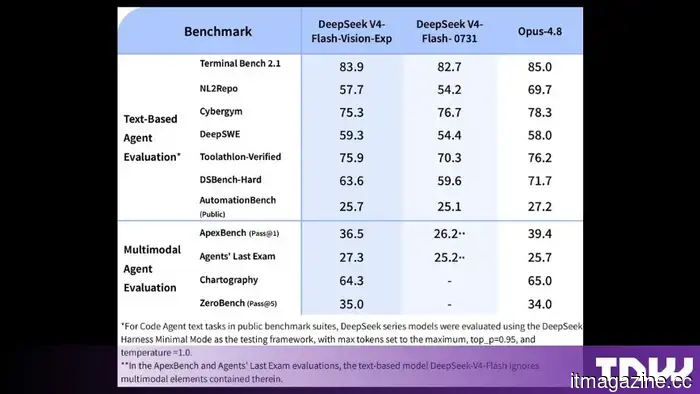
DeepSeek's experimental multimodal model has secured victories in three out of eleven benchmarks when compared to Anthropic's Opus-4.8, according to the table published by DeepSeek itself.
DeepSeek unveils an experimental multimodal model to compete with Anthropic.
DeepSeek's experimental multimodal model has secured victories in three out of eleven benchmarks when compared to Anthropic's Opus-4.8, according to the table published by DeepSeek itself.
Nvidia has paid Poolside $6 billion to obtain a license for its model factory and to employ 109 workers.
Nvidia is compensating Poolside with $6 billion to license its model-building software and to employ 109 individuals. The letter clarifies that this is not an acquisition.