
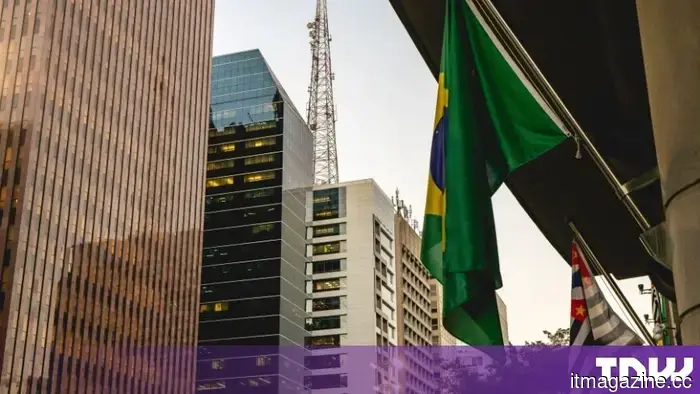
Brazil is developing two AI supercomputers, one in collaboration with China and the other with the United States.
Brazil is investing 2.3 billion reais, approximately $444 million, in two AI supercomputers. One will be developed in collaboration with Huawei, while the other is anticipated to go to Nvidia, which is the main objective. The Lula administration stated, “The strategy is to avoid reliance on a single company, technology, or nation,” highlighting a direct approach that many countries typically take quietly.
The Chinese component is the more significant of the two. Huawei Technologies, along with the speech-recognition firm iFlytek, will create a 1.3 billion reais system in Rio de Janeiro, roughly equating to $251 million, aimed at training large language models, with construction set to commence in July 2027.
The second supercomputer will likely go to Nvidia, according to unnamed officials and the science and technology minister, Luciana Santos. This project is estimated at about 1 billion reais, or $193 million, and is expected to be operational by the end of 2027. It will be located in Rio Grande do Norte, chosen for its energy capabilities rather than geographical proximity. The state possesses considerable wind and solar resources, which are critical for a machine of this scale, as operators worldwide have recognized.
Officials assert that the Nvidia system would rank among the most powerful AI machines globally; however, this claim lacks a detailed specification and should be seen more as an aspiration than a concrete benchmark.
The funding originates from the National Fund for Scientific and Technological Development, disbursed in phases rather than as a lump sum, allowing Brasilia the flexibility to slow either project without cancellation.
Choosing to split the work carries associated costs. Two architectures necessitate separate software systems, distinct sets of trained engineers, and prevent the pooling of resources, forcing the Brazilian research community to navigate an ecosystem divide that most national initiatives typically seek to avoid.
What this arrangement offers is insulation. American export controls have frequently altered which Nvidia components can be exported where, and the Chinese domestic alternative has focused on custom silicon rather than GPUs; thus, a commitment to a single supplier exposes a country to uncontrollable policy changes.
Brazil has not clarified whether US export regulations apply to the Nvidia hardware it plans to acquire, nor has it communicated whether Washington has been consulted. Additionally, it has not addressed if the Huawei system violates any US restrictions regarding the company.
These inquiries are not mere hypotheticals for a middle-income nation making such a sizable investment. Jensen Huang has publicly suggested that Chinese models utilizing Chinese chips would not be favorable for the United States, and Brazil has now facilitated both architectures to operate concurrently within the same national program.
While the amounts involved are modest compared to other nations' expansions, such as Britain's £225 million investment in a single machine, Denmark’s outright purchase of an Nvidia system, and the EU’s €30 billion gigafactory initiative, Brazil’s $444 million appears to be an initial step rather than an attempt to achieve parity.
Furthermore, it represents the largest sovereign AI compute commitment in Latin America. The region has seen significant private investment in data centers over the years, although much of it does not belong to the host countries.
The announcement emphasizes sovereignty, a term that carries substantial weight. Both a Huawei machine and a Nvidia machine are products Brazil does not manufacture, with sovereignty concerning the data and models rather than the hardware itself.
This still holds value. Developing a Portuguese-language model using Brazilian data within Brazil is distinctly different from renting capacity in Virginia, regardless of the brand of the equipment.
The targeted beneficiaries are the research community. Typically, public funding of this nature is directed towards universities and state institutions rather than companies, though Brasilia has not released the access criteria for either supercomputer.
Currently, neither system is in existence. The Huawei project is set to begin in 2027, and the tender for the Nvidia system has yet to be formally awarded.
Otros artículos
 U.S. users can now create and share mini-games using Meta's Pocket app.
Meta's Pocket is now launching in the U.S., enabling users to vibe-code basic game concepts into playable mini-games that they can share and remix.
U.S. users can now create and share mini-games using Meta's Pocket app.
Meta's Pocket is now launching in the U.S., enabling users to vibe-code basic game concepts into playable mini-games that they can share and remix.
 The JISULIFE Ultra2 surpasses Dyson’s handheld fan in cooling performance, and here’s why it's the best choice for this summer.
This post is sponsored in collaboration with JISULIFE. If you've been considering Dyson's latest handheld fan and questioning if it’s truly the top choice for enduring a heatwave, the evidence suggests otherwise. The JISULIFE Ultra2, the flagship model from the premier brand of handheld mini-fans, outperforms Dyson’s handheld […]
The JISULIFE Ultra2 surpasses Dyson’s handheld fan in cooling performance, and here’s why it's the best choice for this summer.
This post is sponsored in collaboration with JISULIFE. If you've been considering Dyson's latest handheld fan and questioning if it’s truly the top choice for enduring a heatwave, the evidence suggests otherwise. The JISULIFE Ultra2, the flagship model from the premier brand of handheld mini-fans, outperforms Dyson’s handheld […]
 I moved from the M1 to the M5 MacBook Air, and the sound quality of the speakers has declined.
I utilized the M1 MacBook Air as my main laptop for almost four years. Throughout that period, I relied on it for a range of tasks, including writing news articles and editing photos for reviews, as well as working during flights and on weekend getaways. The one feature that received more praise than its sleek build and overall aesthetic was […]
I moved from the M1 to the M5 MacBook Air, and the sound quality of the speakers has declined.
I utilized the M1 MacBook Air as my main laptop for almost four years. Throughout that period, I relied on it for a range of tasks, including writing news articles and editing photos for reviews, as well as working during flights and on weekend getaways. The one feature that received more praise than its sleek build and overall aesthetic was […]
 OpenAI has released a Messages plugin that provides summaries of your conversations, detailing who you are speaking with and the topics discussed.
The Mac app from OpenAI now has the ability to read, search, and send Apple Messages. By default, the sending feature is restricted, and OpenAI has noted a bug that may disable the prompt.
OpenAI has released a Messages plugin that provides summaries of your conversations, detailing who you are speaking with and the topics discussed.
The Mac app from OpenAI now has the ability to read, search, and send Apple Messages. By default, the sending feature is restricted, and OpenAI has noted a bug that may disable the prompt.
 GTA 6 might have a second source who has access to internal documents.
Another group has emerged claiming to have GTA 6 development files as Rockstar gets ready to reveal the game on August 27.
GTA 6 might have a second source who has access to internal documents.
Another group has emerged claiming to have GTA 6 development files as Rockstar gets ready to reveal the game on August 27.
 Wave Browser Connects Daily Surfing to Ocean Cleanup Efforts
The majority of individuals select a web browser based on practical factors such as speed, familiarity, compatibility, and convenience. The environmental impact is often not a significant part of this choice. However, Wave Browser is aiming to make it a consideration for users. Created by Eightpoint, Wave is a Chromium-based browser that merges typical browsing capabilities with features designed to assist […]
Wave Browser Connects Daily Surfing to Ocean Cleanup Efforts
The majority of individuals select a web browser based on practical factors such as speed, familiarity, compatibility, and convenience. The environmental impact is often not a significant part of this choice. However, Wave Browser is aiming to make it a consideration for users. Created by Eightpoint, Wave is a Chromium-based browser that merges typical browsing capabilities with features designed to assist […]
Brazil is developing two AI supercomputers, one in collaboration with China and the other with the United States.
Brazil is set to invest 2.3 billion reais in two AI supercomputers, with one being developed in collaboration with Huawei and iFlytek in Rio, and the other anticipated to be supplied by Nvidia in the north-east.