

A third of the internet displays indications of AI-generated content, attributed to ChatGPT.
The Pew Research Center has discovered evidence of AI authorship on a significant portion of web pages published since late 2022.
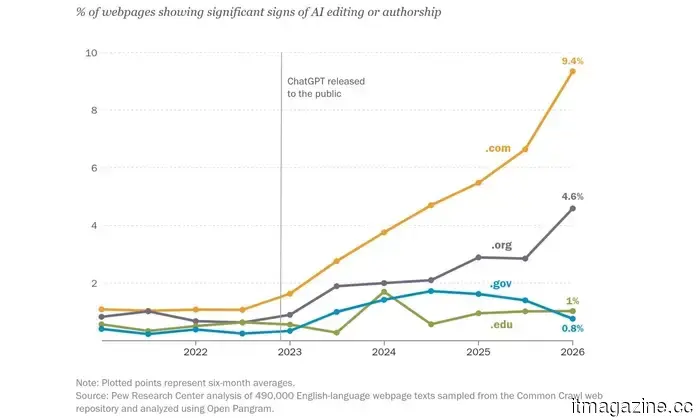
The internet has increasingly seen the rise of AI-generated content since the advent of ChatGPT, and a recent analysis by Pew Research Center helps clarify just how prevalent this phenomenon has become. The study indicates that approximately one-third of web pages published after the launch of ChatGPT exhibit signs of AI authorship.
The internet didn’t transform into AI-driven content overnight.
The key term here is “signs.” Pew's research does not claim that one-third of all webpages on the internet were completely written by AI. Instead, it searched for markers that imply AI was involved in the content creation process.
AI authorship is growing across various web domains, particularly .com sites, which have experienced the most significant growth since ChatGPT was released, according to Pew Research Center.
This distinction is crucial because contemporary online writing is not purely categorized as human or machine. A writer might utilize AI to draft an initial version, revise sections, correct grammar, expand content, or create an SEO-friendly article. Consequently, the final product may feature contributions from both humans and machines.
Nonetheless, this trend is difficult to overlook. Since ChatGPT’s public launch in November 2022, the proportion of web content indicating AI authorship has seen a notable increase. This aligns with previous research showing that AI-generated or aided content has become a noteworthy presence on the web, rather than being confined to a niche associated with apparent content farms.
This scenario creates an unusual internet dynamic.
There’s an intriguing irony at play. AI companies require vast amounts of human-generated content to train their models, while those same models are now helping to produce more content for online publication. The internet is evolving into a space where humans write for machines, machines write for humans, and machines may ultimately learn from content created by other machines.
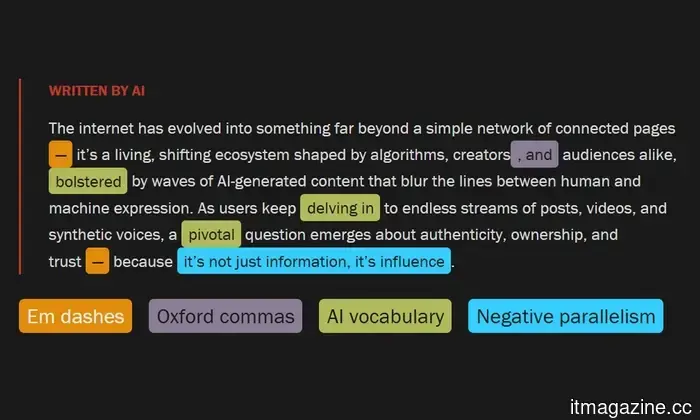
Pew Research Center has identified some common characteristics of AI-generated text.
Additionally, there is a significant discrepancy between the amount of AI content that exists and what people actually encounter. Previous research from Graphite has found that AI-generated articles have neared half of all newly published online articles, yet its separate analysis revealed that human-written pieces still dominate Google search results and references.
This implies that the web isn't on the verge of becoming an unending stream of AI-generated material. However, Pew's findings highlight that the traditional assumption that something posted online was likely authored by a human is becoming increasingly unreliable. While the internet remains human-centric, AI is no longer just a visitor; it is increasingly establishing a presence.
Varun is an experienced technology journalist and editor with over eight years of experience in consumer tech media. His work covers a wide range of topics.
Meta has made its AI assistant available on Mac, but it still has some ground to cover.
The newly introduced desktop assistant can analyze the current screen and accept voice input across macOS. Meta has officially released its Meta AI assistant for Mac via a dedicated desktop application, offering users yet another AI chatbot to manage alongside their existing tabs. This app can evaluate a shared window, respond to queries about on-screen content, create material, and accept voice dictation throughout macOS.
Meta AI has the capability to perceive what is on display.
MIT researchers suggest that AI might be learning from billions of images without directly referencing any specific one.
An unsettling inquiry for the era of generative AI is whether an AI-generated image can be traced back to the particular images that influenced it. A study conducted by the Computer Science and Artificial Intelligence Laboratory at MIT proposes that, particularly with larger models, the answer is frequently no. Researchers Dai and Gifford have termed this phenomenon “attribution decay” in their paper, which has been made available today in Nature Communications. This term describes how the influence of any single training data point becomes progressively more difficult to identify as the dataset's size increases.
The larger the dataset, the more nebulous the attribution becomes.
Researchers are using basic 3D-printed reflective surfaces to resolve the biggest issue with ultra-fast mmWave 5G connections.
5G’s millimeter-wave technology offers exceptionally rapid wireless speeds, but it has a significant drawback: these signals struggle to navigate obstacles. Walls, furniture, people, and even minor movements can drastically weaken mmWave connections. Now, a team at the University of California San Diego is suggesting a surprisingly simple solution: inexpensive reflective tiles that merely redirect the signal to where it needs to go.
The challenge posed by extremely fast 5G needs addressing.





Other articles
 The hidden CIA link that contributed to NeXT's continuation and Steve Jobs' comeback at Apple.
A recently disclosed connection with the CIA might have played a role in sustaining Steve Jobs' struggling NeXT, paving an unexpected path for his eventual comeback to Apple.
The hidden CIA link that contributed to NeXT's continuation and Steve Jobs' comeback at Apple.
A recently disclosed connection with the CIA might have played a role in sustaining Steve Jobs' struggling NeXT, paving an unexpected path for his eventual comeback to Apple.
 Just acquired a Pixel 11? Here are the top accessories I would invest in.
I reviewed numerous accessories compatible with Pixelsnap for the Pixel 11 to determine which ones are truly worth purchasing.
Just acquired a Pixel 11? Here are the top accessories I would invest in.
I reviewed numerous accessories compatible with Pixelsnap for the Pixel 11 to determine which ones are truly worth purchasing.
 Sennheiser has just released earbuds that you won't need to discard when the battery runs out.
Sennheiser's latest Momentum True Wireless 5 earbuds offer premium sound quality, Dolby Atmos support, and a battery that users can replace on their own.
Sennheiser has just released earbuds that you won't need to discard when the battery runs out.
Sennheiser's latest Momentum True Wireless 5 earbuds offer premium sound quality, Dolby Atmos support, and a battery that users can replace on their own.
 Recently acquired a Pixel 11? Here are the top accessories I would recommend investing in.
I explored numerous accessories compatible with Pixelsnap for the Pixel 11 to determine which ones are truly worth purchasing.
Recently acquired a Pixel 11? Here are the top accessories I would recommend investing in.
I explored numerous accessories compatible with Pixelsnap for the Pixel 11 to determine which ones are truly worth purchasing.
 The covert CIA link that contributed to NeXT's endurance and facilitated Jobs' comeback to Apple
A recently disclosed connection with the CIA might have played a role in supporting Steve Jobs' struggling NeXT, ultimately establishing an unforeseen link to his eventual comeback at Apple.
The covert CIA link that contributed to NeXT's endurance and facilitated Jobs' comeback to Apple
A recently disclosed connection with the CIA might have played a role in supporting Steve Jobs' struggling NeXT, ultimately establishing an unforeseen link to his eventual comeback at Apple.
 Meta's smart glasses are now being utilized by school bullies.
Teenagers are utilizing Ray-Ban Meta smart glasses to covertly record their classmates and teachers in school, with a significant amount of the harassment directed towards girls. A lot of the footage remained online until Futurism reached out to Meta and TikTok directly.
Meta's smart glasses are now being utilized by school bullies.
Teenagers are utilizing Ray-Ban Meta smart glasses to covertly record their classmates and teachers in school, with a significant amount of the harassment directed towards girls. A lot of the footage remained online until Futurism reached out to Meta and TikTok directly.
A third of the internet displays indications of AI-generated content, attributed to ChatGPT.
A recent study by the Pew Research Center reveals indicators of AI authorship on about one-third of web pages that have been published since the launch of ChatGPT in late 2022.