
A dull tile aims to resolve the most significant issue with ultra-fast mmWave 5G connections for you.
Researchers are employing simple 3D-printed reflective surfaces to help reroute mmWave signals through challenging indoor settings.
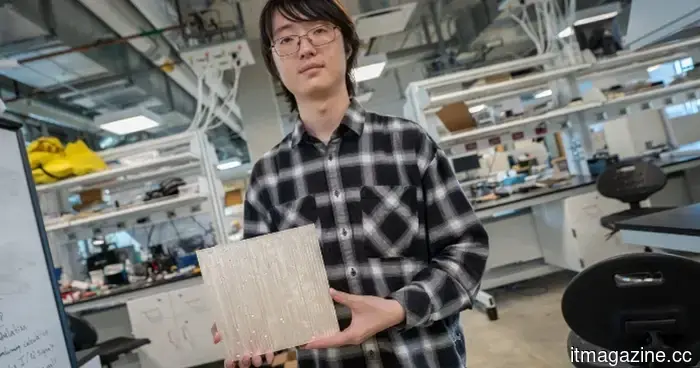
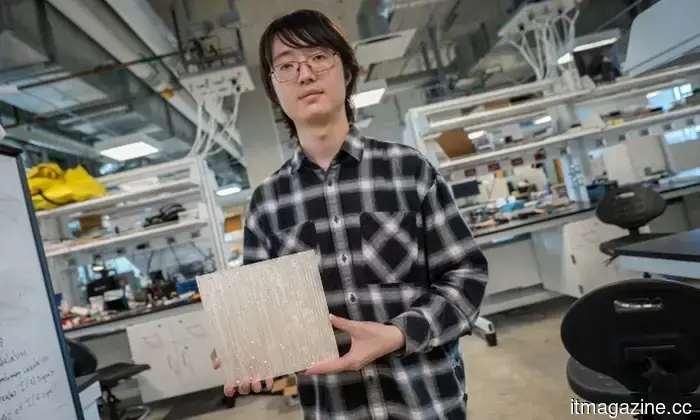
Wuqiong Zhao, a PhD student at UC San Diego and co-author of the study, is shown holding a reflective tile.
5G’s millimeter-wave technology offers remarkably fast wireless speeds, yet it has a significant drawback: these signals struggle to navigate around obstacles. Walls, furniture, people, and even slight movements can drastically weaken mmWave connections. Researchers at the University of California San Diego are suggesting a rather straightforward solution: affordable reflective tiles that simply redirect the signal as needed.
The challenge of ultrafast 5G
mmWave operates at the high-frequency end of wireless communications and provides significantly greater bandwidth compared to traditional cellular frequencies. This feature makes it appealing for extremely high-speed connections, but it comes with a downside: propagation issues. Signals experience considerable path loss and are particularly sensitive to obstacles.
Consequently, this creates a frustrating situation indoors. A phone may have a strong mmWave connection in one location but lose the signal when someone walks between it and the access point. Typically, resolving this would require adding more access points, powered relays, or advanced reconfigurable intelligent surfaces, all of which increase cost and complexity. Fortunately, UC San Diego's idea is much simpler: instead of generating a new signal, just redirect the existing one.
Introducing the $2 signal redirector
The researchers created passive metasurfaces, which are essentially 3D-printed reflective tiles that aim to redirect mmWave signals. These tiles do not require batteries, power supplies, or intricate control electronics. Rather, multiple low-cost surfaces can be strategically placed throughout an environment to steer wireless signals toward poorly covered areas.
The lightweight 3D-printed tiles can nearly double the average indoor mmWave data rates without needing power or network alterations. The UC San Diego team named this approach FlowForm, and their research indicates that networks using these inexpensive passive surfaces can compete with more costly active methods. Priced at about $2 per tile, the cost-effectiveness is particularly appealing: instead of installing another complicated piece of networking equipment every time a signal encounters a problematic wall, a building could use a collection of surprisingly simple reflectors.
The unremarkable solution may be the smartest one
However, this doesn’t imply that every 5G tower needs to be encircled by a barrier of shiny tiles. The technology is still under research, and actual deployment would require determining how many surfaces are necessary, where to place them, and how effectively they perform in various environments.
Each 6×6-inch tile features thousands of tiny elements that passively direct mmWave signals around barriers.
The fundamental concept is intriguing because it addresses one of mmWave’s significant challenges without introducing additional power-hungry devices into the network. As wireless systems advance toward higher frequencies and faster speeds, sometimes the most clever solution is not another complex chip or antenna, but rather a $2 piece of plastic directing a radio signal.






Other articles
 Uber has launched its initial autonomous vehicle rides in Europe, starting in Zagreb, where a safety driver is present.
Uber has introduced autonomous rides in Europe for the first time in Zagreb, utilizing technology from Pony.ai and Verne. A safety operator remains present in the vehicle.
Uber has launched its initial autonomous vehicle rides in Europe, starting in Zagreb, where a safety driver is present.
Uber has introduced autonomous rides in Europe for the first time in Zagreb, utilizing technology from Pony.ai and Verne. A safety operator remains present in the vehicle.
 Google is offering college students a complimentary year of AI Pro along with a variety of study tools.
Google is offering qualifying US college students a complimentary year of AI Pro and introducing new study tools on Search and Gemini for the back-to-school season.
Google is offering college students a complimentary year of AI Pro along with a variety of study tools.
Google is offering qualifying US college students a complimentary year of AI Pro and introducing new study tools on Search and Gemini for the back-to-school season.
 One of the most debated federal agencies is prohibiting employees from using Meta smart glasses.
ICE has prohibited Meta smart glasses in federal offices due to privacy issues, while DHS is pursuing funding for specialized smart glasses intended to aid in biometric identification for immigration enforcement.
One of the most debated federal agencies is prohibiting employees from using Meta smart glasses.
ICE has prohibited Meta smart glasses in federal offices due to privacy issues, while DHS is pursuing funding for specialized smart glasses intended to aid in biometric identification for immigration enforcement.
 Samsung has raised foundry prices by as much as 15%, with China facing the highest increases.
According to Reuters, Samsung has increased its advanced chipmaking prices by as much as 15%, driven by AI demand exceeding TSMC’s production capacity. Chinese clients are now facing the highest prices.
Samsung has raised foundry prices by as much as 15%, with China facing the highest increases.
According to Reuters, Samsung has increased its advanced chipmaking prices by as much as 15%, driven by AI demand exceeding TSMC’s production capacity. Chinese clients are now facing the highest prices.
 A British AI-chip startup is securing funding at a valuation of $6.5 billion following a deal with Anthropic.
British AI-chip startup Fractile is reportedly seeking to raise funds at a valuation of $6.5 billion, according to Bloomberg, which is six times its valuation from May, following a contract to supply Anthropic.
A British AI-chip startup is securing funding at a valuation of $6.5 billion following a deal with Anthropic.
British AI-chip startup Fractile is reportedly seeking to raise funds at a valuation of $6.5 billion, according to Bloomberg, which is six times its valuation from May, following a contract to supply Anthropic.
 Google is offering college students a complimentary year of AI Pro, along with a variety of study tools.
Google is offering qualifying college students in the US a complimentary year of AI Pro and is introducing new study tools in Search and Gemini in preparation for the back-to-school season.
Google is offering college students a complimentary year of AI Pro, along with a variety of study tools.
Google is offering qualifying college students in the US a complimentary year of AI Pro and is introducing new study tools in Search and Gemini in preparation for the back-to-school season.
A dull tile aims to resolve the most significant issue with ultra-fast mmWave 5G connections for you.
Researchers at UC San Diego have created low-cost passive reflective tiles that may assist mmWave 5G signals in navigating around walls and other barriers without needing a power source.