
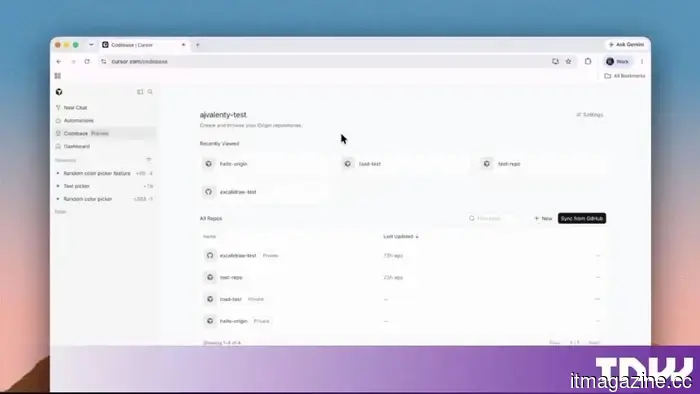
Cursor Origin is enabled by default for paid users, and the terms regarding its data are not publicly available.
Cursor began rolling out Origin, its own code hosting platform, on Monday morning. Approximately three and a half hours later, GitHub encountered significant issues. The sequence is important because much of the internet experienced it in reverse. Matt Palmer, an employee at Cursor, quote-tweeted the company’s launch with a comment that became even more popular than the product itself. He mentioned that although Cursor aimed to launch earlier, GitHub's downtime affected that timeline. It's a humorous observation, and a clever one at that. Origin had already launched by this point. VentureBeat’s Michael Nuñez detailed the timeline and deemed it the best line of the day, pointing out that companies typically schedule launches weeks in advance. There’s no evidence to suggest that Cursor intentionally timed this; it was merely a serendipitous coincidence that benefited the company immensely.
What actually occurred
GitHub's issues lasted six hours and forty-two minutes, resolving at 20:22 UTC. Error rates soared to about 20% for pull requests, issues, and the API. Downloads of archives and raw files experienced around a 50% failure rate. The enterprise single sign-on also went down, impacting SAML, OIDC, SCIM provisioning, and Team Sync. Copilot was affected as well. This marked GitHub's seventh incident on its status page within a fifteen-day span.
The design advantage
Cursor Origin offers repositories, pull requests, code browsing, and search functionalities. The notable aspect is what it does not require. Cursor doesn’t ask users to abandon GitHub; instead, you connect an organization, select repositories, and these show up next to Origin-native ones. Permissions reflect GitHub’s existing read and write configurations rather than establishing a separate system. All pushes continue to go to GitHub, and the changelog indicates that GitHub remains the definitive source for anything initiated there. Pull request comments sync both directions within seconds. Depot and Buildkite facilitate your current GitHub Actions workflows without modifications, while Vercel manages preview deployments. This compatibility forms the core of its strategy. Removing source control is among the riskiest endeavors for an engineering team; typically, a chief technology officer wouldn't endorse such a drastic change for an early beta. A read-mostly mirror provides a cost-free trial and subtly shifts the preferred environment for developers.
The agent discussion is pertinent
Cursor unveiled Origin in June during its inaugural developer conference, marketing the product as a git forge for the agent-driven era. The demo showcased agents achieving 22.6 commits per second to a single repository. The performance exceeded the demo's statistics; RuntimeWire reported that agents operating independently in cloud environments now account for 35% of the pull requests merged within Cursor. A forge designed for humans presupposes that each pull request reflects human intention, allowing users to seek clarification from authors. However, as a third of merged changes originate from software, the review process shifts from a dialogue to a matter of scheduling. Broader data reinforces this perspective. Google’s DORA report for 2025 indicated that AI adoption positively correlates with delivery throughput but negatively affects delivery stability. Stack Overflow’s survey of 49,009 developers revealed a decline in trust in AI accuracy, dropping from 43% to 33%. This mirrors the argument Cursor made for utilizing a team of agents working continuously.
GitHub faced the consequences
An analysis by LeadDev noted 257 incidents related to GitHub between May 2025 and April 2026, with 48 classified as major, averaging roughly one significant disruption weekly. GitHub Actions alone contributed to 57 outages over twelve months. The company has acknowledged this situation itself, with chief technology officer Vlad Fedorov noting that the platform had not prepared for its current scale. An engineering blog post from April admitted that GitHub had failed to uphold its own reliability standards. Users have already transitioned elsewhere; Zig migrated to Codeberg in November, and Mitchell Hashimoto announced in April that Ghostty would follow suit. The Information reported that OpenAI has started developing its alternative partly due to outages preventing engineers from making commits. Since Thomas Dohmke’s resignation a year ago, GitHub has lacked a chief executive, with Microsoft integrating the unit into its CoreAI division. David Uzondu from Neowin mentioned that GitHub hasn't achieved a clean operational month all year.
The unanswered question from Cursor
This is the segment that warrants a security review more than media scrutiny. Cursor Origin will be available to all paid plan users starting Monday, except for enterprise organizations whose administrators opt out. This is an opt-out process, not opt-in. Many companies have yet to determine whether proprietary code can reside on a new host. Cursor has made that determination for them. The company has released no information on data retention, residency, training usage, subprocessors, or migration tools. The documentation addresses namespaces, plan gating, and privacy mode inheritance but lacks further details. Additionally, there’s the ownership aspect; SpaceX finalized its
Другие статьи
 Greg Brockman stated that OpenAI did not fully recognize the cyber capabilities of its own models.
Greg Brockman dismissed OpenAI's departures during a television appearance. In a blog post he penned, he mentioned that the company had misjudged the cyber capabilities of its models.
Greg Brockman stated that OpenAI did not fully recognize the cyber capabilities of its own models.
Greg Brockman dismissed OpenAI's departures during a television appearance. In a blog post he penned, he mentioned that the company had misjudged the cyber capabilities of its models.
 The initial Ferrari Luce was sold for $40 million, which is 36 times higher than its estimated value.
Ferrari's Luce EV Chassis 0 was sold at Monterey for $40 million, setting records for a new car, an electric vehicle, and a charity auction item. The delivery is expected in 2027.
The initial Ferrari Luce was sold for $40 million, which is 36 times higher than its estimated value.
Ferrari's Luce EV Chassis 0 was sold at Monterey for $40 million, setting records for a new car, an electric vehicle, and a charity auction item. The delivery is expected in 2027.
 Damaging your Galaxy Z Fold 8 Ultra screen may result in a repair cost of $639, so it's important to treat it with care.
Repairing a cracked inner screen on the Z Fold 8 Ultra will cost you $639, as stated by Samsung's official repair pricing.
Damaging your Galaxy Z Fold 8 Ultra screen may result in a repair cost of $639, so it's important to treat it with care.
Repairing a cracked inner screen on the Z Fold 8 Ultra will cost you $639, as stated by Samsung's official repair pricing.
 Wispr secured $280 million at a $2 billion valuation to assert that the text box era is over.
The Wispr Series B secured $280 million at a valuation of $2 billion. Menlo claims that the text box is the upcoming interface to become obsolete. Its own error rate exceeds 30% in noisy conditions.
Wispr secured $280 million at a $2 billion valuation to assert that the text box era is over.
The Wispr Series B secured $280 million at a valuation of $2 billion. Menlo claims that the text box is the upcoming interface to become obsolete. Its own error rate exceeds 30% in noisy conditions.
 OpenAI is supporting 13 local newsletters from Axios through a three-year agreement.
The partnership between Axios and OpenAI for local news finances 13 newsletters over a span of three years. Both companies have not disclosed the amount paid or if Axios relinquished its right to file a lawsuit.
OpenAI is supporting 13 local newsletters from Axios through a three-year agreement.
The partnership between Axios and OpenAI for local news finances 13 newsletters over a span of three years. Both companies have not disclosed the amount paid or if Axios relinquished its right to file a lawsuit.
 EY will retain interns for a year prior to extending a job offer.
EY will retain assurance interns on a part-time basis for 8 to 12 months following their internship, as AI takes over the junior tasks that new employees once learned.
EY will retain interns for a year prior to extending a job offer.
EY will retain assurance interns on a part-time basis for 8 to 12 months following their internship, as AI takes over the junior tasks that new employees once learned.
Cursor Origin is enabled by default for paid users, and the terms regarding its data are not publicly available.
Cursor Origin was released just hours before the GitHub outage, not following it. It is enabled by default for paid subscriptions, and Cursor has not provided any data terms regarding it.