

The Supreme Court has decided not to assist Verizon in reclaiming $47 million related to location data.
The US Supreme Court has denied Verizon's request to modify a June ruling, which would have allowed the company to seek a refund of the $47 million it paid for selling access to customer location data. In contrast, AT&T, which is in a different procedural situation, is still able to pursue a reimbursement of its $57 million.
Verizon will not recover the $47 million it spent on customer location data. On Monday, the US Supreme Court rejected a request to adjust a previous ruling so an appeals court could assess the company's refund claim.
AT&T is in a more advantageous position. Due to its distinct procedural circumstances, it can still seek compensation for the $57 million it paid.
The penalties trace back to April 2024, when the Federal Communications Commission fined four carriers nearly $200 million combined. T-Mobile faced an $80 million penalty, AT&T $57 million, Verizon $47 million, and Sprint $12 million for selling access to customers' location data to aggregators who resold it.
In practice, the implications were worse than the amounts indicate. LocationSmart made a demo available online that could almost locate any mobile phone in North America, Securus sold location data to law enforcement, and reporters illustrated the issue by paying $300 to a bounty hunter who located a test phone.
The FCC was also slow to act in this instance. It warned the carriers in February 2020 that their practices were likely illegal and only imposed fines four years later.
The June ruling has broader implications beyond the two companies involved. The court determined that telecom companies cannot request an immediate jury trial upon receiving a forfeiture order.
It also made a statement that the FCC may not appreciate as much. Chief Justice John Roberts described these orders as preliminary notices that do not necessitate payment until court proceedings have occurred, despite the orders explicitly stating that payment "shall be made" within 30 days.
This reevaluation is what has led to the possibility of refunds. Verizon contends it only made the payment because it was misled by the FCC's description, and while the court left space for this argument, it, according to Verizon, provided no procedural means for pursuing it.
The long-term impact is on the companies' leverage. A forfeiture order deemed merely preliminary is a significantly weaker tool than one companies have traditionally regarded as a bill, which is crucial for every privacy case the agency takes on in the future, particularly in a field where regulators in other regions have had to pursue location tracking through legal measures.
Comparatively, the situation in Europe is quite different. Selling customer location access on this scale could subject a carrier to penalties of up to 4% of their global revenue under a regulatory framework where fines can run into billions, rather than a fine that is relatively minor and still under litigation six years after receiving the initial warning.
Other articles
 The AI mathematical advancements that are frequently referenced are counterexamples rather than proofs.
Fields medalist Timothy Gowers asserts that the renowned AI mathematics findings surfaced as counterexamples rather than proofs. In fact, one of them is not even that.
The AI mathematical advancements that are frequently referenced are counterexamples rather than proofs.
Fields medalist Timothy Gowers asserts that the renowned AI mathematics findings surfaced as counterexamples rather than proofs. In fact, one of them is not even that.
 Groq has successfully completed a $350 million Series A funding round, achieving a valuation of $3.5 billion, with Nvidia participating in the investment.
Groq, the AI-inference chip firm previously valued at $6.9 billion, has secured $350 million at a valuation of $3.5 billion. The funding round was spearheaded by Disruptive and, notably, included participation from Nvidia.
Groq has successfully completed a $350 million Series A funding round, achieving a valuation of $3.5 billion, with Nvidia participating in the investment.
Groq, the AI-inference chip firm previously valued at $6.9 billion, has secured $350 million at a valuation of $3.5 billion. The funding round was spearheaded by Disruptive and, notably, included participation from Nvidia.
 Gravis Robotics has secured $200 million in a Series A funding round, which was led by SoftBank.
Gravis Robotics, a spinout from ETH Zurich, has secured a $200 million Series A funding round, led by SoftBank. This fundraising is touted as the largest ever in the construction robotics sector and aims to implement self-driving software on excavators from companies like Caterpillar and Volvo.
Gravis Robotics has secured $200 million in a Series A funding round, which was led by SoftBank.
Gravis Robotics, a spinout from ETH Zurich, has secured a $200 million Series A funding round, led by SoftBank. This fundraising is touted as the largest ever in the construction robotics sector and aims to implement self-driving software on excavators from companies like Caterpillar and Volvo.
 Alphabet embarks on its AI debt journey in Australia with its inaugural Australian dollar bond.
Alphabet is planning to issue its first Australian dollar bond, marking its debut ‘Kangaroo’ deal of approximately US$3.6 billion (around A$5 billion) to support its AI development efforts.
Alphabet embarks on its AI debt journey in Australia with its inaugural Australian dollar bond.
Alphabet is planning to issue its first Australian dollar bond, marking its debut ‘Kangaroo’ deal of approximately US$3.6 billion (around A$5 billion) to support its AI development efforts.
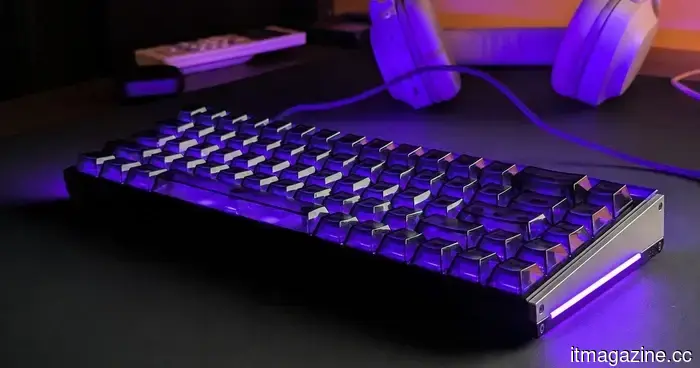 MelGeek MADE68 Ultra V2 Review: Excellent for gaming and surprisingly better than anticipated for typing.
After a month of daily usage, I was impressed by the gaming performance and software of the MADE68 Ultra V2, but the most surprising aspect was its typing experience.
MelGeek MADE68 Ultra V2 Review: Excellent for gaming and surprisingly better than anticipated for typing.
After a month of daily usage, I was impressed by the gaming performance and software of the MADE68 Ultra V2, but the most surprising aspect was its typing experience.
 Deutsche Telekom acquires Macquarie’s Polish fiber and television assets in a €1 billion investment aimed at convergence.
Deutsche Telekom is acquiring Fiberhost and INEA from Macquarie for approximately €1 billion and integrating them into T-Mobile Polska. This move reflects a strategy that aims to secure a competitive advantage in Poland's market by combining mobile, broadband, and television services.
Deutsche Telekom acquires Macquarie’s Polish fiber and television assets in a €1 billion investment aimed at convergence.
Deutsche Telekom is acquiring Fiberhost and INEA from Macquarie for approximately €1 billion and integrating them into T-Mobile Polska. This move reflects a strategy that aims to secure a competitive advantage in Poland's market by combining mobile, broadband, and television services.
The Supreme Court has decided not to assist Verizon in reclaiming $47 million related to location data.
The Supreme Court has declined to assist Verizon in reclaiming the $47 million it paid for selling customer location data access. However, AT&T may still be able to recover its $57 million.