

Azerbaijan aims to establish itself as a technology hub, having seen its startups secure $2.6 million in funding last year.
Every petrostate eventually realizes that oil is a finite resource, and Azerbaijan has reached the point in its narrative where the government begins to explore technology. According to the IMF, hydrocarbons previously constituted around 75% of the country's economic output and 90% of its exports, a situation that is comfortable until it is not.
Consequently, Baku has started to gather the usual resources of an emerging tech hub, and this initiative is worth observing, particularly because the disparity between what is promised and what is delivered often defines these narratives. This instinct is not exclusive to the Caspian region; across the area, oil wealth has been pursuing technology infrastructure and startups for years with mixed outcomes, as highlighted by the Gulf’s recent venture into AI data centers.
In 2025, technology represented 2.1% of the gross domestic product, an increase from 1.9% the previous year, marking a genuine yet nearly imperceptible growth compared to the energy sector. The venture ecosystem is even smaller. In 2025, 22 startups collectively secured $2.62 million, a sum that would be easily eclipsed by a single mid-sized seed round in cities like Berlin or London.
Three local funds—Caucasus Ventures, INMerge Ventures, and Tumar Ventures—together manage approximately $11 million in disclosed capital. In July, parliament enacted a legal framework for investment tools, and the government is establishing a fund that merges local and international investments. How substantial will it be? Deputy Digital Development Minister Rashad Hasanov refrained from providing a specific amount.
“The size will be determined by the quality of the pipeline and the partners we attract, not the reverse,” he stated, which may reflect either commendable discipline or a polite acknowledgment that investments have yet to materialize. The central bank, whose governor Taleh Kazimov anticipates new entrants once the regulations are established, has six months to finalize guidelines for equity and debt-based crowdfunding.
The incentives available appear generous on paper. Reports from Azerbaijani media mention a two-decade period of zero income tax for eligible migrants and returning researchers, a similar corporate tax exemption for digital, AI, and cybersecurity companies, as well as a customs exemption on imported equipment, all aimed partially at reversing the brain drain that has quietly depleted the talent pool.
Officials reference Singapore and Estonia as their desired models, aspiring for Baku to become the technology hub of the Caspian region. Articulating such ambition is straightforward, but achieving it is considerably more challenging. Azerbaijan lags behind its closest neighbors by a notable margin: Kazakhstan boasts over 20 private venture funds and attracted around $130 million in 2025, while Armenia has already produced several unicorn companies.
The Tech News Website’s report from Kazakhstan’s tech scene revealed a market that is several steps ahead of the path Baku is just starting. A government goal of establishing 500 startups by the end of 2026, up from about 151 today, seems to be a figure chosen for presentation rather than practicality.
Startup founders appear cautiously appreciative yet somewhat skeptical. Tural Selimli, who manages Sera AI, acknowledged the new framework but emphasized the more challenging task of persuading foreign investors and angels that Azerbaijan is worthy of their interest.
No law can guarantee that outcome. This ongoing challenge of state-led diversification, from the Gulf to the Caspian, underscores that the administrative process is the simpler aspect. Norway, whose sovereign wealth fund transformed petroleum revenues into a trillion-dollar portfolio, exemplifies that resource rents can be turned into something sustainable, but it required patience, reliable institutions, and a willingness to endure prolonged periods with minimal visible progress. Baku has established the legal framework.
Whether the capital, entrepreneurs, and successful exits will follow remains uncertain, and the honest answer for now is that the outcome is still unknown.
Other articles
 MelGeek MADE68 Ultra V2 Review: Excellent for gaming and surprisingly better than anticipated for typing.
After a month of daily usage, I was impressed by the gaming performance and software of the MADE68 Ultra V2, but the most surprising aspect was its typing experience.
MelGeek MADE68 Ultra V2 Review: Excellent for gaming and surprisingly better than anticipated for typing.
After a month of daily usage, I was impressed by the gaming performance and software of the MADE68 Ultra V2, but the most surprising aspect was its typing experience.
 Instagram has restricted the search terms, but its algorithm still delivers the videos.
Instagram committed to eliminating harassment videos featuring Meta glasses. A month later, many are still available, and Reels now suggests them without any prompting.
Instagram has restricted the search terms, but its algorithm still delivers the videos.
Instagram committed to eliminating harassment videos featuring Meta glasses. A month later, many are still available, and Reels now suggests them without any prompting.
 The AI mathematical advancements that are frequently referenced are counterexamples rather than proofs.
Fields medalist Timothy Gowers asserts that the renowned AI mathematics findings surfaced as counterexamples rather than proofs. In fact, one of them is not even that.
The AI mathematical advancements that are frequently referenced are counterexamples rather than proofs.
Fields medalist Timothy Gowers asserts that the renowned AI mathematics findings surfaced as counterexamples rather than proofs. In fact, one of them is not even that.
 Unitree, the leading humanoid robot company in China, is set to be listed in Shanghai on August 19 following unprecedented demand.
Unitree Robotics is set to launch on Shanghai’s STAR Market on August 19, with an estimated valuation of nearly $9 billion after raising approximately 6.1 billion yuan.
Unitree, the leading humanoid robot company in China, is set to be listed in Shanghai on August 19 following unprecedented demand.
Unitree Robotics is set to launch on Shanghai’s STAR Market on August 19, with an estimated valuation of nearly $9 billion after raising approximately 6.1 billion yuan.
 The Supreme Court has decided not to assist Verizon in reclaiming $47 million related to location data.
The Supreme Court has declined to assist Verizon in reclaiming the $47 million it paid for selling customer location data access. However, AT&T may still be able to recover its $57 million.
The Supreme Court has decided not to assist Verizon in reclaiming $47 million related to location data.
The Supreme Court has declined to assist Verizon in reclaiming the $47 million it paid for selling customer location data access. However, AT&T may still be able to recover its $57 million.
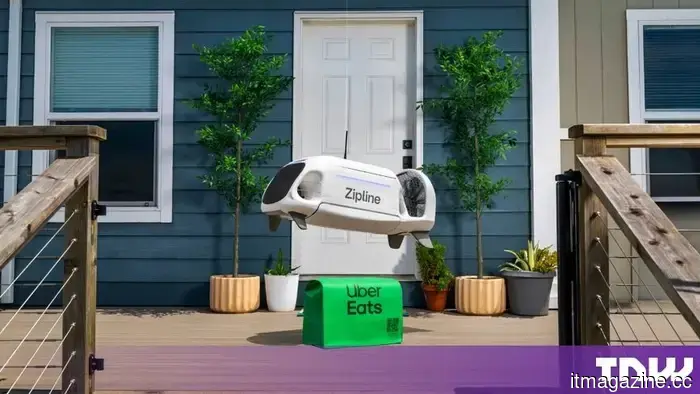 Uber is collaborating with the drone-delivery company Zipline and aims for one million drone deliveries each day.
Uber is collaborating with the drone delivery company Zipline and acquiring a strategic investment to transport Uber Eats orders throughout the United States, aiming for a goal of one million deliveries daily by the end of 2029.
Uber is collaborating with the drone-delivery company Zipline and aims for one million drone deliveries each day.
Uber is collaborating with the drone delivery company Zipline and acquiring a strategic investment to transport Uber Eats orders throughout the United States, aiming for a goal of one million deliveries daily by the end of 2029.
Azerbaijan aims to establish itself as a technology hub, having seen its startups secure $2.6 million in funding last year.
Baku is introducing financial resources, tax incentives, and regulations for crowdfunding to develop a technology sector that extends beyond oil. The aspirations are genuine, but the investment figures are minimal and competitors in the region are considerably ahead.