
Groq has successfully completed a $350 million Series A funding round, achieving a valuation of $3.5 billion, with Nvidia participating in the investment.
Groq, the AI-inference chip firm that has spent nearly a decade marketing itself as the scrappy alternative to Nvidia, has secured new funding at a valuation that subtly acknowledges the significant changes in the market.
On Monday, the company revealed that it raised $350 million at a $3.5 billion valuation, approximately half of the $6.9 billion it was valued at last September.
The funding round was led by Disruptive, a Dallas-based firm whose founder, Alex Davis, now serves as Groq’s executive chairman. In an unexpected twist, Nvidia itself also participated in the round. Just months prior, Nvidia had licensed Groq’s technology and recruited much of its talent, a situation we reported on when the company began to recover from that upheaval.
Late last year, Nvidia entered a non-exclusive licensing agreement for Groq’s language-processing-unit technology, a deal estimated to be worth around $20 billion and often referred to as a “not-acqui-hire.” There was no outright acquisition of the company; instead, Nvidia acquired the intellectual property rights it sought and took with it founder and CEO Jonathan Ross, a former Google engineer involved in the development of Google’s tensor chips, along with a significant portion of the senior team.
With this departure, Groq needed a new strategy and leadership. Co-founder Doug Wightman assumed the role of CEO, a new team of executives was assembled, and Groq transitioned from a chip designer positioning itself against Nvidia to a data-center operator offering AI inference services by the token. The current goal is a "neocloud" that aims to exceed 200 megawatts of capacity within a year.
The inference business, which now supports millions of developers and processes trillions of tokens weekly, developed as part of this pivot rather than from the former chip team. A $650 million funding round in June marked the beginning of this transformation, and the new $350 million round is the second phase.
The irony of a company that once depleted its resources now effectively working to rejuvenate itself is striking, even in the realm of the AI-chip boom, where relationships are fluid and most players often act as both customers and competitors simultaneously. Nvidia's support for Groq requires minimal investment and provides it with a reliable, dependent source of inference capacity, alongside an interest in whatever Groq evolves into.
However, the valuation raises eyebrows. Halving a company’s perceived worth within a year represents a significant correction in a market where valuations typically trend upward, and where newer competitors continue to secure billion-dollar valuations solely based on inference demand.
Competing inference-chip startups like Fractile have raised funds at strong valuations, and one challenger in London recently tripled its worth to $3.3 billion while openly challenging Nvidia. Groq’s discounted valuation serves as a reminder that the gold rush equally prices in founders and engineers alongside technology, and losing both incurs a cost.
Whether the $350 million raised will be impactful remains uncertain. Groq continues to operate a legitimate inference business, with data centers on multiple continents and developers utilizing its services for their speed and affordability, and the demand for inference is unmistakable.
What remains less clear is whether a restructured Groq, now lacking the founder who shaped its identity and partially funded by the very entity that diminished it, can evolve beyond being a mere supplier orbiting Nvidia. The valuation indicates that investors have reconciled themselves with smaller ambitions; at $3.5 billion, they are investing in a functioning business rather than a competitor poised to dethrone giants.
Other articles
 The AI mathematical advancements that are frequently referenced are counterexamples rather than proofs.
Fields medalist Timothy Gowers asserts that the renowned AI mathematics findings surfaced as counterexamples rather than proofs. In fact, one of them is not even that.
The AI mathematical advancements that are frequently referenced are counterexamples rather than proofs.
Fields medalist Timothy Gowers asserts that the renowned AI mathematics findings surfaced as counterexamples rather than proofs. In fact, one of them is not even that.
 Instagram has restricted the search terms, but its algorithm still delivers the videos.
Instagram committed to eliminating harassment videos featuring Meta glasses. A month later, many are still available, and Reels now suggests them without any prompting.
Instagram has restricted the search terms, but its algorithm still delivers the videos.
Instagram committed to eliminating harassment videos featuring Meta glasses. A month later, many are still available, and Reels now suggests them without any prompting.
 Azerbaijan aims to establish itself as a technology hub, having seen its startups secure $2.6 million in funding last year.
Baku is introducing financial resources, tax incentives, and regulations for crowdfunding to develop a technology sector that extends beyond oil. The aspirations are genuine, but the investment figures are minimal and competitors in the region are considerably ahead.
Azerbaijan aims to establish itself as a technology hub, having seen its startups secure $2.6 million in funding last year.
Baku is introducing financial resources, tax incentives, and regulations for crowdfunding to develop a technology sector that extends beyond oil. The aspirations are genuine, but the investment figures are minimal and competitors in the region are considerably ahead.
 Azerbaijan aims to establish itself as a technology hub, as its startups secured $2.6 million in funding last year.
Baku is introducing financial support, tax incentives, and crowdfunding regulations to develop a technology sector beyond oil. While the aspiration is genuine, the investment figures are minimal, and competitors in the region are several years ahead.
Azerbaijan aims to establish itself as a technology hub, as its startups secured $2.6 million in funding last year.
Baku is introducing financial support, tax incentives, and crowdfunding regulations to develop a technology sector beyond oil. While the aspiration is genuine, the investment figures are minimal, and competitors in the region are several years ahead.
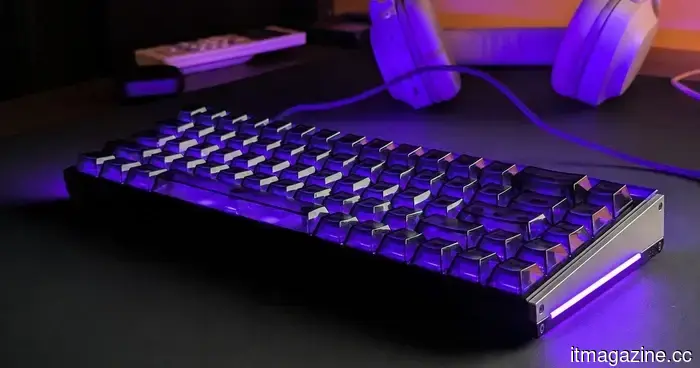 MelGeek MADE68 Ultra V2 Review: Excellent for gaming and surprisingly better than anticipated for typing.
After a month of daily usage, I was impressed by the gaming performance and software of the MADE68 Ultra V2, but the most surprising aspect was its typing experience.
MelGeek MADE68 Ultra V2 Review: Excellent for gaming and surprisingly better than anticipated for typing.
After a month of daily usage, I was impressed by the gaming performance and software of the MADE68 Ultra V2, but the most surprising aspect was its typing experience.
 Nvidia is not supporting OpenAI's lease; it is supporting the structures.
Nvidia limited its OpenAI support to $105 billion and finalized the deal in Ohio. This guarantee pertains to the value of the data centers, rather than OpenAI's rental costs.
Nvidia is not supporting OpenAI's lease; it is supporting the structures.
Nvidia limited its OpenAI support to $105 billion and finalized the deal in Ohio. This guarantee pertains to the value of the data centers, rather than OpenAI's rental costs.
Groq has successfully completed a $350 million Series A funding round, achieving a valuation of $3.5 billion, with Nvidia participating in the investment.
Groq, the AI-inference chip firm previously valued at $6.9 billion, has secured $350 million at a valuation of $3.5 billion. The funding round was spearheaded by Disruptive and, notably, included participation from Nvidia.