
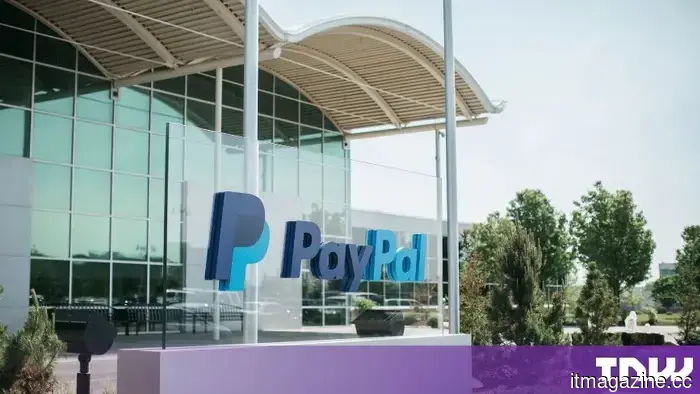
PayPal has stopped rejecting sales. The question now is whether regulators will permit it.
The Wall Street Journal reported on August 14 about the discussions taking place. The article was authored by Cara Lombardo, Gina Heeb, and Lauren Thomas. The context has shifted; PayPal is now exploring a potential sale, instead of receiving an offer that it turned down.
In July, Stripe and Advent International proposed a price of $60.50 per share, which PayPal deemed inadequate. The two parties have been negotiating for a higher amount since then, and a deal could materialize in the upcoming weeks. PayPal chose not to comment, while a spokesperson for Stripe stated that the company does not discuss rumors or speculation.
Investors perceived this as progress, leading to a roughly 1.8% increase in PayPal’s stock on the day of the report's release.
The initial rejection was merely a stance, not a definitive answer. Our desk relayed the $60.50 bid on July 15, which placed PayPal's valuation at over $53 billion, backed by around $50 billion in bank financing. Two days later, the board declared the offer too low, prompting shares to surge about 19% to $56.60 following the news.
Later that month, PayPal responded positively with strong quarterly earnings and a $70 target set by Cantor Fitzgerald, along with the CEO stating he would consider any offers with better value. Viewed sequentially, these three events seem to demonstrate a company defending its position; in light of Friday’s report, they appear to indicate a company setting a price.
The significance of the potential merger extends beyond just the financial aspects. Stripe handles approximately $1.9 trillion annually in merchant transactions. PayPal and Venmo, on the other hand, manage over 440 million consumer accounts. Combined, they would process around $3.7 trillion each year. According to prior reports from Reuters, both Stripe and Advent would hold equal stakes and become co-owners, with no plans to separate PayPal.
The strategic advantage lies not only in volume but also in reducing Stripe's dependency on Visa and Mastercard, while also integrating Venmo, PayPal's checkout services, and its cryptocurrency offerings into Stripe’s portfolio.
An analysis from Mergermarket, released on August 5 by Troy Hooper and Serafina Smith, provides the most valuable insights into the situation thus far. George Paul, an antitrust attorney at White & Case, highlighted a key issue: the deal “combines two sides of the digital payment player market,” summarizing the structural objections succinctly. This would result in one company controlling both the infrastructure used by merchants and the wallets consumers utilize for payments.
The implications for data management arise from this integration, which would allow access to both merchant transactions and consumer identities simultaneously. Aman Verjee, an antitrust scholar and a former PayPal executive, also contributed to this assessment.
Either the Federal Trade Commission or the Department of Justice will conduct the review, although it remains uncertain which agency will take the lead.
The assessment anticipates that the review will not end up in court but may come with specific conditions. Divestitures are the most likely solution, with Venmo or Braintree being the potential candidates for sale. Alternatively, behavioral remedies with interoperability mandates could be required. The review process could potentially span several jurisdictions and take years to complete.
This perspective contrasts with Reuters' reporting on no intention to dismantle PayPal. The most feasible path to obtaining approval appears to involve selling off a portion of the company. Braintree is considered the quieter, yet more pivotal candidate, as it is PayPal's merchant processing division, aligning directly with Stripe's business model.
The motivations behind PayPal's willingness to engage in talks stem from its diminished market valuation. The company was near its historic lows when the bid was presented, having lost approximately $320 billion from its peak during the pandemic.
Enrique Lores, who took charge in March after years at HP, reorganized the company in April into three units: checkout, consumer financial services (including Venmo), and payments and cryptocurrency. He informed investors in May of PayPal's intention to refocus on core principles and reestablish itself as a technology company, accompanied by a plan to achieve $1.5 billion in savings while reducing the workforce by around 20% over the next two to three years.
Despite these challenges, the business itself is not in decline; hence, the board's resistance to the initial offer. In the second quarter, PayPal reported $8.68 billion in revenue, reflecting a 5% increase, alongside adjusted earnings of $1.38 per share and a net income of $1.1 billion.
PayPal was established in 1998 by a group that included Peter Thiel, Elon Musk, Max Levchin, and Luke Nosek, with most of them departing to pursue larger ventures.
Stripe, too, has been actively making acquisitions. This particular proposal is not an isolated effort, as Stripe had
Other articles
 Lamborghini's newest Revuelto SV adds an element of enjoyment with a unique driving mode.
Lamborghini's latest Revuelto SV delivers 1,050 hp, enhanced handling, GT3-inspired technology, and a specialized Pilota driving mode in its V12 hybrid supercar.
Lamborghini's newest Revuelto SV adds an element of enjoyment with a unique driving mode.
Lamborghini's latest Revuelto SV delivers 1,050 hp, enhanced handling, GT3-inspired technology, and a specialized Pilota driving mode in its V12 hybrid supercar.
 The United States is set to urge 35 nations to decide between alignment with itself or China regarding artificial intelligence.
A preliminary US letter cautions the 35 signatories of the Pax Silica and AI Opportunity Statement that they cannot simultaneously participate in China's competing AI framework.
The United States is set to urge 35 nations to decide between alignment with itself or China regarding artificial intelligence.
A preliminary US letter cautions the 35 signatories of the Pax Silica and AI Opportunity Statement that they cannot simultaneously participate in China's competing AI framework.
 Anthropic conducted 133 million contractor conversations with its bioweapon filters disabled.
The Anthropic Risk Report indicates that bioweapon classifiers were inaccurate for 133 million contractor exchanges and revises its previous assessment from February.
Anthropic conducted 133 million contractor conversations with its bioweapon filters disabled.
The Anthropic Risk Report indicates that bioweapon classifiers were inaccurate for 133 million contractor exchanges and revises its previous assessment from February.
 A telecommunications company recently compromised 1.6 million records due to a phone call.
ShinyHunters exposed 1.6 million records of RingCentral customers, claiming they gained access by using voice phishing to obtain a password from an employee.
A telecommunications company recently compromised 1.6 million records due to a phone call.
ShinyHunters exposed 1.6 million records of RingCentral customers, claiming they gained access by using voice phishing to obtain a password from an employee.
 A new leak indicates that the Sonos Ace Ultra could be released at a lower price than the original Ace.
The Sonos Ace Ultra has seemingly been revealed ahead of its announcement in September, showcasing a reduced price, enhanced active noise cancellation, extended battery life, and additional features.
A new leak indicates that the Sonos Ace Ultra could be released at a lower price than the original Ace.
The Sonos Ace Ultra has seemingly been revealed ahead of its announcement in September, showcasing a reduced price, enhanced active noise cancellation, extended battery life, and additional features.
 Nvidia reduced its $250 billion commitment to OpenAI by half. Afterwards, it demonstrated to investors what it possesses.
The Nvidia OpenAI backstop decreases from $250 billion to below $120 billion, during the week when a 13F revealed its SpaceX and Intel holdings fluctuating by $20 billion.
Nvidia reduced its $250 billion commitment to OpenAI by half. Afterwards, it demonstrated to investors what it possesses.
The Nvidia OpenAI backstop decreases from $250 billion to below $120 billion, during the week when a 13F revealed its SpaceX and Intel holdings fluctuating by $20 billion.
PayPal has stopped rejecting sales. The question now is whether regulators will permit it.
The announcement of the Stripe PayPal agreement may come in a matter of weeks. An antitrust evaluation suggests that approving it could have negative implications for Venmo or Braintree.