

The competition in AI is shifting towards data centers, as Alibaba Cloud reduces its delivery time to 100 days.
The competition surrounding large AI models is evolving beyond just models and chips and is increasingly focused on data center infrastructure. In recent years, tech giants globally have significantly boosted their AI computing capacity, with GPU acquisitions and server expansions becoming routine. However, as the need for computing power grows, a new challenge has arisen: while chips can be bought and servers assembled, building data centers is far more complex.
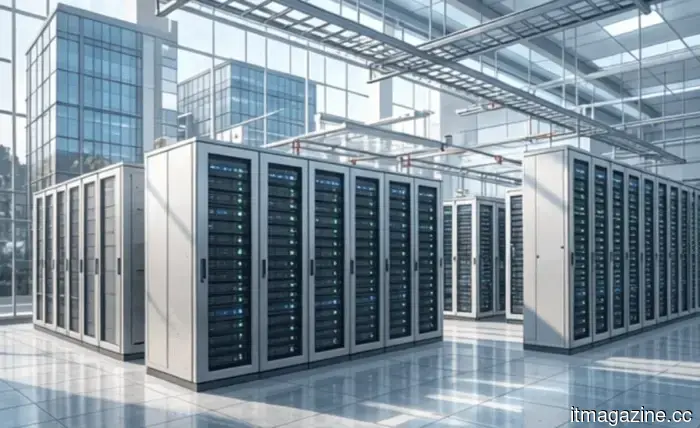
On Monday, Alibaba Cloud revealed that it has shortened the delivery time for large-scale AI data center (AIDC) facilities to 100 days, thanks to a completely modular design architecture. This means that a substantial data center, which could have previously taken nearly a year to construct, can now be completed in around three months under Alibaba Cloud's methodology.
What's more, this quicker delivery has not resulted in increased construction costs. Alibaba Cloud reports that the overall construction expense for its data centers has decreased by more than 10% compared to the previous generation.
Data centers are beginning to resemble building blocks more than ever. The cornerstone of Alibaba Cloud's method is its fully modular design. In simple terms, traditional data center construction resembles building a house from the ground up at the site. Typically, civil engineering, mechanical and electrical systems, power supply, and cooling systems are completed in a fairly sequential manner. A modular approach, however, is akin to assembling building blocks.
Various components of a data center can be standardized ahead of time, manufactured and pre-assembled in factories, and then transported to the construction site for simultaneous installation. This enables processes that previously needed to be completed one after the other to occur at the same time, drastically reducing on-site construction duration.
This shift in data center construction methods is particularly relevant in the AI era, where the demand for AI computing power is escalating at a rapid pace. If data center construction lags behind the installation of GPUs and servers, even purchased chips might remain unused in warehouses. For cloud providers, the speed at which computing infrastructure can be provided is becoming a significant competitive advantage.
Alibaba Cloud is clearly aiming for more than just speeding up individual data center construction. The company intends to more than double the global production capacity of its modular data centers by 2026. This indicates a broader transition: AI data centers are progressively moving away from traditional custom engineering projects toward infrastructure products that can be replicated and scaled.
Historically, data center construction relied heavily on local construction conditions, supply chains, and engineering talent, making it challenging to quickly replicate projects in different areas. With a modular framework, however, standardized design, manufacturing, and delivery processes facilitate the easier reproduction and expansion of data center capacity across various markets.
For Alibaba Cloud, this is not merely about constructing data centers more rapidly; it could also enable the faster deployment of AI computing capability in global markets.
The AI competition is increasingly becoming a race for infrastructure speed. From large AI models to GPUs, and now data centers, the focus across the AI industry is diving deeper into the infrastructure layer. Until now, much attention has been on the most powerful models, the largest GPU supplies, or the lowest inference costs. As AI applications scale, the capacity to transform computing resources into usable capacity might also hinge on elements such as power, networking, cooling, and the pace of data center construction.
The AI arms race is no longer solely about the number of GPUs a company can procure; it’s about how fast it can convert those GPUs into functional computing capacity. Alibaba Cloud’s initiative to reduce the delivery time for large-scale AIDCs to 100 days while boosting its modular data center production capacity is a strategic response to this challenge. As demand for AI computing continues to surge, the speed of data center construction could emerge as a new competitive element for cloud providers in the next phase of the AI boom.
Perhaps the most significant aspect of this infrastructure enhancement is the transition from building data centers to delivering them at scale, similar to manufacturing a product.
Jessie Wu is a tech journalist based in Shanghai. She reports on consumer electronics, semiconductors, and the gaming industry for TechNode. Connect with her via email: jessie.wu@technode.com.



Other articles
 Acer's initial Googlebook could potentially resolve all the issues that Chromebooks have encountered.
Acer's initial Googlebook 14 has appeared featuring a Core Ultra 7 355, as much as 32GB of RAM, and a 2.8K OLED screen, indicating a high-end Chromebook successor.
Acer's initial Googlebook could potentially resolve all the issues that Chromebooks have encountered.
Acer's initial Googlebook 14 has appeared featuring a Core Ultra 7 355, as much as 32GB of RAM, and a 2.8K OLED screen, indicating a high-end Chromebook successor.
 Tap or Swipe: The Impact of Mobile Wallets on the Payment Method Divide
Whether by tapping to pay, swiping a card through a reader, or inserting a chip, card-based payment methods have become essential for everyday transactions. For years, it appeared that these payment options, which have mainly taken the place of cash, couldn't evolve any further; from a consumer's perspective, what could be more convenient than […]
Tap or Swipe: The Impact of Mobile Wallets on the Payment Method Divide
Whether by tapping to pay, swiping a card through a reader, or inserting a chip, card-based payment methods have become essential for everyday transactions. For years, it appeared that these payment options, which have mainly taken the place of cash, couldn't evolve any further; from a consumer's perspective, what could be more convenient than […]
 Tineco Pure ONE Station 5 Pro review: A dependable system that requires minimal maintenance and offers plenty of conveniences.
The Tineco Pure ONE Station 5 Pro merges an intelligent design with a quiet operation, satisfactory battery life, and an array of smart features, establishing it as one of the top cordless vacuum options in its price range.
Tineco Pure ONE Station 5 Pro review: A dependable system that requires minimal maintenance and offers plenty of conveniences.
The Tineco Pure ONE Station 5 Pro merges an intelligent design with a quiet operation, satisfactory battery life, and an array of smart features, establishing it as one of the top cordless vacuum options in its price range.
 Following Google's lead, Apple may discreetly transform iCloud+ into a tiered subscription service focused on AI.
iOS 27 confirms that upgrading to higher iCloud+ storage plans now provides enhanced access to Apple Intelligence functionalities.
Following Google's lead, Apple may discreetly transform iCloud+ into a tiered subscription service focused on AI.
iOS 27 confirms that upgrading to higher iCloud+ storage plans now provides enhanced access to Apple Intelligence functionalities.
 Tap or Swipe: The Impact of Mobile Wallets on the Payment Method Divide
Whether by tapping to pay, swiping a card through a reader, or inserting a chip, card-based payment methods have become essential for making everyday transactions. For many years, it appeared that these methods, which have significantly supplanted cash, had reached their peak; from an average consumer's perspective, what could be more convenient than […]
Tap or Swipe: The Impact of Mobile Wallets on the Payment Method Divide
Whether by tapping to pay, swiping a card through a reader, or inserting a chip, card-based payment methods have become essential for making everyday transactions. For many years, it appeared that these methods, which have significantly supplanted cash, had reached their peak; from an average consumer's perspective, what could be more convenient than […]
 Tap or Swipe: The Impact of Mobile Wallets on Payment Method Distinction
Whether it involves tapping to pay, swiping a card through a terminal, or inserting a chip, card-based payment methods have become essential for everyday transactions. For many years, it appeared that these payment methods, which have largely taken the place of cash, could not advance any further; from a general perspective, what could be more convenient than […]
Tap or Swipe: The Impact of Mobile Wallets on Payment Method Distinction
Whether it involves tapping to pay, swiping a card through a terminal, or inserting a chip, card-based payment methods have become essential for everyday transactions. For many years, it appeared that these payment methods, which have largely taken the place of cash, could not advance any further; from a general perspective, what could be more convenient than […]
The competition in AI is shifting towards data centers, as Alibaba Cloud reduces its delivery time to 100 days.
The rivalry regarding large AI models is shifting focus from just models and chips to the infrastructure of data centers. In recent years, technology