

Tap or Swipe: The Impact of Mobile Wallets on Payment Method Distinction
Whether through tap-to-pay, card swipes on a reader, or chip insertion, card-based payment methods have become essential for everyday transactions. For years, these payment options, which have largely replaced cash, seemed to have reached their peak; from a general perspective, what could be more convenient than paying for groceries or gas by just tapping a card on a screen?
Mobile wallets mark a significant advancement in this area, taking the interaction a step further by maintaining the motion but digitizing the object. Nowadays, individuals can load various debit, credit, and even gift cards onto devices such as smartphones or smartwatches, allowing access to these cards without needing to carry them physically.
While mobile wallets haven't rendered standard cards obsolete, they represent a valuable enhancement to the array of payment methods available, potentially complicating and improving certain elements of the current payment experience.
The Emergence of Mobile NFC Technology
Mobile NFC, or near-field communication, is a technology that enables phones and wearables to interact with other NFC-equipped devices. NFC can be seen as a significant upgrade to radio-frequency identification (RFID), which is typically used for items such as security cards and key fobs.
NFC is crucial for the functionality of mobile wallets, allowing specific devices to send payment information to others over short distances. This technology does not require users to engage in processes like manual pairing or device discovery, unlike Wi-Fi or Bluetooth; instead, users simply bring an NFC-enabled device within a few inches of another, allowing for a seamless communication experience.
In addition to convenience, NFC also stands out for its security and privacy features. Users can avoid carrying physical cards, lowering the risk of loss or theft, and the technology can work alongside authentication measures like passwords and biometric scans. Mobile wallets often include extra security protocols, including data encryption to decrease the chance of digital theft.
Source Unknown
Exploring NFC: EmberPay's Case Study
Over time, companies have become increasingly innovative with mobile NFC interfaces, expanding the technology's applications beyond basic payment methods. For instance, similar to RFID, NFC is utilized in security applications, allowing users to store digital keys on their devices, thus eliminating the need for physical keys.
Meanwhile, some organizations, like EmberPay—founded by Josh Steiner, Charlie Baker, and Micah Thomas—are experimenting with using chat functions for payments instead of debit or credit cards, especially for group payments. Though various existing split-payment applications exist, many operate more as reimbursement tools than as payment methods in-store. Essentially, these require one person to pay upfront and then seek reimbursement from others later.
EmberPay distinguishes itself by requiring all members of a group to pay together at the register, a method the company claims saves time and simplifies the splitting of what might be regarded as minor payments.
Steiner explains the core concept simply: “We’ve abstracted the payment instrument and elevated chats to be the selectable object at the point of sale. Essentially, users can pay for items using chats instead of debit or credit cards.”
In initial trials, the company placed 50 college students in working coffee shops and restaurants, measuring the time required to complete split transactions using both a popular payment app and EmberPay under actual conditions.
With the popular app, the process follows a familiar pattern: one person pays, calculates what each individual owes, opens a messaging app, sends a request, and waits for others to open the app and finalize the payment. According to the company, this sequence took an average of 30 seconds. In contrast, EmberPay achieved the same result in just 3 seconds. A more significant finding emerged from a different question regarding the point at which a transaction feels too trivial to split.
Thomas had surveyed approximately 500 college students before the pilot to establish a baseline, which informed the team's understanding of the product's real competition. “We discovered that when people didn’t request reimbursement, it was primarily due to shyness or hesitation to ask friends for repayment,” he says. “The average amount someone would feel comfortable asking for was $12. Anything below that, people preferred to absorb the cost rather than make a request.”
EmberPay's chat interface aims to alleviate the financial anxiety identified in earlier tests of a different product structure. Initially, the product issued joint cards to groups of friends, but user research showed that the perceived risk of a shared financial tool, no matter how structured, led to psychological resistance that explanations could not resolve.
By replacing the card with a chat thread—an object users comfortably engage with when it comes to payments—the goal is to solve the issue not by diminishing risk but by removing the element that prompted the perception of it.
The pilot with the popular payment app established a split threshold of $24 before participants would agree to divide payments. In contrast, EmberPay lowered that threshold to $4, indicating users were willing to split costs for single items, a transaction that the popular payment app flow rendered economically impractical. EmberPay notes that this six-fold reduction in the minimum split


Other articles
 Tap or Swipe: The Impact of Mobile Wallets on the Payment Method Divide
Whether by tapping to pay, swiping a card through a reader, or inserting a chip, card-based payment methods have become essential for making everyday transactions. For many years, it appeared that these methods, which have significantly supplanted cash, had reached their peak; from an average consumer's perspective, what could be more convenient than […]
Tap or Swipe: The Impact of Mobile Wallets on the Payment Method Divide
Whether by tapping to pay, swiping a card through a reader, or inserting a chip, card-based payment methods have become essential for making everyday transactions. For many years, it appeared that these methods, which have significantly supplanted cash, had reached their peak; from an average consumer's perspective, what could be more convenient than […]
 Tap or Swipe: The Impact of Mobile Wallets on the Payment Method Divide
Whether by tapping to pay, swiping a card through a reader, or inserting a chip, card-based payment methods have become essential for everyday transactions. For years, it appeared that these payment options, which have mainly taken the place of cash, couldn't evolve any further; from a consumer's perspective, what could be more convenient than […]
Tap or Swipe: The Impact of Mobile Wallets on the Payment Method Divide
Whether by tapping to pay, swiping a card through a reader, or inserting a chip, card-based payment methods have become essential for everyday transactions. For years, it appeared that these payment options, which have mainly taken the place of cash, couldn't evolve any further; from a consumer's perspective, what could be more convenient than […]
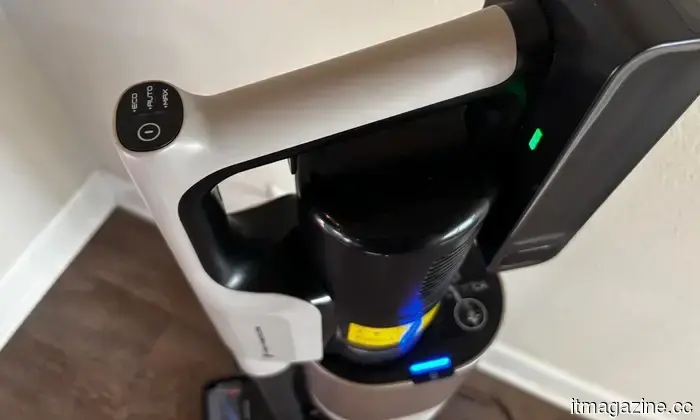 Tineco Pure ONE Station 5 Pro review: A dependable system that requires minimal maintenance and offers plenty of conveniences.
The Tineco Pure ONE Station 5 Pro merges an intelligent design with a quiet operation, satisfactory battery life, and an array of smart features, establishing it as one of the top cordless vacuum options in its price range.
Tineco Pure ONE Station 5 Pro review: A dependable system that requires minimal maintenance and offers plenty of conveniences.
The Tineco Pure ONE Station 5 Pro merges an intelligent design with a quiet operation, satisfactory battery life, and an array of smart features, establishing it as one of the top cordless vacuum options in its price range.
Tap or Swipe: The Impact of Mobile Wallets on Payment Method Distinction
Whether it involves tapping to pay, swiping a card through a terminal, or inserting a chip, card-based payment methods have become essential for everyday transactions. For many years, it appeared that these payment methods, which have largely taken the place of cash, could not advance any further; from a general perspective, what could be more convenient than […]