

The competition in AI is shifting towards data centers, as Alibaba Cloud reduces delivery times to just 100 days.
The competition surrounding large AI models is shifting focus from just models and chips to the infrastructure of data centers. In recent years, technology giants worldwide have been significantly increasing their AI computing capabilities, with the purchase of GPUs and expansion of servers becoming almost routine. However, as the need for computing power rises, a new obstacle has emerged: chips can be procured and servers can be set up, but constructing data centers is far more challenging.
On Monday, Alibaba Cloud announced that it has cut the delivery time for large AI data center (AIDC) facilities to 100 days by implementing a fully modular design architecture. This means that a sizeable data center that used to take close to a year to build can now be completed in about three months with Alibaba Cloud’s method. Importantly, this faster delivery has not resulted in increased construction costs; according to Alibaba Cloud, the overall building costs for its data centers have decreased by over 10% compared to the previous generation.
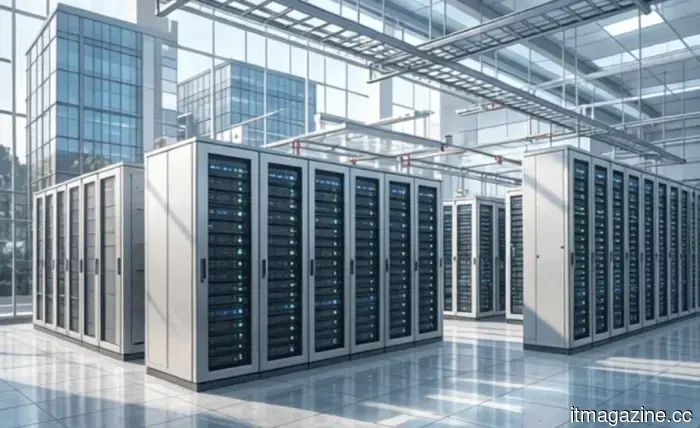
Data centers are increasingly resembling building blocks. The core technology behind Alibaba Cloud’s strategy lies in its fully modular design architecture. Essentially, traditional data center construction is akin to constructing a house from scratch on-site, where civil engineering, mechanical and electrical systems, power supply, and cooling systems are generally completed in a sequential manner. In contrast, a modular approach allows for different components of a data center to be standardized, manufactured, and pre-assembled in factories before being transported to the construction site for simultaneous installation. This method significantly shortens on-site construction time by allowing previously sequential processes to occur concurrently.
This change in data center construction strategies is essential in the AI era, as the demand for AI computing power is escalating too rapidly. If data center construction cannot match the pace of GPU and server deployment, even acquired chips might remain unused in warehouses. Consequently, the speed at which cloud providers can deliver computing infrastructure is turning into a competitive edge.
Alibaba Cloud’s ambition does not stop at accelerating the construction of individual data centers. The company aims to more than double the global production capacity of its modular data centers by 2026. This indicates a broader transformation: AI data centers are evolving from being traditional, one-off engineering projects to becoming scalable infrastructure products that can be easily replicated and delivered.
Historically, data center construction relied heavily on local conditions, supply chains, and engineering teams, complicating quick replication across various locations. However, a modular approach facilitates the standardization of design, manufacturing, and delivery processes, making it simpler to reproduce and enhance data center capacity across different markets. For Alibaba Cloud, this is more than just about faster construction; it also paves the way for quicker deployment of AI computing capabilities in global markets.
The competition in the AI sector is increasingly focusing on the speed of infrastructure. As the AI industry evolves, attention has shifted from who possesses the most powerful models or the largest GPU supply to how quickly companies can convert those GPUs into functional computing capacity. Factors like power, networking, cooling, and the rate of data center construction are becoming crucial as AI applications expand.
The AI arms race now involves not just the quantity of GPUs a company can acquire but the speed at which it can turn them into effective computing resources. Alibaba Cloud's initiative to reduce the large-scale AIDC delivery time to 100 days, while also increasing modular data center production capacity, addresses this challenge. With the ongoing rapid growth in demand for AI computing, the construction speed of data centers may emerge as a new competitive element for cloud providers in the next phase of the AI boom. A key aspect of this infrastructure advancement is the transformation from building individual data centers to delivering them at scale, much like manufacturing a product.
Jessie Wu is a tech journalist based in Shanghai, covering consumer electronics, semiconductors, and the gaming industry for TechNode. You can connect with her via email at jessie.wu@technode.com.



Other articles
 Tap or Swipe: The Impact of Mobile Wallets on Payment Method Distinction
Whether it involves tapping to pay, swiping a card through a terminal, or inserting a chip, card-based payment methods have become essential for everyday transactions. For many years, it appeared that these payment methods, which have largely taken the place of cash, could not advance any further; from a general perspective, what could be more convenient than […]
Tap or Swipe: The Impact of Mobile Wallets on Payment Method Distinction
Whether it involves tapping to pay, swiping a card through a terminal, or inserting a chip, card-based payment methods have become essential for everyday transactions. For many years, it appeared that these payment methods, which have largely taken the place of cash, could not advance any further; from a general perspective, what could be more convenient than […]
 Tineco Pure ONE Station 5 Pro review: A dependable system that requires minimal maintenance and offers plenty of conveniences.
The Tineco Pure ONE Station 5 Pro merges an intelligent design with a quiet operation, satisfactory battery life, and an array of smart features, establishing it as one of the top cordless vacuum options in its price range.
Tineco Pure ONE Station 5 Pro review: A dependable system that requires minimal maintenance and offers plenty of conveniences.
The Tineco Pure ONE Station 5 Pro merges an intelligent design with a quiet operation, satisfactory battery life, and an array of smart features, establishing it as one of the top cordless vacuum options in its price range.
 Tap or Swipe: The Impact of Mobile Wallets on the Payment Method Divide
Whether by tapping to pay, swiping a card through a reader, or inserting a chip, card-based payment methods have become essential for everyday transactions. For years, it appeared that these payment options, which have mainly taken the place of cash, couldn't evolve any further; from a consumer's perspective, what could be more convenient than […]
Tap or Swipe: The Impact of Mobile Wallets on the Payment Method Divide
Whether by tapping to pay, swiping a card through a reader, or inserting a chip, card-based payment methods have become essential for everyday transactions. For years, it appeared that these payment options, which have mainly taken the place of cash, couldn't evolve any further; from a consumer's perspective, what could be more convenient than […]
 Tap or Swipe: The Impact of Mobile Wallets on the Payment Method Divide
Whether by tapping to pay, swiping a card through a reader, or inserting a chip, card-based payment methods have become essential for making everyday transactions. For many years, it appeared that these methods, which have significantly supplanted cash, had reached their peak; from an average consumer's perspective, what could be more convenient than […]
Tap or Swipe: The Impact of Mobile Wallets on the Payment Method Divide
Whether by tapping to pay, swiping a card through a reader, or inserting a chip, card-based payment methods have become essential for making everyday transactions. For many years, it appeared that these methods, which have significantly supplanted cash, had reached their peak; from an average consumer's perspective, what could be more convenient than […]
 The competition in AI is shifting towards data centers, as Alibaba Cloud reduces its delivery time to 100 days.
The rivalry regarding large AI models is shifting focus from just models and chips to the infrastructure of data centers. In recent years, technology
The competition in AI is shifting towards data centers, as Alibaba Cloud reduces its delivery time to 100 days.
The rivalry regarding large AI models is shifting focus from just models and chips to the infrastructure of data centers. In recent years, technology
 Acer's initial Googlebook could potentially resolve all the issues that Chromebooks have encountered.
Acer's initial Googlebook 14 has appeared featuring a Core Ultra 7 355, as much as 32GB of RAM, and a 2.8K OLED screen, indicating a high-end Chromebook successor.
Acer's initial Googlebook could potentially resolve all the issues that Chromebooks have encountered.
Acer's initial Googlebook 14 has appeared featuring a Core Ultra 7 355, as much as 32GB of RAM, and a 2.8K OLED screen, indicating a high-end Chromebook successor.
The competition in AI is shifting towards data centers, as Alibaba Cloud reduces delivery times to just 100 days.
The rivalry concerning large AI models is shifting from just models and chips to the infrastructure of data centers. In recent years, technology