
Six major financial firms support Nvidia's $500 billion initiative to finance AI development.
Nvidia has engaged six major financial institutions to assist in transforming its chips into assets that banks can provide loans against. The company revealed collaborations with Apollo, BlackRock, Blackstone, Brookfield, Goldman Sachs, and KKR to establish what it refers to as “compute financing platforms,” aimed at mobilizing over $500 billion in third-party capital for AI infrastructure.
The objective is to create significant pools of capital at competitive rates for Nvidia’s customers, including frontier AI labs, enterprises, and cloud service providers that purchase its hardware. Essentially, Nvidia is facilitating the development of a financing pipeline surrounding its own product, indicating a more formal shift in the circular financing that connects the AI economy.
Central to this initiative is a new perception of what a GPU represents. Nvidia is marketing its compute technology as “an investable asset” that features the lowest token cost, highest revenue potential, longest operational lifespan, and a robust CUDA-based software ecosystem. The premise is that a graphics processor transcends mere equipment that depreciates in a rack; it is collateral with reliable returns, allowing lenders to consider it akin to a toll road or a power plant.
CEO Jensen Huang articulated this view, stating, “Nvidia compute is uniquely suited for this role. It is broadly adopted, flexible across models and workloads, fungible and transferable.” Goldman Sachs characterized its involvement as “creating a market for credit backed by Nvidia compute,” clearly indicating the aim to develop a tradable asset class where the chips serve as the underlying security.
Each partner contributes different forms of capital: Apollo provides a flexible long-term investment base, BlackRock links long-term funds to crucial infrastructure, KKR merges long-duration financing with infrastructure proficiency, and Brookfield, which already boasts a $100 billion data campus, aims to expand the “AI factories” that accommodate the hardware.
No specific project names or funding amounts were revealed, and the $500 billion figure represents a potential aggregate over time rather than a guaranteed investment. This distinction is significant, as only memorandums of understanding have been signed thus far. Final agreements are yet to be established, which means the impressive figure reflects intention rather than actual financial transactions, and such MOUs can quietly diminish or stall in the period between announcement and finalization.
Additionally, the structure formalizes a concerning trend for investors since Nvidia operates on multiple fronts in these arrangements: it sells the chips, guarantees their resale value, and now aids in gathering capital for their purchase. It is important to recall that Nvidia’s own $750 billion in AI deals raised concerns in the credit market previously, indicating that even its supporters are mindful of how closely these commitments are intertwined.
A deeper concern is the potential for leverage. Most of the projected half a trillion dollars would likely consist of debt, and layering this onto an infrastructure boom is precisely the situation that regulators have warned about. The BIS has cautioned that an AI downturn could impact credit markets as severely as in 2008, largely due to the extensive reliance on borrowed funds and interconnected obligations.
Moreover, the concept of “compute as collateral” remains valid only while demand exists. If AI revenue declines, the asset bolstering this credit could quickly lose value, putting leveraged buyers at risk and lenders with chips worth less than the loans secured against them. While Huang mentions that the hardware is fungible and transferable, a surplus could challenge the actual fungibility.
For now, Nvidia has subtly yet significantly engaged Wall Street to support the demand for its products. If these agreements solidify, the AI expansion could secure a vast new source of capital, even as the underlying debt becomes increasingly opaque.
Other articles
 Six major financial institutions support Nvidia's $500 billion initiative to finance AI development.
Nvidia has brought together six prominent figures in finance to establish 'compute financing platforms' that have the potential to unlock more than $500 billion in third-party capital for the development of AI.
Six major financial institutions support Nvidia's $500 billion initiative to finance AI development.
Nvidia has brought together six prominent figures in finance to establish 'compute financing platforms' that have the potential to unlock more than $500 billion in third-party capital for the development of AI.
 Bios Life exits stealth mode with a $25 million investment and a partnership with Tempus for cancer monitoring.
Bios Life has unveiled itself with $25 million in funding and a partnership with Tempus to create continuous, AI-based cancer monitoring for those at high risk and survivors.
Bios Life exits stealth mode with a $25 million investment and a partnership with Tempus for cancer monitoring.
Bios Life has unveiled itself with $25 million in funding and a partnership with Tempus to create continuous, AI-based cancer monitoring for those at high risk and survivors.
 How AI is changing frontend engineering for contemporary web applications
AI-driven development tools are transitioning frontend developers from monotonous coding tasks to creating more intelligent, adaptive digital experiences with quicker delivery timelines.
How AI is changing frontend engineering for contemporary web applications
AI-driven development tools are transitioning frontend developers from monotonous coding tasks to creating more intelligent, adaptive digital experiences with quicker delivery timelines.
 Intel secures up to $20 billion to support its foundry strategy in competition with TSMC.
Intel is offering $15 billion in stock, with the possibility of increasing this to $20 billion, to finance its foundry investment, capitalizing on the fact that a nearly threefold increase in its shares by 2026 makes issuing new equity more economical.
Intel secures up to $20 billion to support its foundry strategy in competition with TSMC.
Intel is offering $15 billion in stock, with the possibility of increasing this to $20 billion, to finance its foundry investment, capitalizing on the fact that a nearly threefold increase in its shares by 2026 makes issuing new equity more economical.
 Intel secures up to $20 billion to back its foundry investment in competition with TSMC.
Intel is offering $15 billion in stock, with the possibility of increasing this to $20 billion, to finance its foundry initiative, taking advantage of the fact that its shares have nearly tripled in value since 2026, making new equity relatively inexpensive.
Intel secures up to $20 billion to back its foundry investment in competition with TSMC.
Intel is offering $15 billion in stock, with the possibility of increasing this to $20 billion, to finance its foundry initiative, taking advantage of the fact that its shares have nearly tripled in value since 2026, making new equity relatively inexpensive.
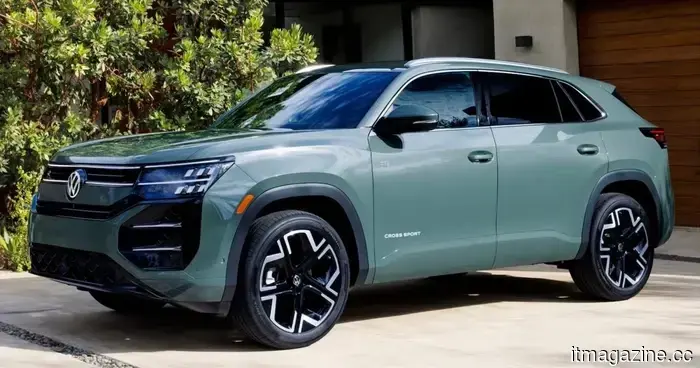 Volkswagen has just enhanced the Atlas Cross Sport with increased power, additional features, and a stronger personality.
The revamped 2027 Atlas Cross Sport from Volkswagen features a more athletic appearance, a truly premium interior, and an enhanced engine, with availability in showrooms early next year.
Volkswagen has just enhanced the Atlas Cross Sport with increased power, additional features, and a stronger personality.
The revamped 2027 Atlas Cross Sport from Volkswagen features a more athletic appearance, a truly premium interior, and an enhanced engine, with availability in showrooms early next year.
Six major financial firms support Nvidia's $500 billion initiative to finance AI development.
Nvidia has brought together six prominent figures in finance to create 'compute financing platforms' that could leverage more than $500 billion of external capital for the expansion of AI.