

The increasing challenge of digital identity is influencing IntegraTRACE's perspective on enterprise visibility.
**TL;DR**
Every new application, API, and automated workflow introduces identities that require management, yet many organizations lack a comprehensive overview of who has access to what. IntegraTRACE, established by software engineer Steve Emmanuel, offers a SOC 2 Type II compliant identity visibility platform that consolidates human, non-human, and agentic identity data across cloud environments. The company is expanding from North America into Europe and Asia.
Over the last ten years, enterprise technology has become much more interconnected. The rise of cloud platforms, automation, artificial intelligence, and software integrations has enhanced organizational speed and flexibility, but it has complicated the understanding of digital access.
Each new application, automated workflow, and API adds more identities that need oversight, making visibility more challenging as technology ecosystems grow. A report indicates that identity-based attacks were responsible for nearly one-third of intrusions recorded in 2024, with attackers increasingly using valid accounts and stolen credentials for initial access.
Steve Emmanuel, CEO and founder of IntegraTRACE, witnessed this change firsthand during his more than ten years in software engineering. Starting as a developer and moving into technical leadership roles, he found that working in larger organizations brought increased complexity. With team expansions, growing cloud environments, and new applications, one challenge persisted.
“The greatest misconception is that someone is monitoring everything,” Emmanuel notes. “Engineering assumes security has the answers, and security assumes engineering has the answers. Everyone thinks someone has the complete picture, but often a reliable source of truth is lacking.”
These experiences ultimately led to the founding of IntegraTRACE, an identity visibility platform compliant with SOC 2 Type II, aimed at helping organizations understand how human, non-human, and agentic identities interact across cloud environments and enterprise applications. Rather than only focusing on authentication or access management, Emmanuel asserts that the company's goal has been to provide a centralized view of digital identities as enterprise infrastructure becomes more decentralized.
From the start, Emmanuel aimed for the platform to tackle real customer issues rather than developing features solely for popularity's sake. He highlights that customer feedback has been crucial for product development, enabling the engineering team to adapt quickly as cloud environments and identity ecosystems evolve.
According to Emmanuel, a common feedback from customers is the realization of how much identity information was scattered across different systems. Centralizing this data clarifies access across the organization and helps identify potential risks before they escalate into significant security problems.
“Visibility changes the conversation,” Emmanuel states. “When organizations can see every identity and its access level in one place, they gain insights that were previously hard to obtain.”
From his viewpoint, customers are often able to uncover over-privileged accounts, inactive credentials, and problematic permission structures that would take weeks or months to identify manually. Bringing these insights into a centralized view allows security and engineering teams to spend less time collecting information and more time mitigating potential risks.
He attributes a considerable amount of the company’s early success to fostering strong customer relationships. Instead of sticking to lengthy development schedules, the engineering team regularly integrates customer feedback into the platform, often implementing requested enhancements within weeks. Emmanuel believes this strategy ensures every product update is linked to a tangible business requirement.
“We’re creating something that people truly need,” he explains. “When customers highlight a problem hindering their progress, we aim to resolve it swiftly. That feedback continues to influence the platform's evolution.”
Looking forward, Emmanuel envisions the company's goals extending far beyond cloud infrastructure. After initial adoption in Canada and the United States, IntegraTRACE is getting ready to expand into Europe and Asia while enhancing visibility capabilities in HR systems, financial applications, and other enterprise software where identities are proliferating.
His long-term aspiration is to establish identity visibility as a core component of an organization’s technology ecosystem. As businesses increasingly embrace AI, automation, and interconnected applications, Emmanuel believes grasping digital access will become as critical as managing the systems themselves.
“The organizations that successfully adapt won’t necessarily be those with the most security tools,” Emmanuel suggests. “They’ll be the ones with the clearest understanding of every identity operating within their business and the confidence to act on that understanding.”
Other articles
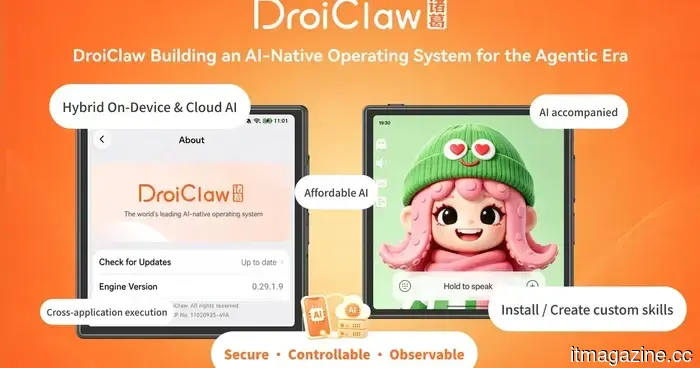 DroiClaw is transforming smart devices from being app-based to utilizing AI-native operating systems.
Transferring data between applications and repetitive prompts may soon become obsolete. Although AI has already changed the way we work and interact, DroiClaw is designing smartphones from scratch with the aim of integrating artificial intelligence as the core of the operating system.
DroiClaw is transforming smart devices from being app-based to utilizing AI-native operating systems.
Transferring data between applications and repetitive prompts may soon become obsolete. Although AI has already changed the way we work and interact, DroiClaw is designing smartphones from scratch with the aim of integrating artificial intelligence as the core of the operating system.
 BMW eliminates 8,000 positions and transfers its automotive computing to Qualcomm.
BMW plans to reduce approximately 8,000 jobs in Germany due to declining sales in China, coinciding with the announcement that Qualcomm will be the exclusive supplier of its vehicles' computing systems for the next ten years.
BMW eliminates 8,000 positions and transfers its automotive computing to Qualcomm.
BMW plans to reduce approximately 8,000 jobs in Germany due to declining sales in China, coinciding with the announcement that Qualcomm will be the exclusive supplier of its vehicles' computing systems for the next ten years.
 AI is not merely being imposed on us; even monkeys in the forest are now part of the test audience for scientific research.
AI has already infiltrated nearly every facet of our lives. Currently, it is found in the rainforest, where wild capuchin monkeys are using an AI-equipped touchscreen to obtain banana rewards as part of an innovative research project.
AI is not merely being imposed on us; even monkeys in the forest are now part of the test audience for scientific research.
AI has already infiltrated nearly every facet of our lives. Currently, it is found in the rainforest, where wild capuchin monkeys are using an AI-equipped touchscreen to obtain banana rewards as part of an innovative research project.
 OpenAI provides 100,000 scientists with complimentary access to AI and demonstrates the process.
OpenAI is granting 100,000 researchers free frontier access until 2027, coinciding with its announcement about reducing token costs for its agents to enable such initiatives.
OpenAI provides 100,000 scientists with complimentary access to AI and demonstrates the process.
OpenAI is granting 100,000 researchers free frontier access until 2027, coinciding with its announcement about reducing token costs for its agents to enable such initiatives.
 Qureight secures $20 million for an AI technology focused on chest conditions to accelerate drug trials.
Cambridge's Qureight secured $20 million in Series B funding to develop an AI "foundation model" for the chest, aimed at accelerating drug trials for lung and heart conditions.
Qureight secures $20 million for an AI technology focused on chest conditions to accelerate drug trials.
Cambridge's Qureight secured $20 million in Series B funding to develop an AI "foundation model" for the chest, aimed at accelerating drug trials for lung and heart conditions.
 Students are opting for AI chatbots over human counselors for college guidance.
Free AI chatbots from Alibaba, ByteDance, Tencent, and Baidu are transforming China's expensive college counseling sector, assisting millions of gaokao students in selecting universities and majors without the need for paid consultants.
Students are opting for AI chatbots over human counselors for college guidance.
Free AI chatbots from Alibaba, ByteDance, Tencent, and Baidu are transforming China's expensive college counseling sector, assisting millions of gaokao students in selecting universities and majors without the need for paid consultants.
The increasing challenge of digital identity is influencing IntegraTRACE's perspective on enterprise visibility.
In 2024, identity-based attacks made up almost a third of all intrusions. Steve Emmanuel, the founder of IntegraTRACE, is developing a centralized visibility framework for human, non-human, and agentic identities spanning cloud and enterprise applications.