
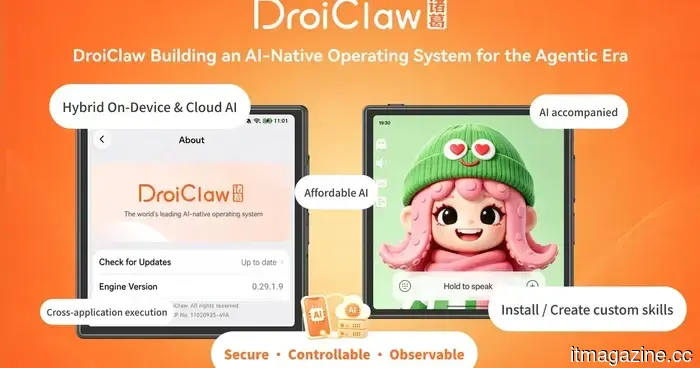
DroiClaw is transforming smart devices from being app-based to utilizing AI-native operating systems.
The development of operating systems (OS) throughout various generations of devices has historically been motivated by necessity. Yet, with the swift growth of the AI agent ecosystem, it's clear that traditional OS are struggling to keep pace. The persistent dependence on legacy operating systems for AI infrastructure has resulted in inefficiencies that often hinder the full potential of AI models.
DroiClaw (Zhuge) is an AI-native operating system created by Shanghai Droi Technology. It incorporates AI into the fundamental system architecture rather than depending on app installations to provide AI functionalities. The OS can handle multimodal inputs—such as text, voice, images, files, and visual data—facilitating more intuitive interactions across various smart-terminal situations. By integrating AI into the system itself, DroiClaw aims to streamline user interactions with their devices while enabling a wider array of intelligent experiences.
What Defines an AI-Native Operating System?
In traditional operating systems, AI functionalities, such as assistants or chatbots, are merely add-ons installed as apps. Therefore, these systems do not possess innate AI capabilities within their architecture. For users to access AI functionalities on conventional operating systems, they must install several specialized AI applications, each typically designed for a specific function or process.
DroiClaw is fundamentally different as it is not just another tool or AI feature added to a conventional OS. It was conceived with AI as a core component of its design. The architecture, model interaction, task scheduling, data processing, agent functions, and user experience are all constructed with AI at their center. Thus, AI is not treated as an extra feature; instead, it is woven into the very essence of the operating system's functionality.
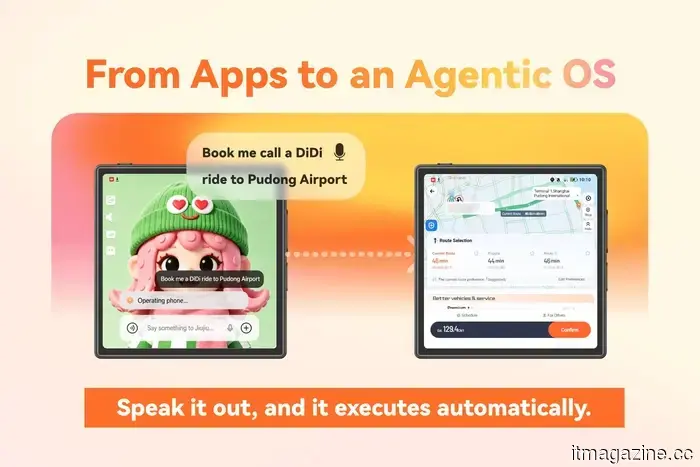
From Applications to an Agentic OS
On smartphones that operate on traditional systems, users often have to open disparate apps and follow numerous steps to complete a task. DroiClaw's primary goal is to create an app-free Agentic OS ecosystem that transcends the conventional app-centric interaction approach.
This smart terminal operating system employs natural-language interactions and AI agents to interpret user intent, delivering a tailored and efficient experience. By coordinating various system functions and services, the OS simplifies complex requests into manageable tasks, executing user-authorized operations and minimizing the necessity for manual app switching. Users can acquire skills from a skill library or craft personalized skills for specific tasks, allowing the system to adjust to various needs and contexts.
While transitioning from an app-focused OS to an intent-driven Agentic OS aims to eliminate the shortcomings of the former and expedite task completion, the authorization step ensures that users retain control over critical actions before they are initiated.
DroiClaw
Hybrid On-Device and Cloud AI
DroiClaw employs a hybrid architecture that merges lightweight on-device AI models with cloud-based larger models to support diverse usage scenarios.
Typically, users depend on cloud-based large models, which offer enhanced capabilities such as multimodal interactions, AIGC, complex reasoning, content generation, scheduled tasks, and skill execution. These cloud models are built to manage more intensive AI workloads while providing a variety of intelligent functions.
On-device models primarily act as backups in certain situations, such as when internet access is lost or cloud service credits have been depleted. In these instances, the system can automatically switch to the local model to address basic Q&A tasks, allowing users to maintain access to fundamental AI functionalities even without cloud support.
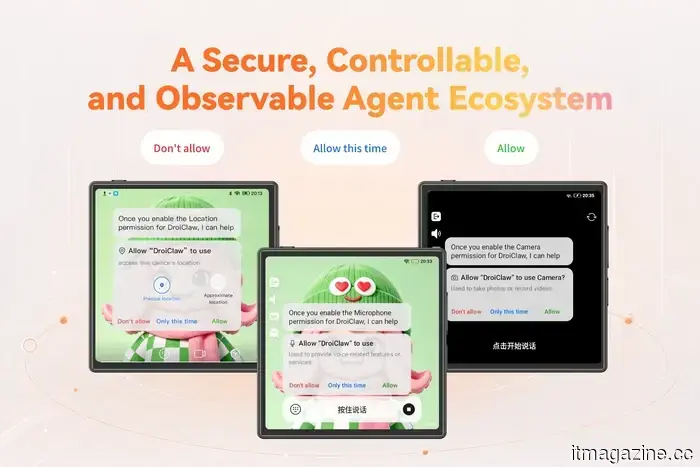
A Secure, Controllable, and Observable Agent Ecosystem
As AI agents advance from performing simple tasks to managing devices, accessing data, and coordinating services, users and ecosystem participants require more visibility and control over data management and transfers.
DroiClaw envisions a more transparent data processing and transfer system through task and model scheduling along with layered data protection.
The AI-native OS from Shanghai Droi Technology provides enhanced transparency and control via user authorization and manageable execution of automated tasks. Sensitive operations only proceed after receiving user approval. The operational permission management system offers users insight into agent actions and permissions, fostering trust in AI agents while enabling user oversight of automated processes.
DroiClaw
Affordable AI and an Open Ecosystem
The major shift that DroiClaw aspires to achieve is to deliver advanced AI capabilities to low- to mid-range, cost-effective smart terminals. This represents a significant advantage for users, as traditional operating systems often necessitate powerful hardware to run on-device AI models, which can elevate device prices beyond the reach of average consumers.
The first smartphones featuring DroiClaw are priced around RMB 1,099 (approximately $165). In contrast, flagship smartphones equipped with traditional OS and on-device AI capabilities typically range from $800 to $1,300 (approximately RMB 5,425 to 8,815).
Shanghai Droi Technology’s AI-native OS is designed to be compatible with various hardware brands and AI services. It fosters an open ecosystem that accommodates multiple hardware platforms and AI models, enabling developers and users to switch between AI models and introduce custom models. The importance of transitioning towards open-source
Other articles
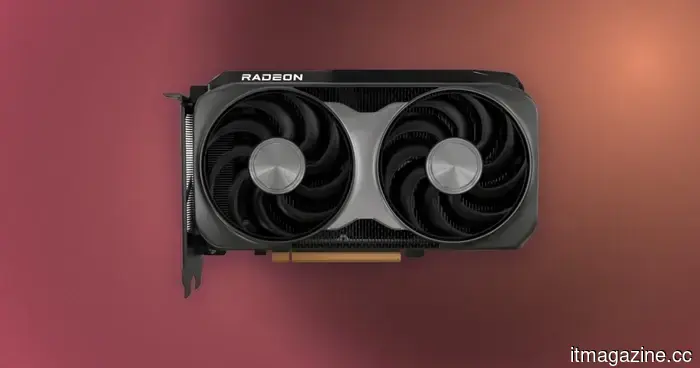 AMD has introduced the affordable RX 9050 GPU. Above all, it highlights the challenging times for the gaming industry.
AMD has introduced the RX 9050, an entry-level graphics card, as escalating component prices make it increasingly challenging to assemble budget gaming PCs.
AMD has introduced the affordable RX 9050 GPU. Above all, it highlights the challenging times for the gaming industry.
AMD has introduced the RX 9050, an entry-level graphics card, as escalating component prices make it increasingly challenging to assemble budget gaming PCs.
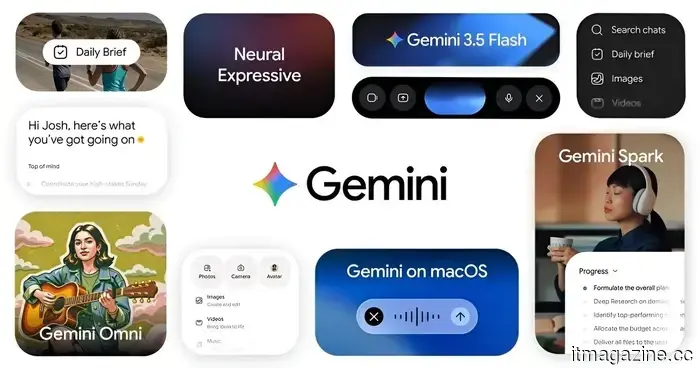 Gemini can now condense the most chaotic comment threads in Google Docs.
Gemini is now able to organize extensive comments in Google Docs by reviewer or topic, highlight unresolved queries, draft replies, and propose edits, although access is contingent upon having the appropriate plan, settings, and document permissions.
Gemini can now condense the most chaotic comment threads in Google Docs.
Gemini is now able to organize extensive comments in Google Docs by reviewer or topic, highlight unresolved queries, draft replies, and propose edits, although access is contingent upon having the appropriate plan, settings, and document permissions.
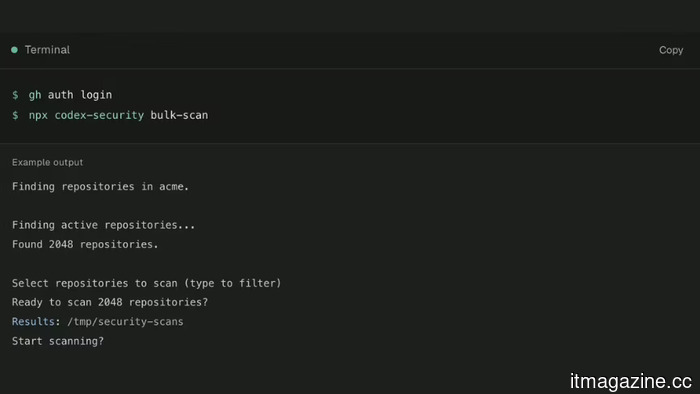 OpenAI has made Codex Security available as open source, but has restricted access to the scanner.
OpenAI has made its Codex Security CLI available as open-source to identify bugs in code, but the scanner remains restricted. This is seen as a strategic move in the AppSec domain and a challenge to Anthropic's Claude Security.
OpenAI has made Codex Security available as open source, but has restricted access to the scanner.
OpenAI has made its Codex Security CLI available as open-source to identify bugs in code, but the scanner remains restricted. This is seen as a strategic move in the AppSec domain and a challenge to Anthropic's Claude Security.
 Students are opting for AI chatbots over human counselors for college guidance.
Free AI chatbots from Alibaba, ByteDance, Tencent, and Baidu are transforming China's expensive college counseling sector, assisting millions of gaokao students in selecting universities and majors without the need for paid consultants.
Students are opting for AI chatbots over human counselors for college guidance.
Free AI chatbots from Alibaba, ByteDance, Tencent, and Baidu are transforming China's expensive college counseling sector, assisting millions of gaokao students in selecting universities and majors without the need for paid consultants.
 DoorDash aims to deliver your food order using a drone in the future.
DoorDash received FAA clearance to launch DoorDash Air, an internal drone delivery service, positioning itself alongside Wing, Zipline, and Amazon as one of just eight certified drone operators in the US.
DoorDash aims to deliver your food order using a drone in the future.
DoorDash received FAA clearance to launch DoorDash Air, an internal drone delivery service, positioning itself alongside Wing, Zipline, and Amazon as one of just eight certified drone operators in the US.
 OpenAI provides 100,000 scientists with complimentary access to AI and demonstrates the process.
OpenAI is granting 100,000 researchers free frontier access until 2027, coinciding with its announcement about reducing token costs for its agents to enable such initiatives.
OpenAI provides 100,000 scientists with complimentary access to AI and demonstrates the process.
OpenAI is granting 100,000 researchers free frontier access until 2027, coinciding with its announcement about reducing token costs for its agents to enable such initiatives.
DroiClaw is transforming smart devices from being app-based to utilizing AI-native operating systems.
Transferring data between applications and repetitive prompts may soon become obsolete. Although AI has already changed the way we work and interact, DroiClaw is designing smartphones from scratch with the aim of integrating artificial intelligence as the core of the operating system.