
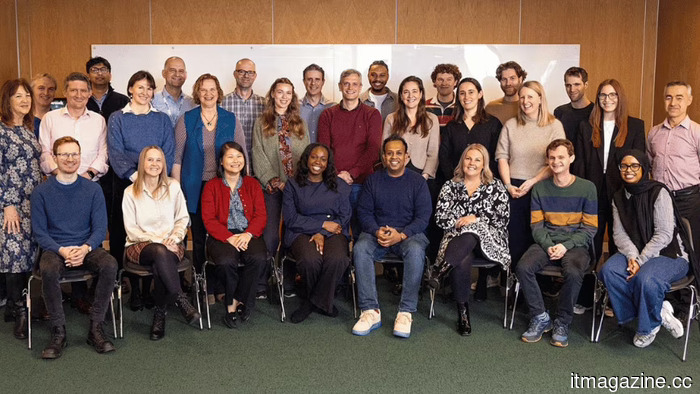
Qureight secures $20 million for an AI technology focused on chest conditions to accelerate drug trials.
Most AI imaging startups develop a distinct model for each disease. However, a company in Cambridge has secured $20 million to create a singular model for the entire chest, allowing it to derive other models from this foundation.
Qureight specializes in AI imaging tools for clinical trials involving the lungs and heart. The company announced the closure of a $20 million Series B funding round led by Molten Ventures, bringing its total funding to over €27 million, as reported by Tech.eu.
A foundational model for the chest
The newly acquired funds will help establish an AI imaging lab centered around a versatile 3D model of the chest. Qureight claims that it can develop disease-specific models in just one to two months using this foundational model, compared to the one-year timeframe required for building a model from scratch. Upcoming models will target asthma, lung cancer, pulmonary hypertension, and bronchiectasis, in addition to its current focus on lung fibrosis.
The appeal to pharmaceutical companies revolves around efficiency. One of Qureight’s tools reduces the time for imaging decisions in a trial from approximately two weeks to just 48 hours. Another tool creates 3D maps of airways and blood vessels to monitor how a drug affects a disease. Additionally, it offers “synthetic control arms,” which are AI-generated substitutes for real control groups, potentially reducing trial costs.
AstraZeneca and Bristol Myers Squibb are already utilizing this technology, as reported by Tech Funding News. The market for lung and heart trials is projected to reach $27.5 billion by 2030.
Two doctors and a CT scan
The inception of Qureight is distinctive for an AI imaging company, as it was founded in 2018 by two doctors rather than engineers. Chief Executive Muhunthan Thillai, a chest physician who still sees patients, started the company after encountering difficulties reading a CT scan confidently.
To bridge the expertise gap, the founders recruited a senior technical team that includes a former global platform head at HP and a machine-learning professor from Imperial College London. Qureight's closest European competitor, Brainomix from Oxford, focuses on selling diagnostic software for hospitals, whereas Qureight operates directly within clinical trials.
Keeping it in London
This funding round highlights the current trend in financial investment within AI in medicine. Qureight initially approached Molten two years ago, but was turned down. This time, however, three investors presented term sheets within six weeks. The company opted to reject US offers and secured funding from a London-based investor.
This influx of capital is evident in the growing interest in AI for drug discovery and biology, alongside a series of health-tech funding rounds. Qureight aims to expand its workforce to 100 employees by December. Whether its chest model becomes a standard in trials or remains a specialized tool will depend on the partnerships it establishes in the future.
Other articles
 Gemini on Mac can now transcribe your speech and respond to what it observes.
Google is enhancing the Gemini application for Mac by introducing system-wide dictation activated by the Fn key, along with an optional mode that enables Gemini to gather context from the current display for more intricate tasks.
Gemini on Mac can now transcribe your speech and respond to what it observes.
Google is enhancing the Gemini application for Mac by introducing system-wide dictation activated by the Fn key, along with an optional mode that enables Gemini to gather context from the current display for more intricate tasks.
 BMW eliminates 8,000 positions and transfers its automotive computing to Qualcomm.
BMW plans to reduce approximately 8,000 jobs in Germany due to declining sales in China, coinciding with the announcement that Qualcomm will be the exclusive supplier of its vehicles' computing systems for the next ten years.
Cyera acquires Oasis Security for $1 billion to monitor AI agents.
Cyera is acquiring Oasis Security for approximately $1 billion to manage the "non-human identities" that AI agents use to access company data, marking the largest security deal in the AI-agent sector to date.
PwC is the most recent Big Four company to be exposed for disseminating poor-quality AI content.
PwC released reports in the Middle East that contained bogus footnotes and fabricated sources, including one URL that ended with “chatgpt.com.” This marks the fourth instance of a Big Four firm being caught utilizing subpar AI content.
BMW eliminates 8,000 positions and transfers its automotive computing to Qualcomm.
BMW plans to reduce approximately 8,000 jobs in Germany due to declining sales in China, coinciding with the announcement that Qualcomm will be the exclusive supplier of its vehicles' computing systems for the next ten years.
Cyera acquires Oasis Security for $1 billion to monitor AI agents.
Cyera is acquiring Oasis Security for approximately $1 billion to manage the "non-human identities" that AI agents use to access company data, marking the largest security deal in the AI-agent sector to date.
PwC is the most recent Big Four company to be exposed for disseminating poor-quality AI content.
PwC released reports in the Middle East that contained bogus footnotes and fabricated sources, including one URL that ended with “chatgpt.com.” This marks the fourth instance of a Big Four firm being caught utilizing subpar AI content.
 As AI produces an increasing number of messages, the ability for humans to recognize them becomes more valuable.
AI has accelerated internal communication, but it has also made it more difficult to trust. Motivosity suggests that integrating company updates into recognition platforms, where employees are already engaged, is the way for organizations to stand out amidst the clutter.
As AI produces an increasing number of messages, the ability for humans to recognize them becomes more valuable.
AI has accelerated internal communication, but it has also made it more difficult to trust. Motivosity suggests that integrating company updates into recognition platforms, where employees are already engaged, is the way for organizations to stand out amidst the clutter.
 OpenAI provides 100,000 scientists with complimentary access to AI and demonstrates the process.
OpenAI is granting 100,000 researchers free frontier access until 2027, coinciding with its announcement about reducing token costs for its agents to enable such initiatives.
OpenAI provides 100,000 scientists with complimentary access to AI and demonstrates the process.
OpenAI is granting 100,000 researchers free frontier access until 2027, coinciding with its announcement about reducing token costs for its agents to enable such initiatives.
Qureight secures $20 million for an AI technology focused on chest conditions to accelerate drug trials.
Cambridge's Qureight secured $20 million in Series B funding to develop an AI "foundation model" for the chest, aimed at accelerating drug trials for lung and heart conditions.