

Aschenbrenner's Situational Awareness fund is sold to Citadel.
The individual who authored the defining case for the AI surge has just faced substantial losses from betting on it. Situational Awareness, the hedge fund established by former OpenAI researcher Leopold Aschenbrenner, has been compelled to divest its public stock portfolio following significant losses. Ken Griffin's Citadel has purchased the entire lot.
The collapse was initially reported by David Faber of CNBC. According to him, the fund's prime brokers were racing to raise funds to cover margin calls. The entire public portfolio was sold in one massive transaction. Approximately two-thirds of the fund’s assets were in public equities, held both long and short. The Wall Street Journal also noted that competing firm Millennium had placed a bid for the portfolio.
The trade that faltered
The fund made a significant leveraged bet: that the AI expansion would continuously boost the companies providing its chips, memory, and power. Unfortunately, that bet proved to be disastrous. Its investments in memory manufacturers like Micron, SK Hynix, Sandisk, Nebius, and CoreWeave unraveled rapidly.
The impact was severe. Nebius, where the fund revealed a multi-billion-dollar investment in May, has dropped nearly 48 percent from its peak, wiping out about $35 billion in market value. Sandisk has plunged 56 percent in barely a month. The fund also shorted software, with bets against companies like Adobe going against it, creating pressure from both ends.
This approach effectively mirrored the long-chips, short-software strategy that has characterized this year, taken to an extreme through borrowed funds. Leverage turned a challenging month into a real crisis. The Financial Times reported that the fund used borrowing to boost returns, a tactic that equally magnifies losses. Bank of America, Goldman Sachs, and JPMorgan were left to manage its positions.
From $225 million to a fire sale
The rapidity of the rise makes the decline even more remarkable. Aschenbrenner founded the fund in 2024 with around $225 million, supported by the founders of Stripe, Nat Friedman, Daniel Gross, and the trading firm Jane Street.
The fund surpassed $20 billion in growth, and CNBC noted it reached as much as $45 billion in early July. It gained 439 percent in the first half of the year.
It operated with a small team. According to The Verge, the fund consisted of eight employees, only four of whom were investment professionals. Aschenbrenner had no prior trading experience before starting it. He has garnered a significant following, with over 250,000 people on X.
Despite the increasing losses, the tone remained unchanged. In a letter to investors dated July 24, seen by the FT, Aschenbrenner acknowledged that the fund had “not been immune” to the sell-off. He then referred to it as one of the best buying opportunities since early 2025, inviting clients to invest more cash on August 1.
Anthropic survives the fallout
One major investment remains intact. Situational Awareness retains its private holdings, with its largest being a stake in Anthropic, valued by the FT at approximately $5 billion. The firm will continue to operate as a private investment vehicle, essentially functioning as an Anthropic holding company with a hedge fund component.
A spokesperson informed CNBC that reports of the firm seeking to sell the Anthropic stake are “not accurate.” Ironically, Aschenbrenner is engaged to Avital Balwit, the chief of staff to Anthropic’s CEO, Dario Amodei.
The oracle’s thesis under scrutiny
This serves as a personal setback for one of the most scrutinized figures in the AI sector. Aschenbrenner, now 25, was a Columbia valedictorian by 19 and worked on OpenAI’s Superalignment team before being dismissed in 2024.
His 165-page essay, “Situational Awareness,” provided the fund its name and shaped the market perspective. He asserted that “the AGI race has begun,” predicting trillion-dollar compute clusters and hundreds of millions of active GPUs. It essentially became the intellectual framework for the entire infrastructure investment.
The essay accurately highlighted that AI requires more chips. The fund's downfall stemmed from leverage rather than a flawed thesis, with a notable twist: the very stocks it was forced to sell, such as SK Hynix, surged sharply the following day. Some interpret this as an indication that the forced selling created a short-term bottom rather than a negative judgment on the AI investment overall.
The comparisons were inevitable. ZeroHedge referred to it as “Archegos 2.0,” in reference to the family office that collapsed due to hidden leverage. Others likened it to Three Arrows, the crypto fund that was overly optimistic about its own supercycle. Commentators pointed out the irony that a firm named Situational Awareness failed to recognize the risk inherent in its own portfolio.
Additionally, several people noted that this marks the second
Other articles
 Zoox receives initial US authorization to charge for rides in its no-wheel robotaxis.
Amazon’s Zoox has secured the first U.S. exemption to offer paid rides in a specially designed robotaxi that lacks a steering wheel, with a limit of 2,500 vehicles per year.
Zoox receives initial US authorization to charge for rides in its no-wheel robotaxis.
Amazon’s Zoox has secured the first U.S. exemption to offer paid rides in a specially designed robotaxi that lacks a steering wheel, with a limit of 2,500 vehicles per year.
 Microsoft Copilot's 'Word worm' continues to function 144 days following its announcement.
A researcher demonstrated that concealed instructions within a Word file can lead Copilot to modify a report and potentially compromise the following document. Microsoft's updates did not address this issue.
Microsoft Copilot's 'Word worm' continues to function 144 days following its announcement.
A researcher demonstrated that concealed instructions within a Word file can lead Copilot to modify a report and potentially compromise the following document. Microsoft's updates did not address this issue.
 Hongqi claims that its latest EV technology can fully charge a battery in only eight minutes, surpassing BYD.
FAW's Hongqi brand asserts that its battery can be charged from 10% to 90% in less than 8 minutes, entering an intensifying competition in the Chinese EV charging market against BYD, CATL, and Geely.
Hongqi claims that its latest EV technology can fully charge a battery in only eight minutes, surpassing BYD.
FAW's Hongqi brand asserts that its battery can be charged from 10% to 90% in less than 8 minutes, entering an intensifying competition in the Chinese EV charging market against BYD, CATL, and Geely.
 Winamp is partnering with Deezer to introduce streaming capabilities to its legendary music player.
Winamp is collaborating with Deezer to integrate music streaming into its upcoming player, which is set to launch in the first half of 2027, while still maintaining local libraries, podcasts, and radio features.
Winamp is partnering with Deezer to introduce streaming capabilities to its legendary music player.
Winamp is collaborating with Deezer to integrate music streaming into its upcoming player, which is set to launch in the first half of 2027, while still maintaining local libraries, podcasts, and radio features.
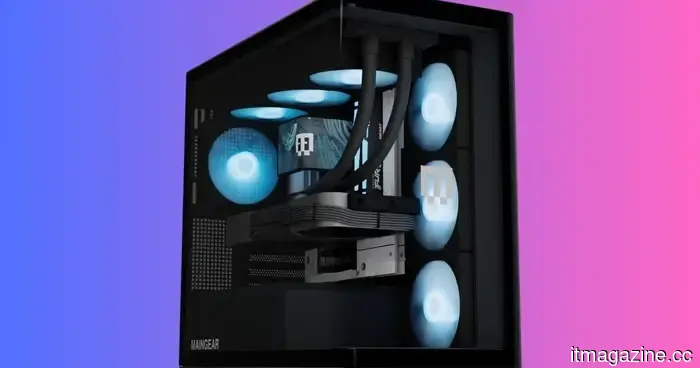 Maingear's Zero desktop features a sleek, wire-free design with curved glass and a considerable amount of power.
The Maingear Zero desktop is equipped with an NVIDIA GeForce RTX 5090 GPU and high-end processors from Intel and AMD. The starting price in the US is a hefty $2,699.
Maingear's Zero desktop features a sleek, wire-free design with curved glass and a considerable amount of power.
The Maingear Zero desktop is equipped with an NVIDIA GeForce RTX 5090 GPU and high-end processors from Intel and AMD. The starting price in the US is a hefty $2,699.
 Microsoft aims to enhance Windows 11's right-click menu to function more effectively, providing users with greater control.
Microsoft is said to be revamping the context menu in Windows 11 to enhance performance and allow for user customization, enabling users to select which applications and actions are displayed.
Microsoft aims to enhance Windows 11's right-click menu to function more effectively, providing users with greater control.
Microsoft is said to be revamping the context menu in Windows 11 to enhance performance and allow for user customization, enabling users to select which applications and actions are displayed.
Aschenbrenner's Situational Awareness fund is sold to Citadel.
Aschenbrenner’s AI hedge fund Situational Awareness disposed of its publicly traded stocks to Citadel following the failure of its leveraged AI investments. However, it retains its stake in Anthropic.