
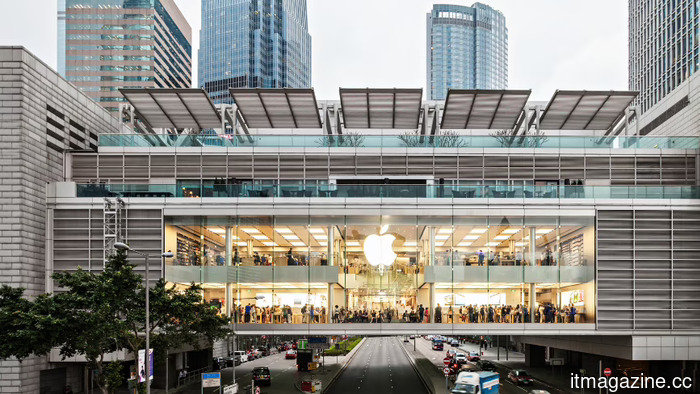
Apple reaches a $5 trillion valuation by avoiding the competition in AI spending.
Apple has become the second company in history to reach a valuation of $5 trillion, achieving this by not investing heavily in AI like other tech giants. On Tuesday, the iPhone manufacturer briefly reached a market value of $5.04 trillion, with shares peaking at $342.89 before settling at $340.08, just below the mark, according to CNBC. The only other company to have reached this threshold is Nvidia, which did so last October.
Just a day prior, Apple surpassed Nvidia to reclaim its title as the world's most valuable company, a position Nvidia had held since June 2025.
The surprising aspect of this achievement lies in the reasons behind it. For two years, investors penalized Apple for not capitalizing on the AI surge, with delays in Siri’s updates and setbacks in its proprietary models. However, this same cautious approach is now benefitting the company. In contrast, companies like Alphabet, Amazon, Meta, and Microsoft have invested hundreds of billions into data centers.
Apple relies on Google's technology for its AI functionalities while keeping its expenditures minimal. Analysts estimate that Apple will spend around $11 billion this year, compared to the $100 billion-plus that major cloud providers are investing.
Apple’s stock has appreciated roughly 25% in 2026, marking the best performance among the “Magnificent Seven.” Conversely, shares of Tesla, Microsoft, and Meta have declined this year. As highlighted by Business Insider, Apple's rally is not attributed to its actions but rather to a shift away from the saturated AI market towards a consumer-focused company that isn’t depleting its finances.
The catalyst for this movement was an unsettling development elsewhere. Google alarmed the market last week by raising its capital expenditure forecast to as high as $205 billion, alongside reporting its first ever negative free cash flow, with $5.9 billion spent in a single quarter, as noted by the Guardian.
Investors are increasingly uneasy about the interconnected financing that supports AI enterprises, as these companies often finance one another's computing needs. This anxiety has led to a market decline. The Nasdaq 100 has dropped more than 10% from its June peak, crossing into correction territory. Semiconductor stocks have been particularly hard hit, with the primary semiconductor ETF down 14% in a month and a popular memory fund down 29%.
In Asia, firms like SK Hynix and Samsung saw declines exceeding 10%, following news that China had started mass-producing its own chipmaking equipment, compounded by weeks of concerns over cheaper Chinese AI models. The capital exiting those sectors has largely flowed into Apple.
However, there is a drawback. The same factors keeping Apple's operating costs low are also holding it back. Its revamped Siri remains in beta and isn’t expected to launch in full until autumn, coinciding with new iPhone releases. Furthermore, its collaboration with OpenAI has mostly disintegrated, leading Apple to file a lawsuit against the company this month for alleged trade-secret theft.
Currently, relying on Google's intelligence is efficient for Apple; however, it also makes the company dependent on a direct competitor for the technology that is transforming its sector.
Signs indicate that this cautious approach might not persist. In its recent report, Apple discreetly abandoned its long-held goal of maintaining an equal balance of cash and debt, potentially freeing up resources for future spending. Whether this spending will materialize remains uncertain.
Tim Cook's upcoming earnings call will be his last as CEO before John Ternus takes over on September 1. Analysts anticipate that revenue will increase by approximately 16% year-over-year. Cook will be leaving at the peak of success, handing his successor a $5 trillion corporation.
The more challenging question lies in how long Apple can continue to thrive without actively engaging in the competitive landscape.
Other articles
 PayPal responds to Stripe's $53 billion offer: willing to consider it, but not at that valuation.
PayPal responded to Stripe's $53 billion offer with a better-than-expected earnings report for Q2 and conveyed that it is amenable to a deal, but not at a price of $60.50 per share. One analyst estimates its value to be closer to $70.
PayPal responds to Stripe's $53 billion offer: willing to consider it, but not at that valuation.
PayPal responded to Stripe's $53 billion offer with a better-than-expected earnings report for Q2 and conveyed that it is amenable to a deal, but not at a price of $60.50 per share. One analyst estimates its value to be closer to $70.
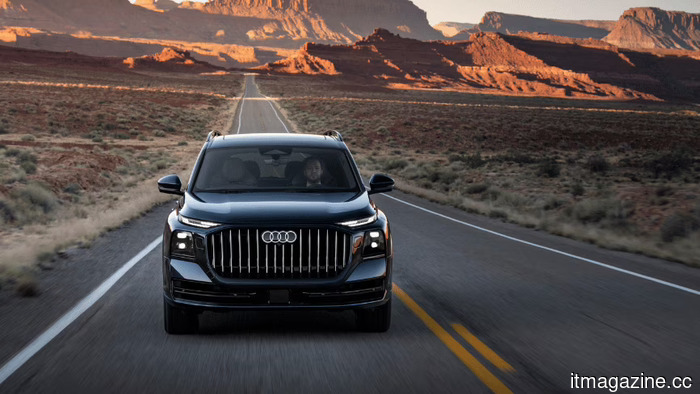 Audi's Q9 is a V8 petrol model aimed at the American market as its electric vehicle strategy faces delays.
Audi's Q9 is a petrol-powered SUV designed to appeal to American preferences, introduced as its electric vehicle initiative faces challenges, tariffs impact its entirely imported lineup, and employees express concerns over potential plant closures.
Cyera acquires Oasis Security for $1 billion to monitor AI agents.
Cyera is acquiring Oasis Security for approximately $1 billion to manage the "non-human identities" that AI agents utilize to access company data, marking the largest deal in AI-agent security to date.
Audi's Q9 is a V8 petrol model aimed at the American market as its electric vehicle strategy faces delays.
Audi's Q9 is a petrol-powered SUV designed to appeal to American preferences, introduced as its electric vehicle initiative faces challenges, tariffs impact its entirely imported lineup, and employees express concerns over potential plant closures.
Cyera acquires Oasis Security for $1 billion to monitor AI agents.
Cyera is acquiring Oasis Security for approximately $1 billion to manage the "non-human identities" that AI agents utilize to access company data, marking the largest deal in AI-agent security to date.
 xAI files a lawsuit against Minnesota regarding the first 'nudify' prohibition in the United States.
xAI is filing a lawsuit to invalidate Minnesota's unique 'nudify' prohibition, asserting that the First Amendment safeguards the tools involved. This action is taking place in the context of a Grok CSAM class action.
xAI files a lawsuit against Minnesota regarding the first 'nudify' prohibition in the United States.
xAI is filing a lawsuit to invalidate Minnesota's unique 'nudify' prohibition, asserting that the First Amendment safeguards the tools involved. This action is taking place in the context of a Grok CSAM class action.
 AI agents are capable of browsing the internet. They now require a method to make payments for this capability.
As AI agents begin to engage in online transactions, existing payment systems designed for humans struggle to adapt. The x402 Foundation, supported by Visa, Mastercard, Google, and Stripe, is developing a standard for commerce between machines, while blockchain initiatives such as Casper are establishing stablecoins as the foundation for settlement infrastructure.
AI agents are capable of browsing the internet. They now require a method to make payments for this capability.
As AI agents begin to engage in online transactions, existing payment systems designed for humans struggle to adapt. The x402 Foundation, supported by Visa, Mastercard, Google, and Stripe, is developing a standard for commerce between machines, while blockchain initiatives such as Casper are establishing stablecoins as the foundation for settlement infrastructure.
 NextEra and Brookfield are planning a $100 billion data center campus in Kentucky.
Bloomberg reports that NextEra and Brookfield are planning a data-center campus in Kentucky, valued at as much as $100 billion, combining the largest utility in the U.S. with a $100 billion AI investment fund.
NextEra and Brookfield are planning a $100 billion data center campus in Kentucky.
Bloomberg reports that NextEra and Brookfield are planning a data-center campus in Kentucky, valued at as much as $100 billion, combining the largest utility in the U.S. with a $100 billion AI investment fund.
Apple reaches a $5 trillion valuation by avoiding the competition in AI spending.
Apple briefly reached a $5 trillion valuation, becoming only the second company to achieve this milestone, as investors moved away from the AI capital expenditure frenzy towards the one major player that remained on the sidelines.