
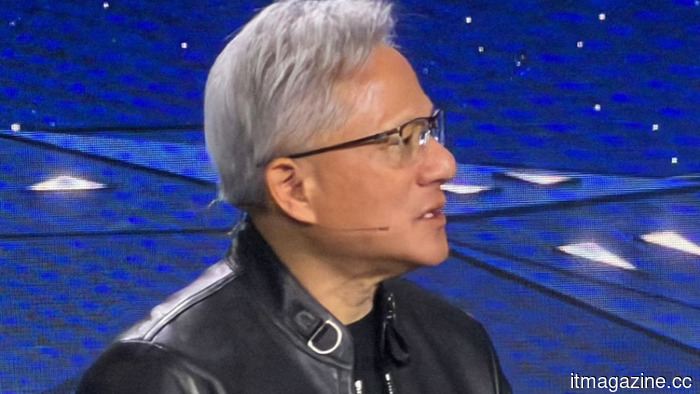
Nvidia is in negotiations to secure $250 billion in debt for OpenAI's data centers.
According to a report by the Wall Street Journal on Sunday, Nvidia is in discussions to offer approximately $250 billion in financing guarantees for OpenAI, as per sources familiar with the situation. This support would allow OpenAI to lease a 10-gigawatt campus in southern Ohio that is being developed by SoftBank’s energy subsidiary.
The need for such a guarantee is clear: OpenAI lacks an investment-grade credit rating. By leveraging Nvidia’s balance sheet, lenders would be able to evaluate the debt against Nvidia’s credit instead of that of OpenAI.
Details on funding
The $250 billion figure pertains to the lease and construction debt for the data center, excluding the Nvidia chips that will populate the facility. Financing for chip purchases could add an additional $350 billion, as reported by the Journal. Overall, the entire project is projected to exceed $500 billion, including silicon, with the first phase of approximately 800 megawatts expected to be completed by 2028.
Nvidia's involvement would facilitate financing mechanisms to provide reassurances to lenders regarding the project's funding. Reuters mentioned that they could not immediately verify this report, and there has been no response from Nvidia, OpenAI, or the US Commerce Department concerning comments.
Political significance of the site
Control of power for the Ohio campus is held by the US government and is financed separately by Japan as part of a recent trade agreement linked to Tokyo's commitment to invest $33 billion in a natural gas facility. The decision on access falls to Commerce Secretary Howard Lutnick.
OpenAI has been in advanced negotiations for the site for several weeks and is among the top contenders. Other interested parties, such as Anthropic, Microsoft, and Google, have also contacted Lutnick recently, according to the Journal.
The circularity dilemma
Investor Michael Burry, known for his short position on the housing market before the 2008 crisis, remarked on X: “Around and around we go. Nvidia to guarantee $200 billion of ChatGPT’s spending on $NVDA chips.” He added to his short position in Nvidia on Friday at $210.28. Tech commentator Ed Zitron was more direct, describing it as “such an insane thing to do on so many levels and about as bearish as it gets, especially considering it is being built by SoftBank.” Both critics were pointing to the same structural issue: a chip supplier backing its customer’s capacity to continuously purchase chips.
Nvidia has already invested over $40 billion in AI equity positions, including approximately $30 billion in OpenAI. Its funding of Ilya Sutskever’s Safe Superintelligence exemplifies this trend, with Nvidia backing companies that spend the funds on Nvidia hardware.
A precedent for this structure
Vendor guarantees for data center obligations are becoming more common, though the scale of this deal stands out. Google has provided around $44 billion in guarantees for other companies’ data center leases, substantially less than the proposed Nvidia backup amount.
OpenAI's financial structure has also become more complex. Eight banks are now underwriting SoftBank’s record $40 billion loan to OpenAI, while SoftBank has been pursuing margin lending secured by its stake in OpenAI.
Much of this financial commitment remains outside traditional debt reporting. Research estimates that Big Tech’s off-balance-sheet AI commitments total approximately $1.65 trillion, with Meta alone responsible for about $420 billion, nearly three times its reported debt.
Benefits for OpenAI
For OpenAI, this deal would represent its first step towards owning its computing infrastructure rather than leasing it from Microsoft, Amazon, and Oracle. Owning the infrastructure allows for control over capacity rather than just negotiating it.
For Nvidia, the interest lies in ensuring demand. Providing guarantees for the building secures years of chip orders from a customer that might otherwise find it difficult to finance them, raising concerns among critics about the nature of the arrangement.
Questioning the scale
AI infrastructure expenditures are projected to surpass $700 billion this year, and the industry is expected to invest over $3 trillion in data centers by 2028, largely financed through the chips contained within. The primary risk is not whether AI will be significant, but whether the construction will exceed demand or if returns will diminish faster than the debt can be repaid.
No agreements have been finalized yet. The Journal emphasized that discussions regarding the site and its financing are ongoing and may change, which represents a significant caveat for a $250 billion guarantee.
Other articles
 Amazon requested the FCC's approval for 5,105 satellites intended for a network that transmits internet directly to your mobile device.
Amazon submitted a proposal to deploy 5,105 satellites for direct-to-device connectivity. This initiative merges Kuiper and Globalstar resources, with a deployment goal set for 2028. SpaceX is already providing direct-to-device services in partnership with T-Mobile.
Amazon requested the FCC's approval for 5,105 satellites intended for a network that transmits internet directly to your mobile device.
Amazon submitted a proposal to deploy 5,105 satellites for direct-to-device connectivity. This initiative merges Kuiper and Globalstar resources, with a deployment goal set for 2028. SpaceX is already providing direct-to-device services in partnership with T-Mobile.
 Meta AI is now available in Threads DMs for users around the globe.
Meta is introducing Meta AI DMs to all Threads users worldwide. You are able to share posts and images using this feature. However, you still cannot block Meta AI's posts in the public feed.
Meta AI is now available in Threads DMs for users around the globe.
Meta is introducing Meta AI DMs to all Threads users worldwide. You are able to share posts and images using this feature. However, you still cannot block Meta AI's posts in the public feed.
 Orange and Morrison intend to launch a EUR 3 billion data center project in France.
Orange and Morrison are set to develop a 400MW data centre platform in France, supported by EUR 3 billion, which is presented as an initiative for European sovereignty financed by a manager from New Zealand.
Orange and Morrison intend to launch a EUR 3 billion data center project in France.
Orange and Morrison are set to develop a 400MW data centre platform in France, supported by EUR 3 billion, which is presented as an initiative for European sovereignty financed by a manager from New Zealand.
 Window AC vs. Mini Split: Which is the Better Cooling Upgrade for the Summer?
Summer doesn't have to result in increased electricity expenses and obstructed window views. Before opting for another short-term solution, discover why contemporary homeowners are turning to quieter, more intelligent mini splits for year-round comfort.
Window AC vs. Mini Split: Which is the Better Cooling Upgrade for the Summer?
Summer doesn't have to result in increased electricity expenses and obstructed window views. Before opting for another short-term solution, discover why contemporary homeowners are turning to quieter, more intelligent mini splits for year-round comfort.
 Young adults are utilizing ChatGPT to draft their face-to-face dialogues. Psychologists refer to this as an
An increasing number of young adults are utilizing AI chatbots to compose dating messages, icebreakers for parties, and instant replies during face-to-face conversations. Experts caution that this practice undermines self-confidence.
Young adults are utilizing ChatGPT to draft their face-to-face dialogues. Psychologists refer to this as an
An increasing number of young adults are utilizing AI chatbots to compose dating messages, icebreakers for parties, and instant replies during face-to-face conversations. Experts caution that this practice undermines self-confidence.
 AI providers are shifting from subscription models to consumption-based pricing. AI PCs serve as a safeguard.
Leading software companies are moving away from per-seat AI pricing in favor of token-based consumption. AI PCs that operate models locally provide businesses with an option to control expenses as cloud costs increase.
AI providers are shifting from subscription models to consumption-based pricing. AI PCs serve as a safeguard.
Leading software companies are moving away from per-seat AI pricing in favor of token-based consumption. AI PCs that operate models locally provide businesses with an option to control expenses as cloud costs increase.
Nvidia is in negotiations to secure $250 billion in debt for OpenAI's data centers.
Nvidia is allegedly considering a $250 billion support package for OpenAI's 10GW campus in Ohio, along with $350 billion in funding for chips. Critics have labeled this arrangement as circular.