
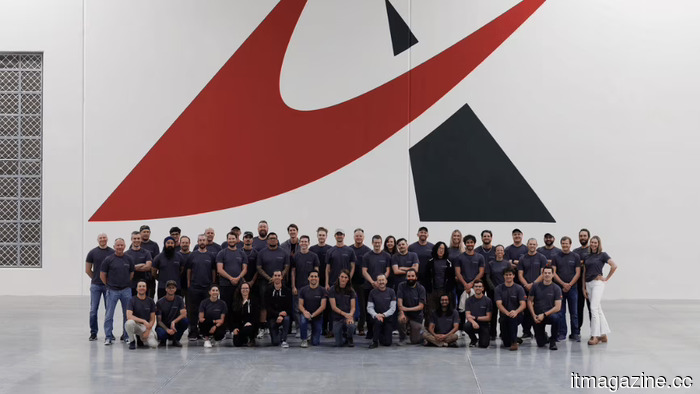
Antares secures $470 million for military nuclear microreactors.
A significant portion of the funding flowing into small nuclear reactors is aimed at AI data centers. This funding round is focused on a deadline.
Antares has secured $470 million, co-led by Paradigm and Caffeinated Capital, with contributions from Point72 Ventures, Shine Capital, and Industrious Ventures. The funding consists of $370 million in equity and $100 million in debt, according to Bloomberg.
Founded in 2023, the company has now garnered over $600 million and aims to have reactors operational at U.S. military installations by 2028.
The deadline driving the initiative
Executive Order 14299 mandates the Department of War to have a reactor operational at a domestic military site by September 30, 2028.
Antares finds itself in a rare position for a nuclear company of any size, with confirmed contracts, a designated site, and a set timeline.
The heart of EU tech
The latest updates from the EU tech sector, insights from our experienced founder Boris, and some dubious AI art. It's a free weekly newsletter in your inbox. Sign up now!
The company clearly articulates its rationale in its announcement. Many U.S. bases rely on a commercial power grid that is under pressure from increasing demand, extreme weather, and adversary targeting.
The Air Force selected Antares under its ANPI initiative for a proposed project at Joint Base San Antonio. CEO Jordan Bramble indicates that more military projects will be revealed this year.
Defining small
The scale of the reactors is often overlooked, and it is the most intriguing number in this context.
Antares reactors generate no more than one megawatt, while a typical nuclear facility produces around one gigawatt. Even among microreactors, which generally reach up to 20 megawatts, Antares operates at the low end of the spectrum.
These units are manufactured in a factory and delivered fully assembled. They can function for years without refueling, with the company aiming for a deployment duration of six years or more.
This presents a different product compared to reactors being developed for the AI industry. Valar Atomics raised $450 million to power data centers, while X-energy secured $1.02 billion through a Nasdaq listing. In the UK, Nuclear Turbines raised £15 million recently to make industrial energy costs more affordable.
Antares focuses on providing resilience for military personnel rather than inexpensive electricity for large-scale data centers.
The significance of the milestone
In June, Antares achieved criticality with its Mark-0 reactor at the Idaho National Laboratory, meaning it maintained a fission reaction.
The company claims this is the first privately developed non-light-water reactor to achieve criticality in the U.S. in over 40 years. Paradigm’s Alana Palmedo went further, asserting it is the first private advanced reactor to reach criticality in decades.
Bloomberg reports it in a narrower context, stating that Antares is the first to produce a self-sustaining fission reaction as part of the Energy Department’s reactor pilot program. This is a notable achievement, albeit on a smaller scale than the company's announcement suggests.
The test was conducted using TRISO fuel, validating reactor physics, reactivity control, and instrumentation in a full-scale core while generating only a limited amount of energy.
“On June 4th, we won the race to criticality, and now we’ve shifted to the race to commercialization,” Bramble remarked.
Current limitations
No microreactor is operational anywhere in the United States, as Bloomberg points out that the technology is still untested at a commercial level.
Antares does not anticipate an electricity-generating system until next year when the Mark-1 is expected to be ready. Achieving criticality and generating useful power are distinct milestones, and the company has accomplished one of them.
Bramble describes the funding as complementing public money rather than replacing it, characterizing the $470 million as investing “one-to-one with the taxpayer” to advance to commercial viability.
An overlooked bottleneck
Fuel has been a persistent constraint for advanced nuclear technologies for years, and Antares made progress on this front in May.
It established a long-term enrichment agreement with Urenco for High-Assay Low-Enriched Uranium, which Urenco referred to as the world’s first multi-year contract for HALEU supply.
Advanced reactors require HALEU. Supply has been limited in the West, with Russia previously being the most dependable source. Securing enrichment is arguably a more complex issue than securing funding, yet it receives considerably less attention.
Why this is significant to follow
Britain and Europe are conducting similar experiments, albeit on different terms. A Polish billionaire’s £35 billion plan for 14 mini reactors aims to achieve initial power by 2034, six years later than Antares’s target to operate at a U.S. airbase.
The difference is less about technical capacity and more about procedural efficiency. The American defense procurement
Other articles
 Waymo's autonomous vehicles continue to receive parking tickets in Austin, and it's not just people who are voicing their concerns.
Waymo's robotaxis in Austin have accumulated 83 parking tickets totaling $9,325, highlighting how ongoing curbside issues can evolve into a more significant operational challenge as they affect an entire autonomous fleet.
Waymo's autonomous vehicles continue to receive parking tickets in Austin, and it's not just people who are voicing their concerns.
Waymo's robotaxis in Austin have accumulated 83 parking tickets totaling $9,325, highlighting how ongoing curbside issues can evolve into a more significant operational challenge as they affect an entire autonomous fleet.
 The top note-taking applications for iOS and Android.
We’ve gathered a selection of our preferred note-taking applications for iOS and Android devices, including phones and tablets, to assist you in staying organized and managing your thoughts.
The top note-taking applications for iOS and Android.
We’ve gathered a selection of our preferred note-taking applications for iOS and Android devices, including phones and tablets, to assist you in staying organized and managing your thoughts.
 Antares secures $470 million for military nuclear microreactors.
Antares secured $470 million to install 1MW reactors at US military bases by 2028, the deadline established by an executive order. Currently, there are no microreactors operating in the US.
Antares secures $470 million for military nuclear microreactors.
Antares secured $470 million to install 1MW reactors at US military bases by 2028, the deadline established by an executive order. Currently, there are no microreactors operating in the US.
 Google might soon allow you to unlock your Pixel Watch using your phone.
According to reports, Google is developing a method to unlock your Pixel Watch using your phone, effectively reversing the current Watch Unlock feature.
Google might soon allow you to unlock your Pixel Watch using your phone.
According to reports, Google is developing a method to unlock your Pixel Watch using your phone, effectively reversing the current Watch Unlock feature.
 OpenAI is creating 250 jobs in Dublin as Ireland experiences a decline in tech positions due to AI shifts elsewhere.
OpenAI plans to lease 88,000 square feet at Dublin's Tropical Fruit Warehouse and will create 250 new jobs. Meanwhile, Meta and TikTok have recently reduced their workforce in Ireland. Anthropic is also growing its presence in the area.
OpenAI is creating 250 jobs in Dublin as Ireland experiences a decline in tech positions due to AI shifts elsewhere.
OpenAI plans to lease 88,000 square feet at Dublin's Tropical Fruit Warehouse and will create 250 new jobs. Meanwhile, Meta and TikTok have recently reduced their workforce in Ireland. Anthropic is also growing its presence in the area.
 Apple's top device protection offer is finally departing from the US.
AppleCare One is set to expand outside the US for the first time, offering bundled protection for several Apple devices in four new countries starting August 4.
Apple's top device protection offer is finally departing from the US.
AppleCare One is set to expand outside the US for the first time, offering bundled protection for several Apple devices in four new countries starting August 4.
Antares secures $470 million for military nuclear microreactors.
Antares has secured $470 million to install 1MW reactors at US military bases by 2028, as mandated by an executive order. Currently, there are no microreactors operating in the US.